

3 Takeaways
Borrowers may willingly pay higher interest rates because speed, certainty, flexibility, and access to capital can have real economic value.
Some real estate projects and business situations simply do not fit traditional bank lending, even when the underlying opportunity makes financial sense.
A high rate should make you ask why the borrower is using private capital. The answer can tell you a lot about the risk of the loan.
If you see a private loan paying investors 10%, 12%, or even more, one of the first questions that probably comes to mind is pretty reasonable: Why would anyone borrow money at that rate?
After all, banks make loans. Mortgage rates may be lower. Businesses have lines of credit. If someone is willing to pay double-digit interest, it is easy to assume they must have run out of other options.
Sometimes that is exactly what happened. But not always.
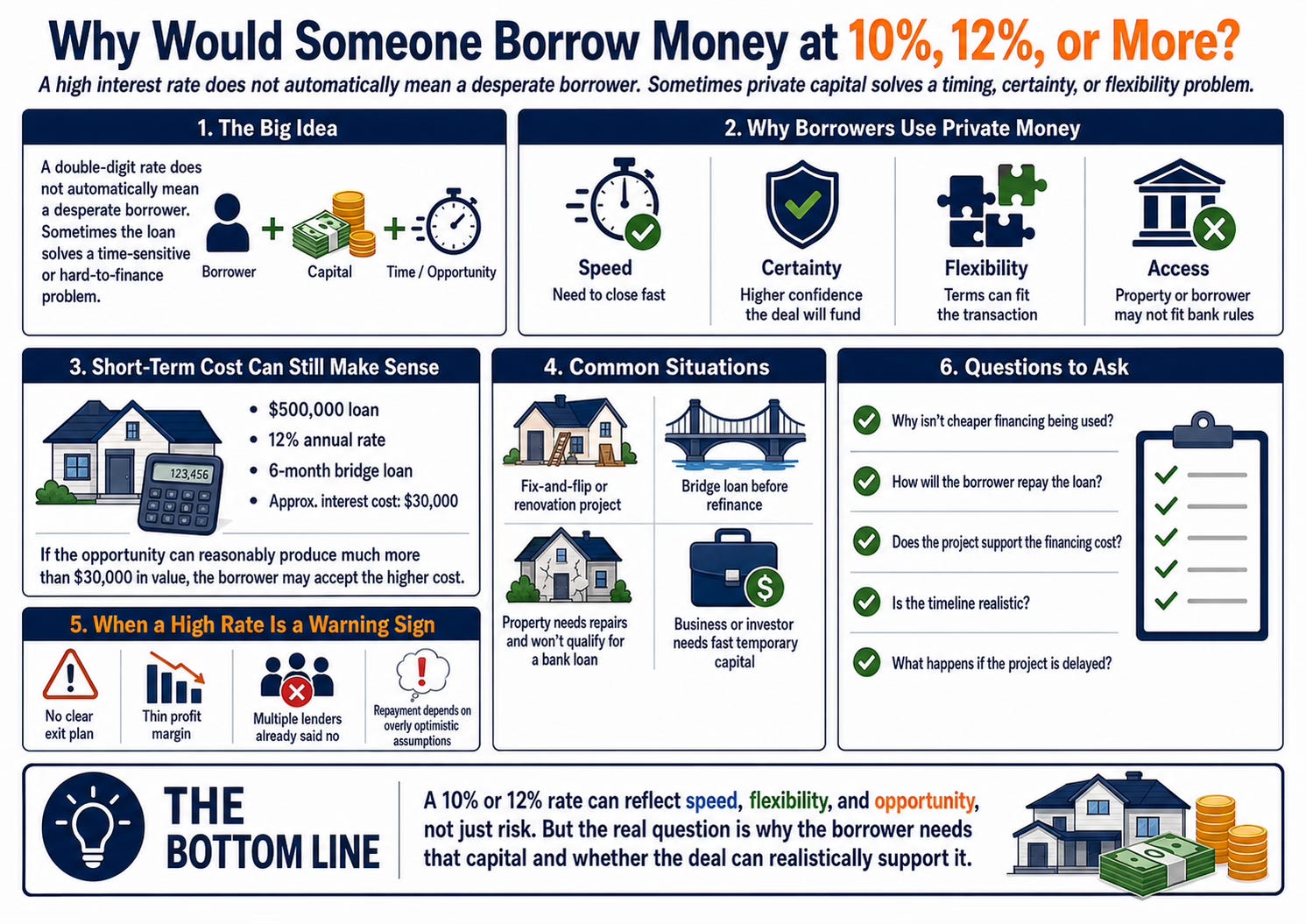
One of the biggest misconceptions about private lending is that a higher interest rate automatically means you are dealing with a desperate borrower or a bad loan. In reality, borrowers use private capital for a lot of different reasons. Sometimes they need speed. Sometimes the property does not fit a bank’s lending guidelines. Sometimes they only need the money for a few months. And sometimes paying a higher rate is simply a reasonable cost of completing a profitable transaction.
The interest rate matters. But the reason behind the interest rate matters more.
Banks Are Cheaper, but They Are Not Always Flexible
Traditional bank financing has an obvious advantage: it is usually cheaper. If you are buying a house you plan to live in for 30 years, paying a private lender 12% probably would not make much sense if you qualify for a conventional mortgage at a much lower rate. Over a long period of time, that difference in interest becomes enormous.
Private borrowers are often solving a very different problem. A real estate investor may be buying a property that needs major repairs. A developer may need to close on land quickly. A business owner may need temporary capital while waiting for another transaction to close. A property investor may plan to hold a loan for only six or nine months before refinancing into cheaper long-term debt.
Banks have underwriting standards, documentation requirements, regulatory requirements, and internal lending policies. Those systems make sense for the type of lending banks do, but they can also make the process slower and less flexible. A private lender can sometimes look at the same transaction and structure financing around the deal itself rather than forcing the deal into a standardized loan product.
The borrower pays more for that flexibility.
Sometimes Speed Is Worth Paying For
Imagine a real estate investor finds a property worth $700,000 that can be purchased for $500,000 because the seller needs to close quickly. The investor believes they can renovate the property and eventually sell it for substantially more, but the seller wants the transaction completed in 10 days.
A bank loan might take 30, 45, or even 60 days depending on the situation. If the buyer cannot close quickly, someone else may get the property.
Now suppose a private lender is willing to fund $400,000 at a 12% annual rate for six months. On a simple-interest basis, six months of interest would be about $24,000 before fees and other costs.
Twelve percent sounds expensive when you look at the rate by itself. But the borrower may not really be comparing a 12% private loan with a cheaper bank loan. The real comparison may be between paying $24,000 in interest and losing the opportunity entirely.
If the transaction can reasonably produce substantially more than the financing cost, paying the higher rate may make sense. That does not automatically make the loan safe for the lender. It simply explains why a rational borrower might willingly pay 12%.
The Length of the Loan Changes the Math
Interest rates can also sound more extreme than the actual financing cost when you forget about the loan term.
A 12% annual rate on a 30-year mortgage would be very expensive. A 12% annual rate on a six-month bridge loan is a different calculation.
Suppose a borrower takes a $500,000 loan at 12% and pays it off after six months. Ignoring fees and assuming simple interest, the interest cost would be approximately $30,000. If the borrower is using that $500,000 to complete a transaction expected to generate $150,000 of profit, the financing cost may be acceptable.
The borrower is not planning to pay 12% forever. They are using expensive capital temporarily to accomplish something specific.
This is why private loans are often called bridge loans. The financing helps the borrower get from one point to another. Maybe they buy and renovate a property, then sell it. Maybe they stabilize an apartment building and refinance it with a bank. Maybe a company uses short-term financing until another source of capital becomes available.
The private loan is the bridge between where the borrower is today and where they expect to be later.
Some Properties Do Not Fit Bank Lending
Banks generally prefer properties and borrowers they can evaluate using established guidelines. Private lenders can sometimes finance situations that are harder to fit into those rules.
Consider a house that has been vacant for years and needs a complete renovation. It might have damaged flooring, an outdated electrical system, missing appliances, or other problems. A traditional lender may not want to make a conventional mortgage on the property in its current condition.
A real estate investor may look at the same property and see something different. They may see a $300,000 property that needs $100,000 of work and could be worth $550,000 when finished.
The property is not necessarily a bad asset. It is simply not a finished asset yet.
A private lender may be willing to evaluate the purchase price, renovation budget, borrower’s experience, current property value, projected value, and exit strategy and make a loan based on that larger picture. The borrower pays a higher rate because the lender is financing something the traditional system may not be designed to handle.
Banks Also Evaluate Borrowers Differently
The property is only part of the issue. Banks tend to place a lot of emphasis on income, credit history, tax returns, debt ratios, financial statements, and other documentation. Private lenders may consider those things too, but some private loans place more emphasis on the asset and the overall transaction.
Imagine an experienced real estate investor who owns several properties but has complicated tax returns because of depreciation, business entities, and investment activity. Their financial position may be strong while still being difficult to fit neatly into a conventional lending model.
Or imagine a business owner whose income varies significantly from year to year. The business may own valuable assets and generate substantial cash flow over time, but the borrower’s tax returns may not look as clean as those of a salaried employee.
A private lender may be willing to look at the situation differently. That does not mean private lenders should ignore creditworthiness. A borrower still needs a realistic ability to repay the debt. It simply means private underwriting can place different weight on different factors.
Certainty Can Be Just as Valuable as Speed
Borrowers do not only care about finding the lowest possible interest rate. They also care about whether the money will actually be there when they need it.
This matters a lot in real estate. A buyer may enter a contract and put up a substantial earnest-money deposit. If the financing falls apart a few days before closing, the borrower could lose the property, the deposit, or both.
A private lender that understands the transaction and can give the borrower a high level of certainty may be worth paying more for. This is especially true for professional investors who make money by completing transactions. They may prefer financing that costs more but has fewer moving parts if it increases the likelihood that the deal actually closes.
The cheapest capital is not always the most useful capital.
That is an important idea because investors often look at lending from only one side. We ask why the borrower would pay us 10% when cheaper money exists somewhere else. The borrower may be asking a different question: Which source of capital gives me the best chance of completing this deal?
Those are not the same question.
Flexibility Has a Price
Private loans can also be structured around circumstances that would be difficult to accommodate with a standard loan product.
A borrower might need interest-only payments for a period. They may need a six-month extension option. A construction loan might release money in stages as work is completed. A lender might agree to specific terms around collateral, repayment, or refinancing that fit the project.
That flexibility can be valuable because the financing can match what is actually happening in the transaction.
A bank may have a specific product with specific requirements. A private lender may be able to look at the deal and ask what loan structure actually makes sense.
That customization takes more underwriting and can create additional risk for the lender. The borrower may pay for it through a higher rate, fees, or both.
Sometimes the Borrower Really Is Riskier
There is an important other side to this.
Not every 12% borrower is an experienced real estate investor making a smart decision about the cost of capital. Sometimes the rate is high because the borrower cannot qualify for cheaper financing.
Maybe their credit history is poor. Maybe they have too much existing debt. Maybe the project is speculative. Maybe the property’s value is uncertain. Maybe the repayment plan depends on assumptions that could easily fall apart.
Private capital can finance good opportunities that traditional banks cannot. It can also finance bad opportunities that traditional banks were right to avoid.
As the lender, you need to figure out which situation you are looking at.
That is why asking “Why are they borrowing at this rate?” is so useful. The answer could be, “We need to close in eight days and will refinance after renovation.” That is very different from, “Five banks already turned us down and we have no other option.”
The interest rate may be identical. The story behind it is not.
Follow the Borrower’s Exit Plan
One of the best ways to understand a private loan is to ask how the borrower expects to repay it.
Suppose a borrower takes a 12-month private real estate loan at 11%. What happens in month 12?
If the answer is that the borrower is renovating the property and expects to sell it, you want to understand whether the renovation and expected sale price are realistic. If the borrower plans to refinance, you want to understand what needs to change before a conventional lender will approve the new loan.
Maybe the property needs to be completed. Maybe occupancy needs to increase. Maybe the borrower needs additional operating history.
There should be a believable path from expensive short-term capital to repayment.
A private loan can make perfect sense as temporary financing. It becomes much more concerning when the borrower is paying a high rate with no clear way to get out of the loan. That is why the exit strategy is not just the borrower’s problem. It is part of the lender’s underwriting.
The Borrower’s Profit Margin Matters
Another useful question is whether the economics of the underlying transaction can comfortably support the financing cost.
Imagine someone borrows $500,000 at 12% for one year to pursue a project expected to generate only $40,000 in profit. The interest alone could be $60,000 before fees and other financing costs. The math clearly does not work very well.
Now imagine the same loan is helping finance a project with a reasonable expectation of producing $250,000 of profit. The 12% financing cost looks very different in that context.
This does not mean lenders should simply accept the borrower’s profit projections. Those assumptions still need to be tested. Construction costs can rise. Properties can sell for less than expected. Projects can take longer than planned.
But you want to understand why the borrower believes paying the higher financing cost makes sense. If there is no economic room to support the interest payments, that should get your attention.
Higher Rates Can Create Their Own Risk
There is a point where the interest rate itself can become part of the problem.
The more expensive a loan becomes, the more cash flow or profit the borrower needs to generate to service the debt. That can put additional pressure on the transaction.
A borrower paying 15% does not just need to repay the principal. They need to generate enough money to cover a substantial financing expense too. If the project experiences delays, those interest costs keep accumulating.
A six-month project that turns into a 12-month project can look very different financially.
This is why investors should not automatically celebrate the highest interest rate they can find. The question is not simply, “How much is the borrower willing to pay?” It is, “Can this transaction realistically support what the borrower has agreed to pay?”
A loan that promises 14% but puts so much pressure on the borrower that repayment becomes unlikely may be a worse investment than a well-structured loan paying less.
Look at Why the Borrower Needs You
Private credit becomes easier to understand once you stop assuming that expensive money is automatically bad money.
Businesses and real estate investors make decisions based on opportunity, timing, flexibility, certainty, and return on capital. Sometimes paying a higher interest rate is a rational business decision because the financing allows them to do something valuable.
That can create an opportunity for private lenders.
Banks are built to provide capital efficiently within a particular set of rules. Private lenders can operate in the gaps where a transaction may be too fast, too unusual, too short-term, or too specialized for traditional financing. Those gaps are part of where private credit comes from.
But they are also where investors need to pay attention.
When someone is willing to pay you 10%, 12%, or more, do not immediately assume you found a great investment. And do not immediately assume the borrower must be in trouble.
Ask why the borrower needs private capital. Ask why cheaper financing is not being used. Ask what the borrower plans to accomplish with the money. Ask how the loan will be repaid. Ask whether the underlying transaction can realistically support the financing cost.
Once you understand those answers, the interest rate starts to make a lot more sense.
The rate tells you what the borrower is paying. The reason they are willing to pay it tells you much more about the investment.
Disclaimer: The information provided in this article is for educational and informational purposes only and should not be considered investment, financial, legal, tax, or accounting advice. Nothing in this article is an offer, solicitation, or recommendation to buy or sell any investment or security. Alternative investments involve risk and may not be suitable for everyone. You should evaluate any investment opportunity based on your own circumstances and consult with qualified financial, legal, and tax professionals before making any investment decision. GoVesty does not provide investment advice, manage customer funds, or guarantee investment results.