

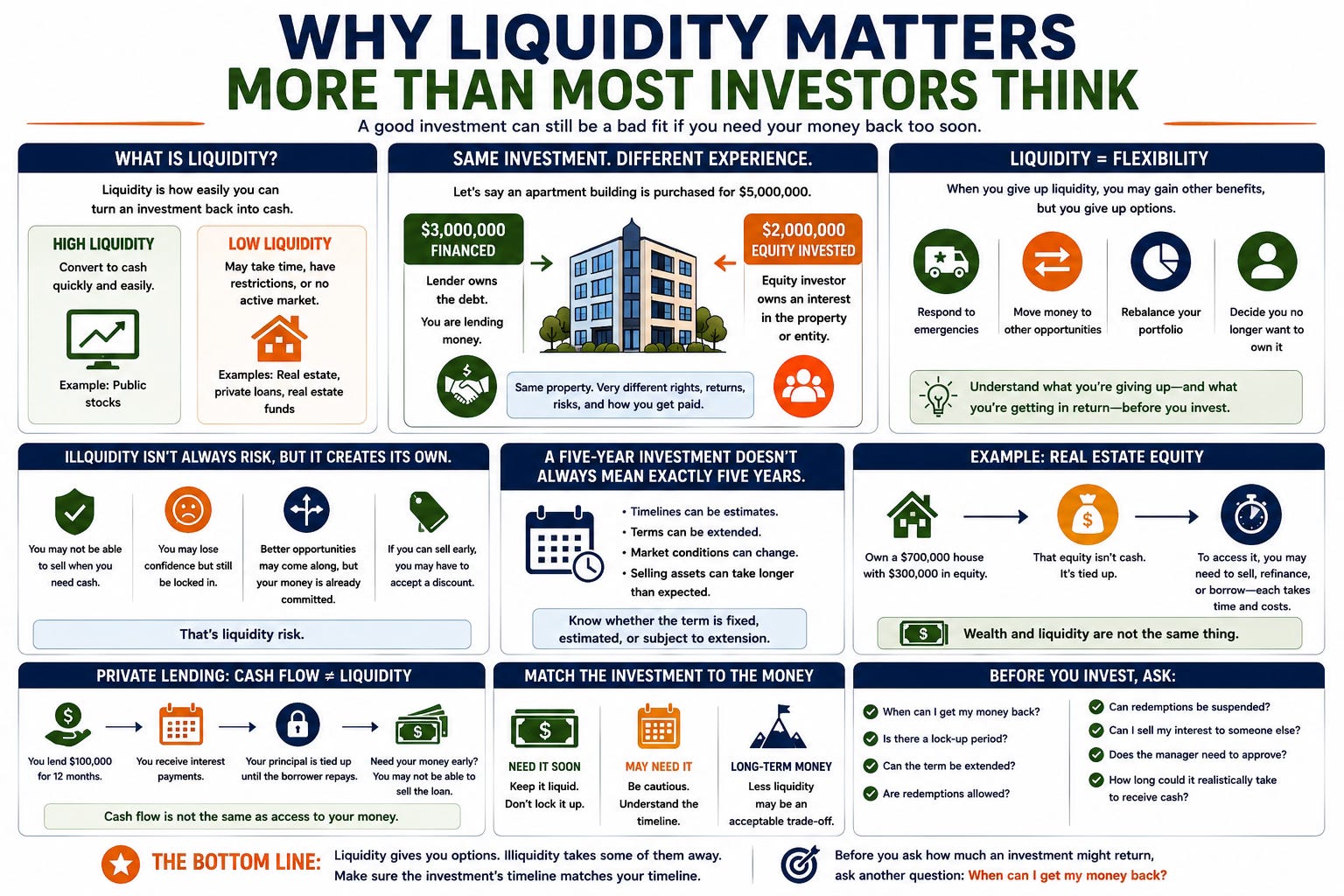
Liquidity sounds like one of those finance words people throw around without really thinking about it. But the concept is pretty simple. Liquidity is about how easily you can turn an investment back into cash.
If you own shares of a large public company, you can usually sell them during market hours and have access to your money pretty quickly. If you own a rental property, a private loan, or an interest in a real estate fund, getting your money back can be a very different process.
That difference matters because an investment can look great on paper and still be a terrible fit if you need access to your money sooner than the investment allows.
Let’s say you put $100,000 into a private real estate deal with an expected five-year hold. Maybe the projected returns look attractive. Maybe the property looks solid. Maybe the people running the deal have a good track record. But then two years later, you need $50,000.
Can you get it?
Maybe. Maybe not.
With a publicly traded stock, you can usually sell some shares. With a private real estate investment, there may be no active market where someone is ready to buy your interest. The investment documents may also restrict when or how you can sell.
Your money isn’t necessarily gone. It’s just tied up.
That’s illiquidity.
So why would anyone agree to that? Because liquidity has value. Being able to sell something whenever you want gives you flexibility. You can respond to an emergency, move money into another opportunity, rebalance your investments, or simply decide you don’t want to own something anymore.
When you give up that flexibility, you should understand what you’re getting in return. Sometimes an illiquid investment may offer the potential for more income, different risk characteristics, or access to investments you can’t get through the public markets.
That doesn’t automatically make illiquidity good or bad. It’s a tradeoff. You’re committing your capital for some period of time in exchange for whatever the investment is offering.
The important part is knowing that before you invest.
Another thing worth understanding is that a five-year investment doesn’t necessarily mean you’re getting your money back exactly five years from today.
It might be an estimate.
A real estate investment might plan to sell a property in five years, but what if the market is terrible when year five arrives? Maybe selling at that point doesn’t make sense and the manager decides to hold the property another year.
A private loan might have a one-year maturity, but the borrower could ask for an extension. A private equity fund could take years to invest its capital and several more years to sell its holdings and return money to investors.
Timelines can move.
That’s why I think it’s important to understand whether an investment’s term is fixed, estimated, or subject to extension. If your financial plan depends on having that money available on an exact date, that matters.
Illiquidity also isn’t necessarily the same thing as risk.
A very stable piece of real estate can still be illiquid. A publicly traded stock can be extremely liquid and extremely risky. They’re different characteristics.
But being illiquid does create its own kind of risk. If something changes in your life and you need cash, you may not be able to sell. If you lose confidence in the investment, you may still be stuck in it. If another opportunity comes along, your capital may already be committed somewhere else.
And even if you’re allowed to sell early, you may have to accept less than what you think the investment is worth.
That’s liquidity risk.
Real estate is probably one of the easiest ways to understand this. You could own a $700,000 house with hundreds of thousands of dollars in equity, but that doesn’t mean you have hundreds of thousands of dollars sitting in your checking account.
To turn that equity into cash, you generally have to sell the house, refinance it, or borrow against it. All of those things take time and usually cost money.
That’s the difference between having wealth and having liquidity.
The same thing happens with investments. You could own an interest in a private real estate fund that owns valuable properties. Your investment may have real value, but if there’s no market for your interest, you may not be able to turn that value into cash quickly.
Private lending works the same way.
Let’s say you lend someone $100,000 for 12 months. They pay you interest every month, and at the end of the year they’re supposed to repay your $100,000.
Everything is going exactly according to plan.
But four months into the loan, you need the $100,000 back.
What now?
Can you sell the loan to someone else? Maybe. Are you allowed to transfer it? Maybe. Is there actually someone willing to buy it from you? That’s another question.
Or you may simply have to wait until the borrower repays you.
That’s an important distinction because you can have cash flow without having liquidity. The loan may be sending you interest every month, but your principal is still tied up.
Liquidity can also change when markets get stressed. Even publicly traded investments can experience this in a different way. You may technically be able to sell something immediately, but that doesn’t mean you can sell it at the price you want.
There’s a difference between being able to sell and being able to sell at a good price.
Public markets generally give investors much more liquidity than private investments, but that liquidity can also create volatility. When millions of people can buy and sell something instantly, prices can move very quickly.
Private investments usually don’t have that same constant pricing. You don’t open an app and watch your private real estate investment move up 3% in the morning and down 4% after lunch.
That doesn’t mean the underlying investment hasn’t changed in value. It just means nobody is publicly repricing it every second.
This is where I think liquidity becomes less about deciding whether one type of investment is better and more about deciding what the money is actually for.
If the money is your emergency fund, locking it up in a five-year private investment probably doesn’t make much sense. If you’re planning to buy a house next year, putting your down payment into something you can’t easily sell could create a problem.
But if it’s money you’re investing for the next 10 or 20 years and you genuinely don’t expect to need it, giving up some liquidity may be much easier to live with.
That’s really the key. Match the investment to the money.
Money you might need soon should probably behave differently from money you won’t need for a long time.
This becomes especially important when comparing returns.
Let’s say Investment A is expected to return 6% and gives you relatively easy access to your money. Investment B targets 10%, but your money may be locked up for five years.
Which one is better?
We don’t know.
The 10% gets your attention, but you’re giving something up to pursue it. You’re giving up access to your money.
Maybe that’s completely fine. Maybe you’re comfortable committing that capital for five years and the potential return makes sense to you.
But that decision should be intentional.
You don’t want to discover two years later that “five-year hold” actually means, “No, you really can’t get your money back right now.”
That’s a bad time to learn how liquidity works.
So when you’re looking at a private investment, don’t just focus on how you get into it. Spend some time figuring out how you get out.
When can you request your money back? Is there a lock-up period? Can the investment term be extended? Are redemptions allowed? Can redemptions be suspended? Can you sell your interest to someone else? Does the manager have to approve the transfer? Are there penalties or discounts for getting out early?
And maybe the most practical question of all: If I needed this money, how long could it realistically take before cash actually hits my bank account?
Those questions aren’t nearly as exciting as talking about projected returns.
But they become very interesting when you actually need the money.
That’s really how I think about liquidity. It’s flexibility.
Liquidity gives you options. Illiquidity takes some of those options away.
That doesn’t make illiquid investments bad. Real estate, private credit, private businesses, and other alternative investments often require investors to commit capital for longer periods. For someone investing long-term money, that may be perfectly reasonable.
The problem is when the investment’s timeline and your timeline don’t match.
Because an investment can be performing exactly as expected and still create a problem if you need your capital before it’s available.
So before you ask how much an investment might return, ask another question.
When can I get my money back?
It might not be the most exciting question in investing.
But it’s a pretty important one.
Key Takeaways
Liquidity is about how easily an investment can be converted back into cash. Private investments are often much less liquid than publicly traded investments, even when the underlying investment is performing well.
A higher projected return doesn’t automatically make an illiquid investment better. You have to consider what you’re giving up in exchange for that potential return, including access to your capital.
Before investing, understand the expected holding period, exit terms, redemption rules, possible extensions, transfer restrictions, and how long it could realistically take to get your money back.
Beyond Wall Street is for educational and informational purposes only. Nothing published here is investment, financial, legal, or tax advice. Alternative investments may be illiquid and can involve long holding periods, restrictions on transfers or redemptions, and possible loss of principal.