

Where Does a 10% Return Actually Come From?
Before focusing on the percentage, understand what creates it.
Key Takeaways
Every investment return should have an identifiable economic source. Something has to create the money being paid to investors.
Higher projected returns usually come with some combination of additional risk, less liquidity, leverage, complexity, or uncertainty.
Before asking how much an investment pays, ask how the investment actually makes money.
A 10% return sounds pretty good. But where does that 10% actually come from? It seems like an obvious question, yet it is surprisingly easy to skip. Investors often focus on the return first. An opportunity pays 8%. Another targets 10%. Another projects 12% or 15%. Before long, you are comparing percentages without really comparing the investments behind them.
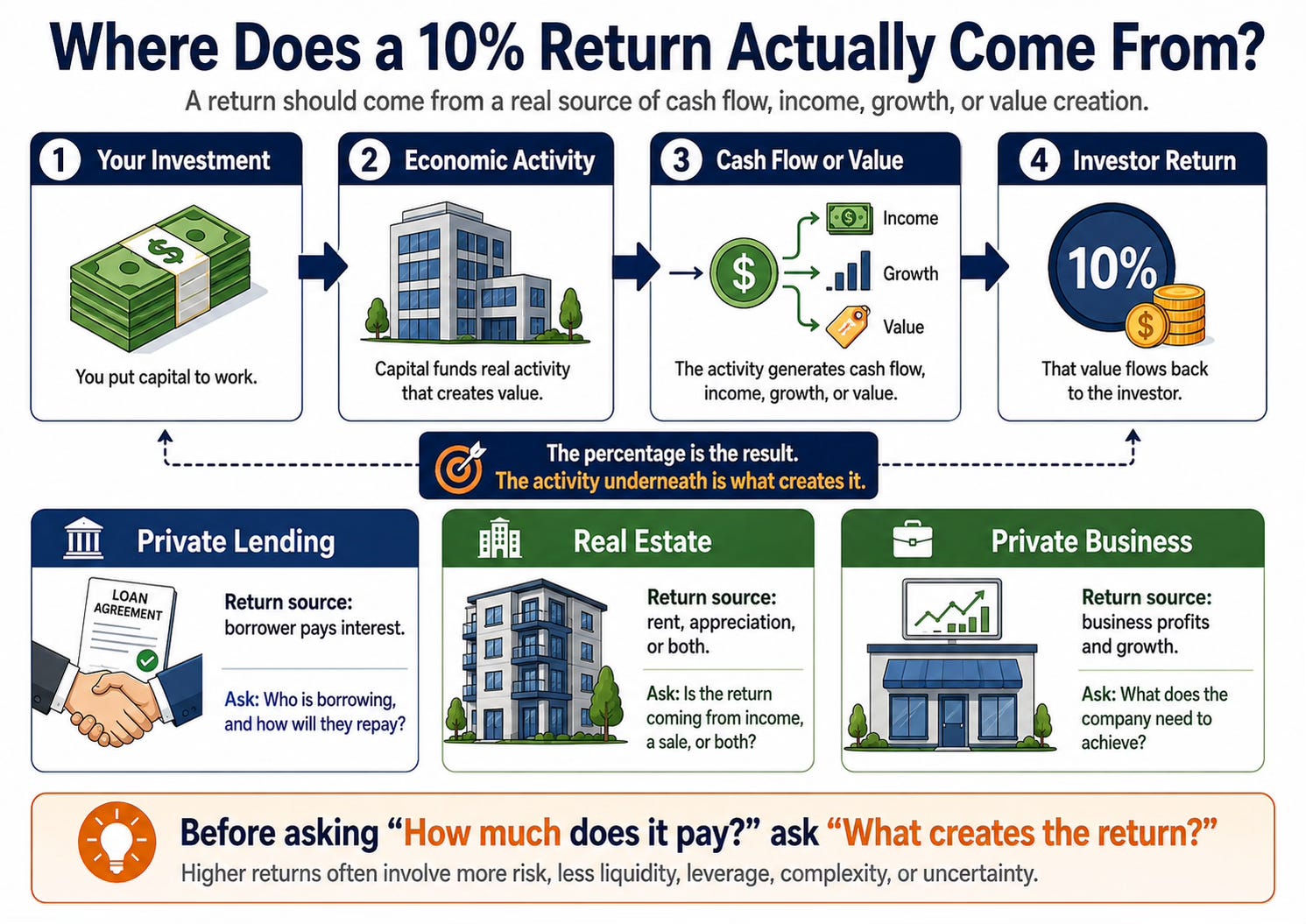
A return does not just appear because someone put a number in a presentation. Something underneath the investment has to generate the money.
If you understand what creates the return, you are in a much better position to understand the investment itself.
Every Return Has an Engine
Think about a basic savings account. You deposit money at a bank, and the bank pays you interest. The bank can do that because it uses deposits as part of its broader lending and banking business. There is an economic activity behind the interest you receive.
The same idea applies to stocks. A company sells products or services, earns revenue, and hopefully grows its profits over time. Investors may benefit through dividends, an increase in the value of their shares, or both.
Alternative investments work the same way. The structures may look different, but there still needs to be something generating the return.
With private lending, the source is usually pretty straightforward. A borrower needs capital and agrees to pay interest for using it. If an investor lends $100,000 at a 10% annual interest rate, the borrower would owe $10,000 in annual interest under a simple interest structure, assuming the loan remains outstanding for the full year and payments are made as agreed.
The investor is not earning 10% because the investment is labeled “private credit.” The investor is earning interest because someone is paying to borrow the money.
That distinction matters.
Real Estate Returns Can Come From More Than One Place
Real estate gets a little more interesting because a return can come from several sources.
Imagine investors buy an apartment building. Tenants pay rent. The property has expenses such as maintenance, insurance, property taxes, management, and debt payments. If there is money left after those expenses, some of that cash may be distributed to investors.
That is one potential source of return.
The property might also increase in value. Maybe rents increase. Maybe the neighborhood improves. Maybe the owners renovate the property and increase its income. If the property is eventually sold for more than the investors paid for it, that appreciation can contribute to the overall return.
So when you see a real estate investment targeting a 10% return, the next question should be: What is expected to create that 10%?
Is most of it coming from rental income? Is the business plan relying heavily on the property increasing in value? Does the return depend on renovations being completed on time? Is debt being used to increase the potential return?
Those are very different situations even if the headline number is the same.
A 10% Return Is Not Always the Same 10%
This is where comparing investments based only on the percentage can get misleading.
Suppose one investment pays investors 10% interest from a loan secured by a piece of real estate. Another projects a 10% annual return from buying, renovating, and eventually selling an apartment complex. A third targets 10% by investing in private businesses.
All three might show the same number, but almost everything underneath that number is different.
The private loan depends heavily on the borrower making payments and ultimately repaying the loan. The apartment investment depends on property income, expenses, financing, occupancy, and the eventual sale price. The private business investment depends on the performance and value of the companies being purchased.
Same percentage. Completely different economic engines.
This is why the headline return should be the beginning of your questions, not the end of them.
Why Would an Investment Pay More?
If one investment offers a higher potential return than another, there is usually a reason.
Sometimes the investor is accepting more risk. Sometimes the money has to remain invested for several years. Sometimes the investment is harder to sell. In other cases, the opportunity requires more complicated underwriting or active management.
Private markets can also compensate investors for providing capital that is not as easy to obtain from traditional sources.
For example, a real estate investor may be willing to pay a private lender a higher interest rate because the lender can close quickly. A business might use private credit because a bank will not make the type of loan it needs. A real estate sponsor may offer investors a larger share of the potential return because investors are committing money to a project that could take years to complete.
None of those things automatically make the investment good or bad. They simply help explain why the potential return might be higher.
The important question is whether the return makes sense for the risks and restrictions you are accepting.
Be Careful With the Word “Return”
There is another detail worth paying attention to. When someone says an investment “returns 10%,” what exactly do they mean?
They could be talking about an interest rate. They could be talking about annual cash distributions. They might mean a projected average annual return over several years. They could also be including an estimated increase in the value of the investment.
Those numbers are not interchangeable.
An investment that distributes 10% in cash each year is different from an investment that produces very little cash today but projects a 10% annualized return after the asset is sold several years from now.
Fees can also change what the investor actually receives. An investment might generate a certain return before management fees, transaction costs, performance fees, or other expenses are deducted.
This does not mean you need to become a financial analyst every time you look at an investment. You just need to know what the percentage is actually describing.
Follow the Money
One of the simplest habits you can develop as an investor is to follow the money through the investment.
Where does your money go when you invest? What does the person or company receiving that money do with it? What activity creates revenue or cash flow? What expenses get paid before you get paid? What has to happen for you to receive your original investment back?
If you cannot follow that chain in a way that makes sense, you probably do not understand the investment yet.
This is especially important when projected returns start getting higher. A 12% or 15% target can get your attention, but the percentage alone tells you almost nothing about whether the investment makes sense.
You want to know what has to happen for that return to be achieved.
Maybe a borrower simply has to make the payments required under a loan. Maybe an apartment building needs to maintain occupancy and increase rents. Maybe a property has to be renovated and sold at a higher price. Maybe a private company needs to grow revenue and eventually find a buyer.
The return is the result.
The business or investment activity underneath it is what creates that result.
Ask Where the Return Comes From First
There is nothing wrong with wanting a strong return on your money. That is one of the reasons people invest in the first place.
But starting with the percentage can cause you to look at an investment backward.
Instead of asking, “How can I earn 10%?” start with, “What is happening here that could produce a 10% return?”
That small change forces you to look underneath the number.
Who is paying you? Why are they paying you? What has to go right? What could go wrong? Is the return coming from real cash flow, appreciation, interest payments, leverage, or some combination of them?
Once you understand where the money comes from, the percentage starts to mean something.
And that is a much better place to begin evaluating an investment.
Beyond Wall Street is for educational and informational purposes only. Nothing published here is investment, financial, legal, or tax advice. Examples and return figures are hypothetical and are used only to explain investment concepts. Actual investments involve risk, including the possible loss of principal.