

As you start looking beyond stocks, bonds, and publicly traded investments, you’re eventually going to run into a term that sounds more exclusive than it really is: accredited investor.
You’ll see it on investment websites. You’ll see it in offering documents. Someone might ask you to check a box confirming that you’re accredited before they’ll even show you the details of an investment.
So what exactly does it mean?
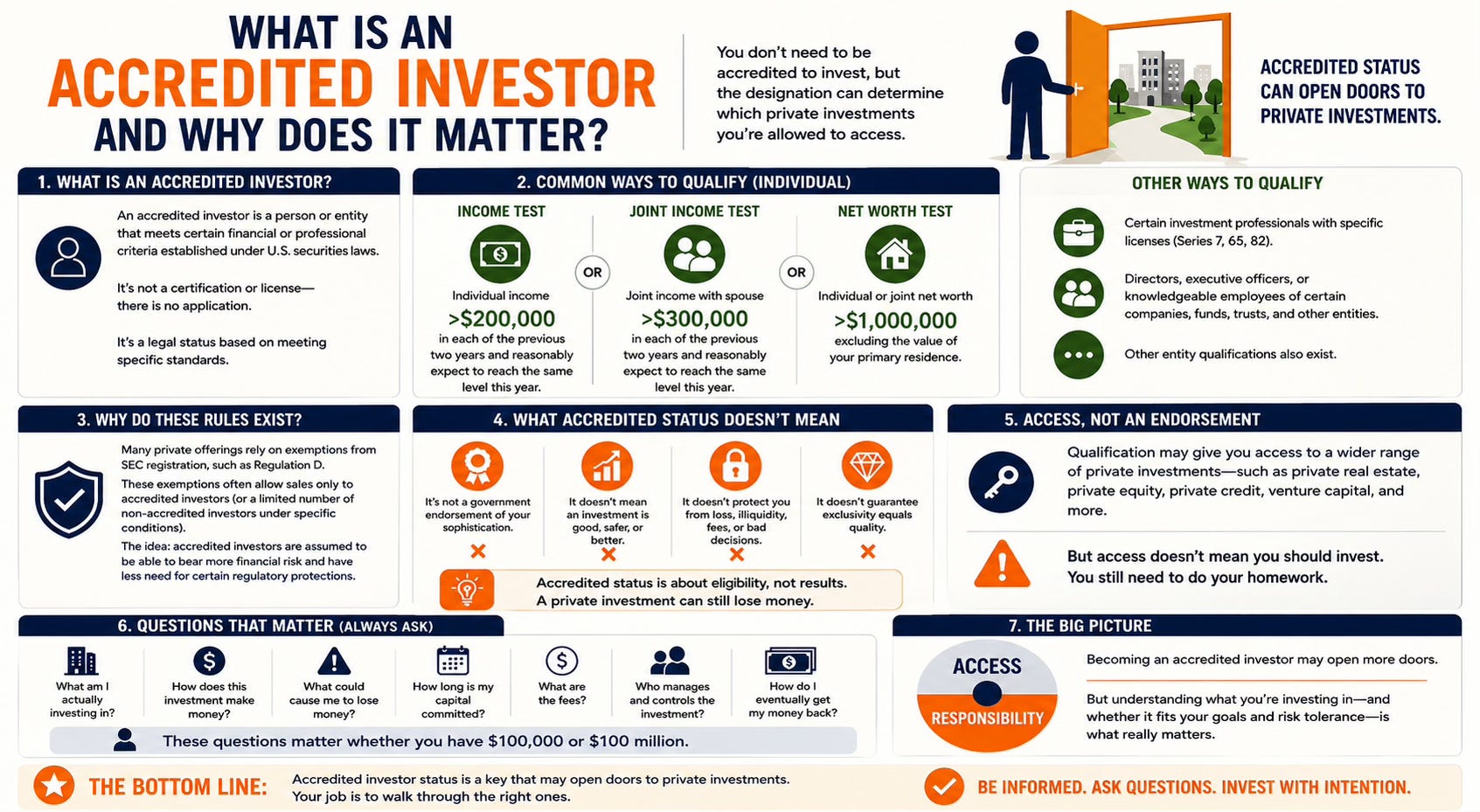
An accredited investor is basically a person or entity that meets certain financial or professional criteria established under U.S. securities laws. Meeting those criteria can allow someone to participate in certain private investment offerings that aren’t registered with the SEC in the same way publicly traded investments are.
The important thing to understand is that being accredited isn’t a certification you apply for. There’s no accredited investor license. There’s no government card that shows up in the mail. It’s a status based on whether you meet one of the qualifying standards.
For an individual, two of the most common ways to qualify involve income or net worth. Under current SEC rules, you may qualify if your individual income exceeded $200,000 in each of the previous two years, or your joint income with a spouse or spousal equivalent exceeded $300,000, and you reasonably expect to reach the same income level this year.
You can also qualify based on net worth. If your individual net worth, or your joint net worth with a spouse or spousal equivalent, exceeds $1 million, you may qualify. There’s an important catch, though. The value of your primary residence generally doesn’t count toward that $1 million calculation.
There are other ways to qualify too. Certain investment professionals holding specific licenses, such as the Series 7, Series 65, or Series 82, may qualify regardless of their income or net worth. Certain directors, executive officers, knowledgeable employees of private funds, trusts, companies, and other entities can also qualify under specific circumstances.
But for most people who encounter the term for the first time, the $200,000 income or $1 million net worth tests are probably the ones they’re going to hear about.
So why do these rules exist in the first place?
To understand that, you have to understand something about private investments. When a company sells stock to the general public, there are extensive registration and disclosure requirements designed to give investors information about what they’re buying.
Private offerings can operate differently.
Companies and investment sponsors can sometimes raise money without going through the full public registration process by relying on exemptions from securities registration. One of the most commonly discussed exemptions is Regulation D.
That’s where accredited investors become important.
Some private offerings can be sold only to accredited investors, while other exemptions may permit a limited number of non-accredited investors under certain conditions. The exact rules depend on how the offering is structured.
This is why becoming interested in alternative investments can suddenly introduce you to the accredited investor conversation. Private real estate funds, private equity, venture capital, private credit funds, and other private offerings frequently rely on securities-law exemptions rather than trading on public exchanges.
It doesn’t mean every alternative investment requires you to be accredited.
That’s an important distinction.
There are alternative investments and structures available to people who don’t meet the accredited investor standards. There are also private offerings that may accept non-accredited investors depending on the exemption being used and the requirements of the offering.
So “alternative investment” and “accredited investors only” aren’t interchangeable terms.
The accreditation question really depends on what you’re investing in and how that particular investment is being offered.
There’s another misconception worth clearing up. Being accredited doesn’t mean the government has decided you’re a sophisticated investor.
You could have a net worth of $5 million and know almost nothing about investing.
You could also have spent 20 years analyzing real estate deals and not meet the financial thresholds.
Accredited investor status is a legal classification. It isn’t a score measuring how good you are at investing.
And it definitely doesn’t mean an investment is good just because you have to be accredited to buy it.
I actually think this is one of the more important things to understand when you first get access to private investments.
There’s a psychological effect that can happen when someone tells you an opportunity is “only available to accredited investors.” Suddenly it sounds exclusive. Maybe it feels like you’ve unlocked some secret section of the investment world.
But exclusivity doesn’t equal quality.
A private investment can lose money. A real estate project can fail. A borrower can default. A private company can go out of business. A fund manager can make bad decisions. An investment can charge high fees or lock up your money much longer than expected.
Your accredited status doesn’t protect you from any of that.
In fact, one reason accredited investors can participate in certain unregistered offerings is that the regulatory framework assumes they can bear the financial risk and have less need for some of the protections associated with registered public offerings.
That’s a very different message from saying, “Congratulations, these investments are better.”
They’re not automatically better.
You simply may be eligible to consider a wider range of them.
Let’s say you’ve built a $1.5 million investment portfolio and qualify as an accredited investor. You find a private real estate fund that requires a $100,000 minimum investment and is open only to accredited investors.
The fact that you’re eligible tells you almost nothing about whether you should invest.
You still need to understand what the fund owns, who manages it, how the manager gets paid, how much leverage is being used, how long your money could be tied up, what the risks are, how distributions work, and what needs to happen for you to eventually get your capital back.
Those are the same kinds of questions we’ve been talking about throughout this series.
Accreditation gets you through the door.
It doesn’t tell you what’s on the other side.
There’s also an interesting connection to the liquidity conversation from the last article. Many private investments available to accredited investors are illiquid. You may be committing your money for several years without having an easy way to sell your investment.
That makes the financial thresholds easier to understand. If someone has substantial income or net worth, the rules are essentially using those financial characteristics as one way of determining who can participate in certain investments with fewer regulatory protections.
Whether those thresholds are the best way to measure someone’s ability to understand investment risk is a separate debate.
But that’s the system investors are operating under today.
So if somebody asks whether you’re an accredited investor, don’t read too much into the terminology. They’re usually trying to determine whether you’re legally eligible to participate in a particular offering.
And if you do qualify, don’t let the label change the way you evaluate the investment.
You should still ask the boring questions.
What am I actually investing in? How does this investment make money? What could cause me to lose money? How long is my capital committed? What are the fees? Who controls the investment? How do I eventually get my money back?
Those questions matter whether you have $100,000 or $100 million.
The interesting thing about becoming an accredited investor isn’t that you suddenly become a better investor. It’s that the universe of investments you can potentially access gets larger.
And once that universe gets larger, understanding what you’re buying becomes even more important.
Being allowed to invest and deciding that you should invest are two completely different things.
Key Takeaways
An accredited investor is a legal classification under U.S. securities laws. Individuals can qualify in several ways, including meeting certain income or net-worth thresholds, and the value of a primary residence generally isn’t included when calculating the $1 million net-worth test. Other qualification paths exist for certain licensed investment professionals and other individuals or entities that meet specific criteria.
Accredited status can give investors access to certain private offerings that aren’t registered with the SEC in the same way as publicly traded investments. It doesn’t mean every alternative investment requires accreditation, and it doesn’t mean an investment is safer, better, or more appropriate simply because participation is restricted to accredited investors.
If you qualify, treat accreditation as access, not an endorsement. You still need to understand the investment itself, including the underlying assets, risks, fees, liquidity, management, structure, and how your capital is expected to be returned.
Beyond Wall Street is for educational and informational purposes only. Nothing published here is investment, financial, legal, or tax advice. Private investments can involve substantial risk, limited liquidity, restrictions on transfer, and possible loss of principal. Accredited investor requirements and securities regulations can change, and eligibility depends on the applicable rules and circumstances.