


Key Takeaways
• Some private investment offerings limit participation based on whether an investor meets the legal definition of an accredited investor.
• Accreditation is a securities-law classification. It does not mean someone is an experienced investor, understands a particular deal, or is better at evaluating investments.
• Being legally eligible to participate in an offering does not tell you whether that investment fits your goals, risk tolerance, liquidity needs, or financial situation.
Spend enough time looking at private real estate, private credit, startups, private equity, or other alternative investments and eventually you will see the same question: Are you an accredited investor?
The term can sound like some kind of certification. It is easy to imagine that an accredited investor has taken a test, completed a course, or received approval from a regulator. That is not really what it means.
In the United States, “accredited investor” is a legal category used in federal securities regulations. The definition helps determine who can participate in certain securities offerings that are exempt from the full registration process normally associated with securities sold to the general public. Some private offerings are limited entirely to accredited investors, while others can include a limited number of non-accredited investors under specific conditions. (SEC)
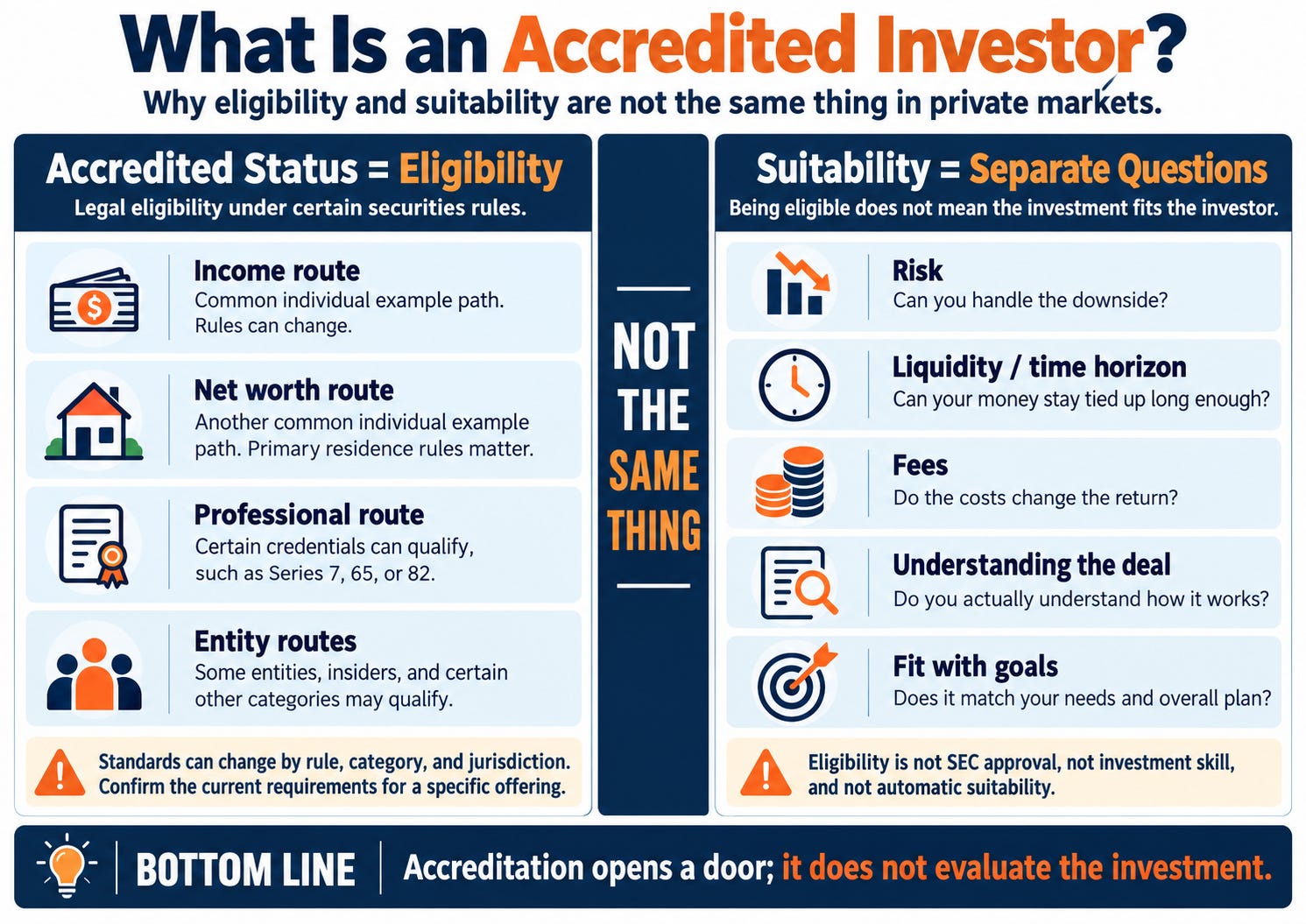
That distinction matters because private investments often operate under a different regulatory framework than publicly traded stocks and bonds. But it is equally important to understand what accredited status does not mean. It is not an SEC endorsement of an investor. It is not a statement that someone understands private markets. And it definitely is not a determination that a particular investment is appropriate for that person. Accreditation answers an eligibility question. Due diligence answers a completely different one.
Why Does the Accredited Investor Category Exist?
To understand accredited investors, it helps to understand why private offerings exist in the first place.
Companies raising capital generally must either register their securities offering under the Securities Act of 1933 or qualify for an exemption from registration. Registration can involve extensive disclosure, reporting, and procedural requirements designed to protect investors in public securities markets. Federal securities laws also provide exemptions that allow companies to raise capital without going through the full public-registration process. (SEC)
The accredited investor definition plays an important role in several of those exemptions. The SEC has described the concept as a way of identifying investors who meet financial or other qualifications that allow them to participate in investment opportunities without all of the disclosure and procedural protections associated with a registered offering. Over time, the definition has expanded beyond income and net worth to include certain measures of professional knowledge and experience. (SEC)
That does not mean accredited investors receive no information or have no legal protections. Anti-fraud laws still apply, and individual offerings may provide substantial disclosure. The point is that the regulatory structure can be different. This is one reason accreditation appears so often in private markets. The issuer is not simply deciding that wealthy people are its preferred customers. In many cases, the investor qualification requirements are tied directly to the securities-law exemption being used to raise the money.
How Does Someone Become an Accredited Investor?
There is no application you submit to the SEC to become accredited. There is no government-issued accredited investor card, and there is no single exam everyone has to pass. Instead, an individual qualifies by meeting one of several criteria in the SEC’s definition.
As of September 2026, one common way for an individual to qualify is through net worth. The SEC’s current standard includes an individual net worth, or joint net worth with a spouse or spousal equivalent, exceeding $1 million. The value of the person’s primary residence is excluded from that calculation, subject to specific rules for debt associated with the residence. (SEC)
Another route is income. An individual may qualify with income exceeding $200,000 in each of the prior two years and a reasonable expectation of reaching the same level in the current year. Joint income with a spouse or spousal equivalent can qualify at more than $300,000 under the same general timing standard. These are current federal thresholds as of September 2026, but securities rules can change, so investors and issuers should confirm the standards that apply at the time of a transaction. (SEC)
Those financial tests are probably the ones most people associate with accreditation, but they are no longer the only paths. Certain investment professionals can qualify based on professional credentials. The SEC currently recognizes holders in good standing of the Series 7, Series 65, and Series 82 licenses. Certain directors, executive officers, and general partners of the company selling the securities can also qualify, and there are additional categories for certain knowledgeable employees of private funds and qualifying family-office relationships. (SEC)
This is an important change in how the concept should be understood. Accreditation is not simply shorthand for “millionaire.” The rules recognize several types of investors and entities.
Companies and Other Entities Can Be Accredited Too
Individuals are only one part of the definition. Corporations, partnerships, LLCs, trusts, investment advisers, broker-dealers, banks, insurance companies, family offices, and other entities can qualify under different parts of the rule. Depending on the type of entity, qualification may be based on assets, investments, regulatory status, or whether all of the entity’s equity owners are themselves accredited investors. (SEC)
For example, certain entities can qualify based on owning more than $5 million in investments, while several specified types of organizations may qualify based on having more than $5 million in assets. The exact test depends on the entity and the part of Rule 501(a) that applies. (SEC)
For a typical individual investor, you probably do not need to memorize every entity category. The larger lesson is that “accredited investor” is a regulatory classification with multiple paths to qualification. It is broader than one simple wealth test.
Why Do Some Private Deals Ask for Accreditation?
Suppose a real estate sponsor wants to raise money from investors to purchase an apartment building. Instead of registering the offering as a public securities offering, the sponsor may rely on an exemption under Regulation D. This is where the specific exemption matters.
Under Rule 506(b), an issuer can generally sell securities to an unlimited number of accredited investors and up to 35 non-accredited investors during a 90-calendar-day period, provided those non-accredited investors meet a specified sophistication standard. Rule 506(b) also prohibits general solicitation or advertising. If non-accredited investors participate, additional disclosure requirements apply. (SEC)
Rule 506(c) works differently. It allows the issuer to broadly advertise the offering, but all purchasers must be accredited investors, and the issuer must take reasonable steps to verify their accredited status. (SEC)
This distinction helps explain something investors sometimes find confusing. One private investment may tell you that accreditation is required, while another may allow certain non-accredited investors to participate. That does not necessarily mean one company is being stricter than another. They may be operating under different exemptions with different requirements. The phrase “private investment” does not describe one universal set of investor eligibility rules.
Why Might Someone Ask to Verify Your Income or Assets?
If you have ever looked at a private offering and wondered why the company wanted documentation of your financial situation, Rule 506(c) may be part of the explanation.
In a Rule 506(c) offering, the issuer must take reasonable steps to verify that purchasers are accredited investors. The SEC describes several possible verification methods, including reviewing certain tax documents for income, reviewing financial documents for net worth, or obtaining written confirmation from certain professionals such as registered broker-dealers, SEC-registered investment advisers, licensed attorneys, or CPAs. The rules also allow principles-based verification methods depending on the circumstances. (SEC)
The verification process can therefore feel more involved than simply checking a box that says, “Yes, I am accredited.” That is because under Rule 506(c), the issuer has its own obligation to take reasonable steps to verify investor status. The SEC specifically notes that self-certification alone, without other knowledge of the investor’s financial circumstances or sophistication, is not sufficient to satisfy the applicable standards. (SEC)
The details can differ depending on the offering. The important thing for an investor to understand is why the question is being asked in the first place. It is often part of the issuer’s securities-law compliance process.
Accreditation Does Not Mean the SEC Approved the Investment
This is probably one of the most important misconceptions to clear up. If an offering is available only to accredited investors, that does not mean the SEC has examined the deal and concluded that it is a good investment.
Accreditation describes the investor, not the quality of the investment.
A real estate syndication can be offered to accredited investors and still perform poorly. A private company can fail. A borrower can default. A private fund can make bad decisions. A property can lose value. An investor can lose some or all of the capital committed to a private offering. The legal eligibility of the investor does not change the economic reality of the investment.
This is why you should never use “accredited investors only” as a quality signal. It tells you something about the offering structure and who may participate. It tells you almost nothing about whether the investment itself is attractive.
Accreditation Is Not a Measure of Investment Skill
The word “accredited” can also create the wrong impression because it sounds like a credential. Someone who qualifies because of income or net worth may have decades of investing experience. They may also have almost none.
Imagine two people. The first has spent 20 years analyzing private real estate loans, understands lien priority, LTV, underwriting, default procedures, and loan documents, but does not currently meet one of the accredited investor standards. The second recently crossed the income threshold required under the rule but has never evaluated a private investment before.
Under the securities rules, the second person may qualify as accredited while the first person may not qualify under the financial tests. That does not mean the second investor is more knowledgeable.
This is exactly why accreditation and investment sophistication should not be treated as synonyms. The SEC’s 2020 amendments added certain professional qualifications to the definition, partly recognizing that knowledge and experience can matter alongside wealth. But meeting the definition still does not certify that someone understands every investment they are allowed to buy. (SEC)
Being Accredited Does Not Mean Every Private Investment Is Appropriate
Eligibility is also different from suitability. Suppose someone qualifies as an accredited investor and is considering a private real estate fund with a seven-year expected term. The investor may legally be allowed to participate, but that tells us nothing about whether they can comfortably leave the money invested for seven years. Maybe they need the capital in two years. Or perhaps the investment is highly leveraged and the investor is uncomfortable with that level of risk. Maybe most of their wealth is already tied to real estate, making another large real estate investment a poor fit for their overall exposure. Maybe the investment structure is simply too complicated for them to understand confidently.
Accredited status answers none of those questions. It does not evaluate your cash needs, portfolio concentration, tax situation, tolerance for losses, time horizon, financial goals, or understanding of the deal. Those are investment questions. Accreditation is a regulatory question. Keeping those two ideas separate makes private-market investing much easier to understand.
Accreditation Does Not Remove the Need for Due Diligence
If anything, private investments can require more homework because you may not have the same standardized information, daily market prices, analyst coverage, or liquidity that exists around many publicly traded securities.
If you qualify as accredited, the next question should not be, “What accredited investment can I buy?” It should be the same question you would ask about any investment: How does this thing actually work?
What do you own? How does it generate returns? Who controls the investment? What fees are charged? How much leverage is used? How long is the money committed? What assumptions support the projections? What happens if those assumptions are wrong? Where do you stand if the investment runs into trouble?
Those questions do not become less important because someone meets an SEC definition. In fact, the regulatory framework around some exempt offerings assumes that accredited investors may participate without some of the disclosure requirements that would otherwise apply. That makes understanding the actual offering documents and structure even more important. (SEC)
Accredited Does Not Mean Wealthy Forever
There is another practical point worth understanding. Accredited investor status is not necessarily a permanent identity. A person’s income can change. Their net worth can rise or fall. Professional licenses can be obtained, surrendered, suspended, or lost. The relevant determination is generally connected to whether the investor qualifies under the applicable rules at the time of the securities transaction.
That is another reason it is better to think of accreditation as a regulatory status rather than a personal title. Someone might qualify for one investment and later no longer meet the same financial test. Another investor who did not previously qualify might later become eligible.
The rules can also change over time. The SEC expanded the definition in 2020, and regulators continue to study the accredited investor framework. Investors should therefore rely on the standards in effect when evaluating a particular offering rather than assuming today’s definition will remain unchanged indefinitely. (SEC)
What Accreditation Really Tells You
When an investment asks whether you are accredited, think of the question as a doorway. The rule may determine whether you are legally eligible to walk through that doorway. It does not tell you what is waiting on the other side.
A private investment available only to accredited investors could involve a conservative first-position real estate loan, a highly speculative startup, a diversified private credit fund, an apartment syndication, a private equity fund, or something entirely different. Each one can have a completely different risk profile. The accreditation requirement does not evaluate those differences for you. That work still belongs in the investment analysis.
This is why understanding the term matters. Once you strip away the financial-industry language, the concept becomes much simpler. An accredited investor is someone who meets one or more legal criteria established under securities rules, allowing that person or entity to participate in certain private offerings. That status can open access to parts of the private market that may not be available to everyone.
But access is not an investment thesis.
Eligibility Is Only the Beginning
There is a natural tendency to view access as something valuable by itself. If an opportunity is restricted, it can feel more exclusive. If only accredited investors are allowed in, it may even seem more sophisticated. That is not a useful way to evaluate an investment.
Accreditation tells you that you meet a legal qualification used in certain securities offerings. It does not tell you whether the projected return is realistic, whether the manager is competent, whether the fees are reasonable, whether the collateral is strong, whether the borrower can repay, or whether the investment fits your financial situation. Those questions still have to be answered one by one.
So when someone asks whether you are an accredited investor, you now know what they are really asking. They are trying to determine whether you meet a regulatory definition that may affect your eligibility to participate in the offering. If the answer is yes, the next step is not automatically to invest. The next step is to understand the investment.
Disclaimer: Beyond Wall Street is published by GoVesty and is provided for educational and informational purposes only. Nothing in this article should be considered investment, financial, legal, tax, or accounting advice, or an offer, solicitation, or recommendation to buy or sell any investment or security. Alternative investments involve risk and may not be suitable for everyone. You should evaluate any opportunity based on your own circumstances and consult with qualified financial, legal, and tax professionals before making an investment decision. GoVesty does not provide investment advice, manage customer funds, or guarantee investment results.