

In the last article, we talked about private lending and what it means to “become the bank.” You lend money to a borrower, the borrower agrees to pay you interest, and eventually you’re supposed to get your original money back. But that brings up an obvious question: What happens if they don’t pay you?
This is where trust deeds come into the conversation.
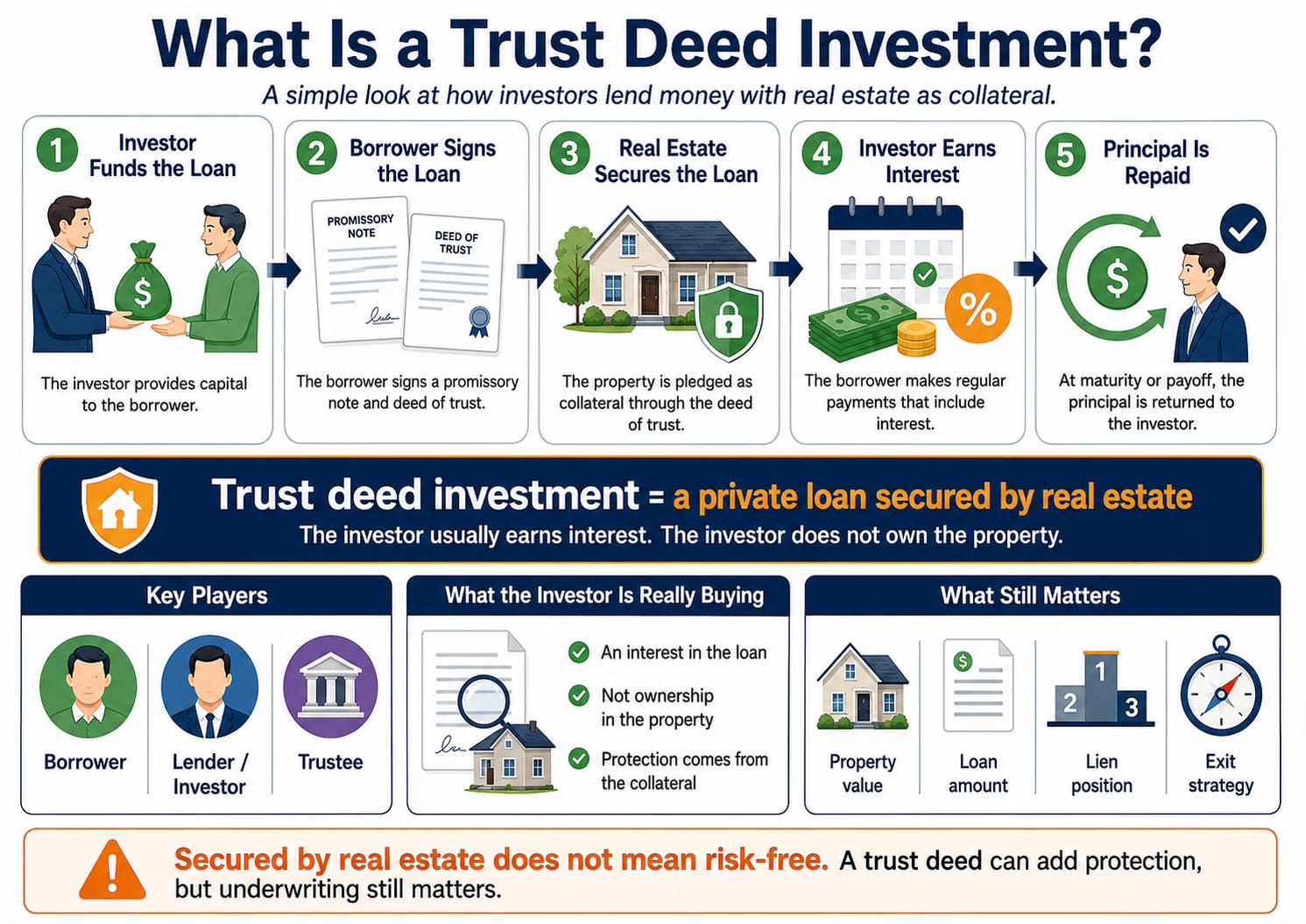
A trust deed, also called a deed of trust, is a legal document used in many states to secure a real estate loan. If you’ve ever bought a house, there’s a decent chance you’ve been on the other side of one. The concept isn’t that complicated. Someone borrows money, and real estate is used as collateral for the loan. The trust deed is part of the legal structure that connects that debt to the property.
So when you hear someone talk about “trust deed investing,” they’re generally talking about lending money where the loan is secured by real estate. You’re not necessarily investing in the property itself. You’re investing in the loan.
That’s an important difference.
Let’s put some numbers behind it
Say a real estate investor wants to buy a property for $500,000. They put $200,000 of their own money into the deal and borrow the remaining $300,000 from a private lender.
The borrower signs documents agreeing to the terms of the loan. Depending on the state and structure of the transaction, a deed of trust may be recorded against the property to secure that debt. So now you have two things that are related, but aren’t the same. You have the loan itself, which lays out things like the amount borrowed, interest rate, payment terms, maturity date, and the borrower’s obligation to repay. Then you have the security instrument connecting that debt to the real estate.
That’s where the property becomes important to the lender. If the borrower makes every payment and eventually repays the $300,000, great. The loan did what it was supposed to do. But if the borrower stops paying, the lender may have rights involving the property securing the loan.
That’s the basic idea.
You’re lending against the property, not buying it
This is probably the easiest place to get confused. If you invest $300,000 into a trust deed loan secured by a house, you don’t suddenly own the house. You’re the lender. The borrower still owns the property. Your investment is the debt.
That’s very different from putting $300,000 into a real estate partnership where you’re buying an equity interest in the entity that owns the property. In an equity investment, you may participate in the property’s income and appreciation. With a loan, your economics are generally based on the terms of the loan. The borrower owes principal and interest according to the agreement.
If the property doubles in value, you don’t automatically get twice as much interest. You’re the lender, not the owner.
This is one of the big differences between real estate debt and real estate equity, and we’ll get deeper into that later.
Why does the property value matter?
If you’re not buying the property, why should you care what it’s worth?
Because it’s collateral.
Go back to our $500,000 property with the $300,000 loan. There’s a $200,000 difference between the property’s stated value and the amount being borrowed. That’s often referred to as an equity cushion.
Now imagine the property is worth $500,000 but the borrower wants a $490,000 loan. That’s a very different situation. The interest rate could be exactly the same. The borrower could be exactly the same. The property could be exactly the same. But the lender’s position is different because there’s much less room between the loan balance and the property’s value.
This is where you’ll start hearing the term loan-to-value, or LTV. In our first example, a $300,000 loan against a $500,000 property would have a 60% LTV. You simply divide the $300,000 loan by the $500,000 property value.
It sounds like a boring little ratio, but it’s one of the most important numbers in real estate lending. We’ll give LTV its own article because there’s more to it than the math.
But who decides the property is worth $500,000?
Good question.
A property isn’t worth $500,000 just because somebody typed “$500,000” into a presentation. Maybe there’s an appraisal. Maybe there’s a broker price opinion. Maybe there are comparable sales. Maybe the lender performs its own analysis.
And different properties can be harder to value than others. A normal house in a neighborhood with 50 recent comparable sales might be relatively straightforward. A partially completed development project on 40 acres of land is a different story.
So when you’re looking at the value of the collateral, it’s worth asking where that number came from. Your LTV is only as useful as the property value being used to calculate it.
What does “first position” mean?
Here’s another term you’ll hear all the time: first-position trust deed.
Imagine our $500,000 property has one $300,000 loan secured against it. That lender may hold the first-position lien. Now imagine there’s another $75,000 loan secured by the same property behind the first one. That second lender may be in second position.
Why does that matter? Because lien priority can affect who gets paid first from the collateral if things go badly. Generally speaking, a senior lien has priority over liens behind it, although the actual rights depend on the documents, applicable law, taxes, other claims, and the specific situation.
That’s why simply hearing “secured by real estate” isn’t enough. You want to know where the loan sits. A $100,000 loan in first position is not necessarily the same risk as a $100,000 loan sitting behind $400,000 of other debt.
Same property. Same $100,000 loan. Very different position.
We’ll get into first versus second position in the next article because it deserves a proper explanation.
What happens if the borrower defaults?
This is the part that makes the collateral meaningful. If the borrower stops making payments or otherwise defaults under the loan documents, the lender may have remedies involving the property. Depending on the state, the loan documents, and the circumstances, that could eventually involve foreclosure.
The basic idea is that the property may be sold and proceeds used to satisfy the debt. But don’t turn that into, “If they don’t pay me, I just take the house.” It’s usually not that simple.
Foreclosure involves legal procedures. It can take time. There can be costs. There may be taxes, liens, property damage, bankruptcy issues, or other complications. And there’s always the biggest question: What is the property actually worth when you need to sell it?
A property that looked like it was worth $500,000 when the loan was made may not sell for $500,000 later. That’s why the lender shouldn’t rely on the collateral as an excuse to make a bad loan.
Ideally, you want the borrower to repay you. Foreclosure is the backup plan.
The interest rate is still only part of the story
Let’s say someone shows you two trust deed investments. Loan A pays 9%. Loan B pays 12%. Which one is better?
You already know where I’m going with this. We don’t have enough information.
You’d want to know what property is securing the loan and what it’s worth. How was that value determined? How much is being borrowed? Who is the borrower? What’s their experience? What are they doing with the money? How are they planning to repay it? What position is the lien in? How long is the loan?
A 9% loan with strong collateral and a clear repayment plan might look very different from a 12% loan where almost everything has to go right. Or maybe the 12% loan is attractive too.
The point is that the rate doesn’t answer the question. You need the rest of the deal.
Why trust deeds are worth understanding
The basic structure is pretty easy to understand. You’re lending money. The borrower pays interest. Real estate helps secure the debt.
But underneath that simple structure are questions about property value, borrower quality, loan amount, lien position, repayment strategy, and risk. That’s where the real analysis happens.
And it’s why I keep coming back to the same idea throughout Beyond Wall Street: Don’t just ask what the return is. Ask what’s underneath it.
With a trust deed investment, there’s an actual loan, an actual borrower, and an actual piece of real estate behind the transaction. Your job is to understand how all three fit together.
Next, we’re going to dig into something that can completely change the risk of a real estate loan even when the property stays exactly the same: first position versus second position.
Beyond Wall Street is for educational and informational purposes only. Nothing published here is investment, financial, legal, or tax advice. Trust deed and private lending investments involve risk, including borrower default and possible loss of principal. Loan structures, lien rights, foreclosure procedures, and terminology vary by transaction and jurisdiction.