


Key Takeaways
Some retirement accounts can hold alternative assets.
The account structure does not make an investment safer.
Tax and prohibited-transaction rules require careful attention.
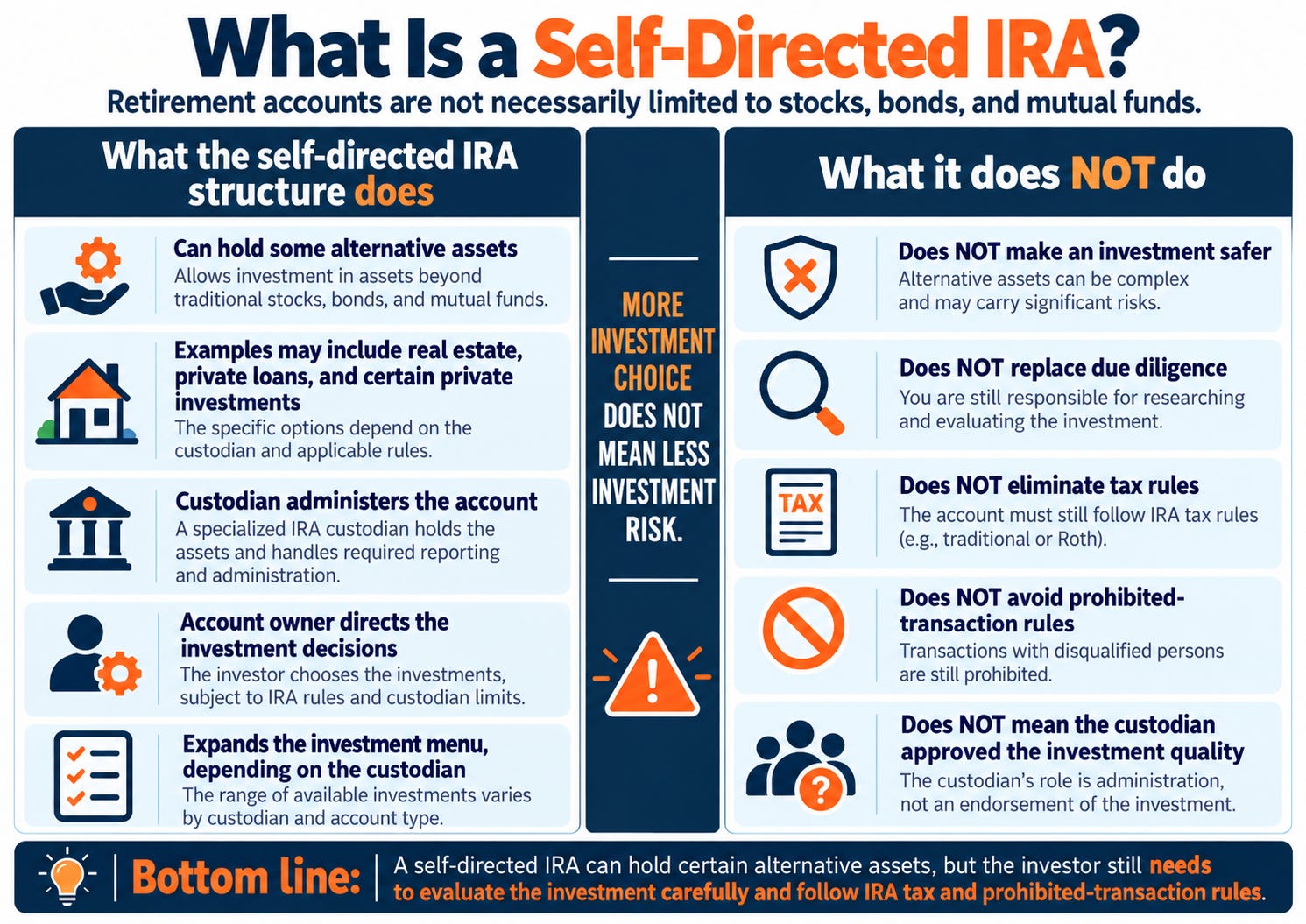
When most people picture an IRA, they probably imagine an account filled with mutual funds, ETFs, stocks, and bonds. That makes sense because those are the investments most large brokerage firms make available inside retirement accounts. But the tax rules governing IRAs do not require every account to be limited to the menu offered by a traditional brokerage.
A self-directed IRA, commonly shortened to SDIRA, is essentially an IRA held by a custodian that allows a broader range of investments than many conventional IRA providers permit. Depending on the custodian and the type of account, that broader menu can include assets such as real estate, private-placement securities, promissory notes, certain precious metals, and other alternative investments. The account itself is still an IRA. What changes is the range of investments the custodian is willing to administer. The SECs Investor.gov describes self-directed IRAs in similar terms and notes that some custodians permit assets such as real estate, private placements, precious metals, promissory notes, tax-lien certificates, and other alternative assets.
That distinction is important. “Self-directed” does not create a special tax loophole, a different class of retirement account, or an investment that is automatically better than a traditional IRA. It mainly describes how much control the account owner has over the investments held inside the account.
The IRA Is Still an IRA
A self-directed IRA still operates under the same basic federal retirement-account framework as other IRAs. An individual retirement account is generally established as a trust or custodial account for the exclusive benefit of the account owner or beneficiaries, and the trustee or custodian generally must be a bank, federally insured credit union, savings and loan association, or another entity approved by the IRS to serve in that role.
The word “self-directed” simply tells you that the custodian is willing to administer investments that many mainstream brokerage firms do not support. A large brokerage may decide that its IRA customers can choose from stocks, bonds, mutual funds, ETFs, CDs, and similar products. Another custodian may build its business around administering real estate, private loans, private companies, or other alternative assets. The SEC’s Investor.gov also emphasizes that self-directed IRA custodians generally hold and administer these assets rather than selecting or recommending them for the investor.
The tax code may permit an asset while a particular custodian still refuses to hold it. Real estate is a good example. Federal IRA rules do not generally prohibit an IRA from owning real estate, but an IRA provider is not required to offer real estate as an investment option. The IRS specifically notes that trustees may impose additional restrictions and that many do not permit real estate because of the administrative burden. So when someone says, “My IRA won’t let me invest in real estate,” that may actually mean their current custodian does not support it. That is different from saying IRA rules prohibit real estate entirely.
What Can a Self-Directed IRA Hold?
This is where self-directed IRAs become relevant to alternative investors. Depending on the custodian and the specific transaction, a self-directed IRA may be able to hold assets such as directly owned real estate, interests in private companies or private funds, promissory notes, private lending investments, certain precious metals, and other assets that would not normally appear inside a traditional brokerage IRA. Investor.gov specifically identifies real estate, private-placement securities, precious metals and other commodities, promissory notes, tax-lien certificates, and other alternative assets as examples that some self-directed IRA custodians permit.
For someone interested in private lending, for example, the IRA might provide capital for a properly structured private loan rather than purchasing shares of a bond fund. The loan could generate interest that returns to the retirement account. In a real estate investment, the IRA might own an interest in a property or investment entity rather than buying a publicly traded real estate investment trust.
The important phrase is “the IRA might.” The details matter. Whether a particular transaction is permitted can depend on the asset, the parties involved, the custodian, the account structure, and the tax rules governing the transaction. This flexibility is one of the main reasons alternative investors become interested in self-directed accounts, but broader investment choice also creates more responsibility.
The Custodian and the Investor Have Different Jobs
One of the easiest mistakes to make with a self-directed IRA is assuming that because a custodian agrees to hold an investment, the custodian has evaluated that investment. That is generally not the case.
According to the SEC’s Investor.gov, self-directed IRA custodians typically do not sell investment products, provide investment advice, evaluate the quality or legitimacy of the investment or its promoter, or verify the financial information supplied for an investment. Their role is generally to hold and administer the assets in the retirement account. That changes the dynamic significantly.
With a conventional brokerage account, the platform has usually already decided which securities and products it will make available. In a self-directed IRA, the owner may identify an outside investment and then instruct the custodian to execute the transaction through the retirement account, assuming the custodian supports that asset and the transaction meets its administrative requirements.
The custodian handles the retirement-account infrastructure. The account owner typically bears much more responsibility for evaluating the actual investment. That is why “self-directed” should be taken pretty literally. More investment freedom usually means more responsibility for due diligence.
Imagine a Private Real Estate Loan Inside an IRA
Consider a simplified example. An investor has retirement funds inside a self-directed IRA and finds a private real estate loan they want the IRA to participate in. The borrower needs capital, the loan is secured by real estate, and the investment is expected to produce interest payments.
The investor cannot simply withdraw money personally, write the borrower a check, and later put the proceeds back into the IRA while treating the transaction as though the IRA made the investment. The retirement account itself needs to participate through the appropriate custodial structure. This separation matters because the investment belongs to the retirement account, and the IRS prohibits various forms of improper personal use or self-dealing involving IRA assets.
If the loan produces interest, that interest belongs to the IRA. If the investment requires an expense that properly belongs to the IRA-owned investment, that expense generally needs to be handled through the retirement account as well. The account owner cannot simply treat the asset as personal property because they selected the investment.
This separation between the individual and the retirement account is a central concept in self-directed investing.
You Cannot Put Just Anything Into an IRA
The broader menu of a self-directed IRA does not mean every imaginable asset is allowed. IRA rules specifically restrict certain investments, including life insurance contracts and many types of collectibles. The IRS identifies artwork, rugs, antiques, gems, alcoholic beverages, many coins and metals, and certain other tangible personal property as collectibles, while providing specific exceptions for certain coins and qualifying precious-metal bullion.
This is a good example of why the phrase “alternative asset” can be misleading. Something can be alternative without being permissible inside an IRA. A rental property may be possible. A private loan may be possible. Certain privately held securities may be possible. Buying a painting because you believe it will appreciate and placing it inside your IRA is a very different story.
The rules apply to the actual transaction, not simply to how someone labels the investment.
Prohibited Transactions Are the Part You Cannot Ignore
The bigger issue with self-directed IRAs is often not what the IRA owns but how the IRA owner interacts with the asset. Under IRS rules, prohibited transactions generally involve improper use of an IRA by the owner, beneficiary, or another disqualified person. Examples include borrowing money from the IRA, selling property to it, using the IRA as security for a loan, or using IRA funds to buy property for present or future personal use.
This is where a self-directed real estate investment can become more complicated than simply owning a rental house personally. Suppose an IRA owns a property. The account owner cannot simply treat it as their own personal vacation property because they happen to own the IRA. Similarly, transferring personally owned property into the IRA can create prohibited-transaction issues rather than functioning like an ordinary transaction between unrelated parties. The IRS specifically cautions that unconventional assets such as real estate and closely held companies can increase the risk of running afoul of prohibited-transaction rules against self-dealing.
The same concern can appear in private businesses, loans, partnerships, and other investments. Transactions involving the account owner, certain family members, and other disqualified persons need careful review because these rules are designed to prevent retirement accounts from being used for improper current personal benefit.
Who Counts as a Disqualified Person?
The rules extend beyond the account owner. For IRA purposes, the IRS identifies disqualified persons as including the IRA owner’s fiduciary and certain family members, including a spouse, ancestor, lineal descendant, and the spouse of a lineal descendant.
That means an IRA transaction cannot be evaluated only by asking, “Am I personally getting a benefit? The relationships among all of the parties may matter. Imagine an IRA buying property from the account owner’s parent, lending money in a transaction involving certain related parties, or purchasing an asset intended for the owner’s personal use. These are exactly the kinds of situations where prohibited-transaction rules become important.
The rules can be technical, and small structural differences can matter. That is one reason investors considering unusual transactions often involve qualified tax or legal professionals before completing them rather than trying to correct a problem afterward.
The Consequences Can Be Bigger Than a Small Penalty
Prohibited transactions are not merely paperwork mistakes. The IRS states that if an IRA owner or beneficiary engages in a prohibited transaction involving the IRA, the account generally stops being treated as an IRA as of the first day of that year. The account may then be treated as distributing all of its assets to the owner at fair market value, potentially creating taxable income and other consequences.
That is a serious distinction. If someone makes a poor investment inside an IRA, they may lose money on the investment. If they improperly structure a transaction and jeopardize the accounts tax treatment, the problem can extend beyond the performance of the asset itself.
This is why the tax rules deserve just as much attention as the projected return. A self-directed IRA gives an investor more control over what the retirement account owns. It does not give the investor permission to ignore the retirement-account rules.
Alternative Assets Can Create Tax Issues Inside the IRA Too
Another common assumption is that because an asset sits inside an IRA, every dollar of income it produces is automatically insulated from current taxation. That is not always the case.
The IRS notes that an IRA can be subject to tax on unrelated business income if it carries on an unrelated trade or business. Special rules can also apply to income from debt-financed property, where otherwise excluded investment income may be included in unrelated business taxable income in proportion to the debt, subject to applicable rules and exceptions.
That does not mean using debt inside an IRA is automatically prohibited. It means the tax analysis can become more complicated than “the investment is in an IRA, so there are no current taxes.” Once again, structure matters.
Traditional and Roth Self-Directed IRAs Are Still Different Accounts
“Self-directed” describes the investment flexibility of the account, not its underlying tax category. Investor.gov identifies traditional IRAs, Roth IRAs, SEP IRAs, and SIMPLE IRAs as common IRA structures and explains self-directed IRAs in terms of the broader range of assets a custodian permits, rather than as a separate tax classification.
The contribution, distribution, eligibility, and tax rules associated with the underlying type of IRA still apply. Opening a self-directed IRA does not replace the distinction between traditional and Roth accounts.
The investment menu and the tax structure are two separate questions. An investor could potentially hold the same type of private investment inside different types of IRAs while having different tax treatment when money eventually leaves the account. Understanding the investment and understanding the retirement account are both necessary.
Alternative Assets Can Be Harder to Value
Publicly traded investments make valuation relatively easy. If an IRA owns 100 shares of a publicly traded company, there is usually a market price available every day. Private assets can be very different.
What is a privately held business interest worth today? What is the current value of a private loan that has two years remaining? What is an undeveloped parcel of land worth? What is the fair market value of an ownership interest in a private real estate fund that cannot easily be sold?
These questions matter because alternative investments may be illiquid and difficult to value. Investor.gov warns that values appearing on self-directed IRA statements may sometimes reflect the original purchase price, information reported by the promoter, or another supplied valuation rather than a readily observable market price. It therefore encourages investors to independently verify prices and asset values when possible.
That does not make private assets unsuitable for retirement accounts. It simply means the investor may need to think differently about valuation than they would with an ETF or publicly traded stock.
Liquidity Matters More Inside a Retirement Account Than People Expect
Alternative investments can also have long holding periods. A private real estate fund may expect to hold properties for several years. A private loan may not have an active secondary market. An ownership interest in a private company might be difficult or impossible to sell until the company completes some future transaction.
This becomes especially relevant when retirement-account rules eventually require money to leave the account or when an investor needs liquidity for another reason. Investor.gov specifically identifies limited liquidity as one of the risks investors should consider when holding alternative assets through self-directed IRAs.
An investment can be performing exactly as expected while still being difficult to turn into cash. That makes the investment timeline part of the retirement-account decision. The projected return is only one piece of the puzzle. If capital may be tied up for years, the investor needs to understand how that illiquidity fits with the broader retirement plan.
A Custodian Does Not Make a Bad Investment Good
This point deserves repeating because the structure can create a false sense of legitimacy. An investment becoming available through a self-directed IRA does not mean the IRS or SEC approved it. It does not mean the custodian evaluated it. It does not mean the investment is safe, legitimate, fairly priced, liquid, or appropriate.
The SEC’s Investor.gov specifically warns that using a legitimate self-directed IRA custodian does not make the underlying investment legitimate. Self-directed IRA custodians generally administer the account rather than evaluate the quality of an investment or its promoter. This is the same distinction we have made throughout Beyond Wall Street. Structure and investment quality are two different things.
A trust deed does not automatically make a loan safe. A low LTV does not tell you everything about a borrower. Accredited-investor status does not tell you whether an investment is appropriate. And placing an investment inside a self-directed IRA does not improve the quality of the underlying asset.
The investment still has to stand on its own.
More Choice Means More Responsibility
The appeal of a self-directed IRA is easy to understand. Instead of assuming retirement investing has to mean choosing among public stocks, bonds, mutual funds, and ETFs, investors may be able to access real estate, private lending, private companies, and other assets that operate outside public markets.
That flexibility can be useful, especially for someone who already understands a particular alternative asset class. But the trade-off is that the investor often takes on much more responsibility for evaluating the investment, understanding the structure, maintaining separation between personal and retirement assets, monitoring valuations, and avoiding prohibited transactions. Investor.gov makes the same basic point: self-directed IRA investors are generally responsible for evaluating and understanding the investments they choose, while the custodian’s role is primarily administrative.
A self-directed IRA is best understood as a container. The container can hold a broader set of investments, but it does not change the economics of what is inside. A poorly underwritten loan is still a poorly underwritten loan. An overpriced property is still overpriced. An illiquid private investment is still illiquid. A fraudulent offering does not become legitimate simply because a retirement custodian processed the transaction.
The account gives the investor access and control, but it does not provide a shortcut around due diligence. That is the real lesson behind self-directed IRAs. Retirement accounts may have more investment flexibility than many people realize, but with that flexibility comes another layer of rules that investors need to understand. The interesting part is not simply that an IRA can hold alternative assets. It is understanding how the investment, the custodian, the retirement account, and the tax rules all fit together.
Disclaimer: Beyond Wall Street is published by GoVesty and is provided for educational and informational purposes only. Nothing in this article should be considered investment, financial, legal, tax, or accounting advice, or an offer, solicitation, or recommendation to buy or sell any investment or security. Alternative investments involve risk and may not be suitable for everyone. You should evaluate any opportunity based on your own circumstances and consult with qualified financial, legal, and tax professionals before making an investment decision. GoVesty does not provide investment advice, manage customer funds, or guarantee investment results.