


Key Takeaways
A default does not automatically mean the lender loses money. The borrower may catch up, refinance, sell the property, negotiate an extension, or work out another solution.
Real estate collateral gives the lender options if the borrower cannot repay, but enforcing those rights can take time and cost money.
Before making a private loan, you should understand what happens if the borrower stops paying, not just what happens when everything goes according to plan.
Most private lending conversations naturally focus on the good outcome. The borrower makes the payments, the investor earns interest, and the principal comes back when the loan matures. That is how the investment is supposed to work, but understanding private lending also means understanding what happens when the borrower does not hold up their end of the deal.
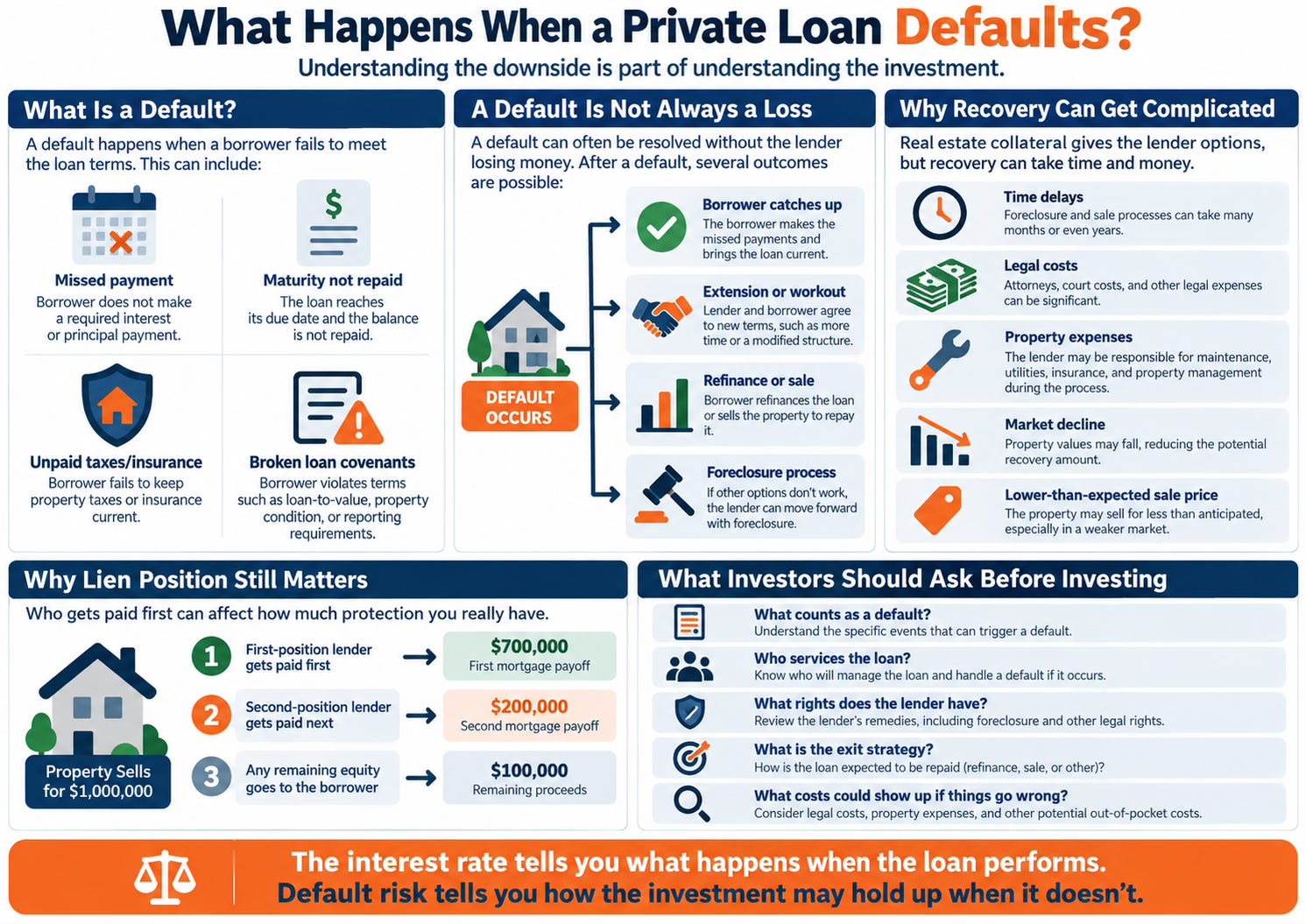
This is where terms like default, workout, foreclosure, and recovery start showing up. They can sound intimidating, but the basic idea is pretty simple. The borrower agreed to do certain things under the loan documents. If they fail to do them, the lender may gain additional rights and options. A default does not necessarily mean the investment is over or that the lender is about to lose money, but it does mean the original plan is no longer working as expected.
What Actually Counts as a Default?
The most obvious default is a missed payment. If the borrower is supposed to make an interest payment every month and stops paying, the loan may eventually be considered in default based on the terms of the loan documents and any applicable grace period.
Missing a payment is not the only way a borrower can default. The loan agreement may also require the borrower to maintain insurance, pay property taxes, provide financial information, complete certain construction work, maintain the property, or avoid taking on additional debt without approval. Violating one of those requirements can sometimes create a default even if the borrower is still making the monthly interest payments.
This is one reason the loan documents matter so much. They define what the borrower has agreed to do and what rights the lender has when those obligations are not met. Before investing, it is worth understanding what the specific loan considers a default rather than assuming the term only refers to missed payments.
A Missed Payment Does Not Always Mean Disaster
Suppose a borrower is expected to make a $5,000 interest payment on the first of every month and one month the payment does not arrive. That is clearly a problem, but it does not necessarily mean the property is headed straight to foreclosure.
Maybe the borrower had a temporary cash-flow problem. A property sale could have been delayed, a tenant might have paid late, or a bank transfer may have failed. The lender will usually want to know what happened, whether the borrower can correct it quickly, and whether the problem appears temporary or part of something larger.
A borrower who is a few days late, explains what happened, makes the payment, and continues performing is very different from a borrower who has run out of money and has no realistic way to repay the loan. The missed payment matters in both cases, but the situation surrounding it tells you much more about what may happen next.
Communication Becomes Very Important
When a loan starts having problems, information becomes extremely valuable. The lender wants to know what caused the issue, what is happening with the property, whether the borrower still has cash available, and whether the original repayment plan is still realistic.
This is also where loan servicing becomes important. Someone needs to notice that the payment was missed, contact the borrower, document what happened, track deadlines, and make sure the lender’s rights are being protected. If the borrower is renovating a property, the lender may also want updates on construction progress, remaining costs, and whether the expected refinance or sale is still possible.
Private lending is not just about making a good decision when the loan is originated. Someone also has to manage the loan during its life, especially when something stops going according to plan.
Sometimes a Workout Makes More Sense Than Foreclosure
If the borrower cannot immediately fix the problem, the lender may consider what is commonly called a workout. A workout is an attempt to restructure the situation so the borrower can still repay the debt without forcing the lender to take the property.
For example, imagine a borrower reaches the maturity date but needs another four months to finish renovations before refinancing. The lender might agree to extend the loan in exchange for an extension fee, additional interest, more borrower capital, or other protections. In another situation, the borrower may be trying to sell the property and simply needs more time for the transaction to close.
There are times when giving a capable borrower more time makes more sense than immediately starting foreclosure. If the lender believes the borrower has a realistic path to full repayment, an extension or restructuring could save everyone time and expense. The goal of the lender is usually to get the money back, not to become the owner of a distressed property.
That does not mean every troubled loan should be extended. Repeatedly giving more time to a borrower whose plan no longer makes sense can simply delay the inevitable. A workout only helps if there is still a believable path to repayment.
The Exit Strategy Gets Tested During a Default
Earlier in the series, we talked about the importance of the borrower’s exit strategy. A default is often where that plan gets tested.
Suppose a borrower takes a 12-month private loan to renovate a property and then refinance it with a bank. Month 12 arrives, but the renovation took longer than expected and the bank will not refinance the property yet. The lender now has to decide whether the original exit strategy is simply delayed or whether it has actually failed.
If the work is almost finished, the borrower still has money, and a bank is already reviewing the refinance, an extension may be reasonable. If the project is only half finished, the borrower has run out of cash, and no lender is willing to refinance the property, the situation looks very different.
This is why a good exit plan should be evaluated before the loan is made. When the loan gets into trouble, the lender wants to know what other paths to repayment still exist.
When Foreclosure Enters the Picture
If the borrower cannot cure the default and there is no realistic workout available, the lender may eventually decide to enforce its rights against the real estate. This is where foreclosure can enter the picture.
The exact process depends on the state, the loan documents, the type of security instrument, the lien position, and the specific circumstances of the loan. At a high level, the idea is that the lender has a debt secured by real estate. If the borrower does not repay the debt, the lender may be able to use a legal process to force a sale of the property or otherwise pursue the collateral.
The proceeds can then be used to repay the debt according to the priority of the various liens and claims against the property. That sounds fairly straightforward, but there can be a long road between the first missed payment and the lender actually receiving money from the collateral.
Foreclosure Takes Time and Costs Money
One reason default risk matters so much is that recovering money may not happen quickly. There can be notices, waiting periods, legal filings, trustee actions, borrower responses, property management issues, and other steps before the collateral can actually be sold. The timeline can vary quite a bit depending on where the property is located and what is happening with the borrower.
During that time, the investor’s principal may remain tied up. Even if the lender eventually recovers every dollar, an investment expected to last 12 months could turn into an 18-month or two-year situation. That changes the investor’s liquidity and may prevent the capital from being used somewhere else.
There can also be significant costs involved. Attorneys, trustee expenses, unpaid taxes, insurance, maintenance, repairs, security, utilities, and selling costs can all reduce the equity cushion protecting the lender. If the property eventually has to be sold, commissions and other transaction expenses may also come out of the proceeds.
This is why a loan with a seemingly comfortable LTV can become much tighter during a default. A property valued at $1 million with a $600,000 loan appears to have a $400,000 cushion, but that cushion can shrink if the market declines, the recovery process takes a year, and the lender has to spend money protecting and selling the property.
The Property May Not Be Worth What Everyone Thought
A default can also expose problems with the original property valuation. When the loan was made, an appraisal may have valued the property at $1 million. A year later, the lender may discover that the market has weakened, planned improvements were never completed, the property has deteriorated, or the original valuation was simply too optimistic.
This is where the difference between estimated value and actual recovery value becomes very real. A property is ultimately worth what someone is willing to pay for it under the circumstances in which it has to be sold. If the lender needs to dispose of the property quickly, that price could be lower than the value everyone expected when the loan was originated.
That does not make appraisals useless. It simply means property values are estimates, not guarantees. Conservative lending leaves room for the possibility that those estimates turn out to be wrong.
Lien Position Matters Even More When Things Go Wrong
First position and second position can sound like technical lending terms when a loan is performing normally. During a default, the difference becomes very practical.
Imagine a property is eventually sold and there is $700,000 available after certain costs. A first-position lender is owed $600,000, while a second-position lender is owed another $150,000. The first lender generally gets paid before the second lender. If only $100,000 remains after satisfying the senior debt and other superior claims, the second-position lender may not recover the full amount owed.
Both lenders were secured by the same property, but their protection was very different because of where they stood in the repayment order. This is why understanding lien position before investing is so important. Default is where that priority stops being theoretical.
Default Does Not Automatically Mean a Loss
One thing worth keeping in perspective is that default and loss are not the same thing. A borrower can miss payments, go into default, and still ultimately repay the lender in full.
The loan might be extended and refinanced a few months later. The property might be sold and generate enough proceeds to cover the debt. The lender could eventually foreclose and recover the principal from the collateral. Depending on the documents and applicable law, the lender may also receive late fees, extension fees, or default interest.
Still, investors should not assume that those extra charges make a default attractive. A troubled loan can create delays, uncertainty, expenses, and a lot of work. The best outcome is usually still the boring one: the borrower makes the payments and repays the principal on time.
A Default Can Still Produce a Real Loss
The opposite can happen too. Real estate collateral does not guarantee that the lender will recover everything.
Imagine a lender makes a $700,000 loan against a property believed to be worth $1 million. The borrower defaults, the real estate market weakens, and the property eventually sells for $650,000 after the situation has deteriorated. Once legal fees, taxes, repairs, and selling expenses are included, there may be even less money available.
At that point, the lender could lose part of the original principal. This is why a high interest rate should never distract you from the size of the principal at risk. An investor might earn tens of thousands of dollars in interest and still have a poor overall result if a much larger amount of principal is lost later.
The return matters, but protecting the capital matters more.
The Lender Could End Up With the Property
There is another outcome investors sometimes overlook. Depending on the foreclosure process and the circumstances of the sale, the lender or an affiliated entity could ultimately end up controlling the property.
That changes the investment completely. The person who originally wanted to earn interest may now be dealing with repairs, insurance, property taxes, tenants, maintenance, management, and eventually a sale. Lending money and owning distressed real estate are two very different businesses.
This is another reason lenders generally prefer a normal repayment or sensible workout. Foreclosure is an important protection, but it is the backup plan, not the investment strategy.
This Is Why Underwriting Happens Before the Money Goes Out
The easiest time to deal with default risk is before the loan is made. That is really what underwriting is trying to accomplish.
You evaluate the borrower because you want to understand how likely they are to repay. You evaluate the property because you want to know what may be available if they do not. You look at LTV because you want a margin for error, lien position because you want to understand repayment priority, and the exit strategy because you want to know how the principal is expected to come back.
All of those questions are really asking two things: What happens to my money if the plan works, and what happens if it does not?
A lender who only analyzes the expected interest rate has only analyzed half the investment. The downside deserves just as much attention as the upside.
Understand the Downside Before You Invest
Private lending can look very simple when everything is working. The borrower pays interest, the investor collects income, and the principal is returned at maturity. Default reveals everything underneath that simple structure because it tests the borrower, the collateral, the valuation, the LTV, the lien position, the loan documents, the servicing, and the exit strategy all at the same time.
Sometimes the problem is temporary and gets resolved quickly. Other times the lender may agree to an extension or workout because there is still a reasonable path to repayment. In more serious cases, the lender may have to enforce its rights against the property, spend money protecting the collateral, and wait much longer than expected to recover the capital. If the property’s value is not sufficient, the investor can still lose money even though the loan was secured by real estate.
That is why understanding default should be part of evaluating the investment from the beginning. Before making a private loan, you should know what counts as a default, who handles missed payments, what rights the lender has, what position the lien holds, how the collateral could be recovered, what expenses might arise, and how long the process could reasonably take.
The interest rate tells you what you might earn when the loan performs as planned. Understanding default tells you how well the investment may hold up when it does not.
Disclaimer: The information in this article is for educational and informational purposes only and should not be considered investment, financial, legal, tax, or accounting advice. Nothing in this article is an offer, solicitation, or recommendation to buy or sell any investment or security. Alternative investments involve risk and may not be suitable for everyone. You should evaluate any investment opportunity based on your own circumstances and consult with qualified financial, legal, and tax professionals before making any investment decision. GoVesty does not provide investment advice, manage customer funds, or guarantee investment results.