


Key Takeaways
Compare investments using returns after fees when possible.
Recurring fees compound along with investment performance.
Understand who gets paid, how much, and when.
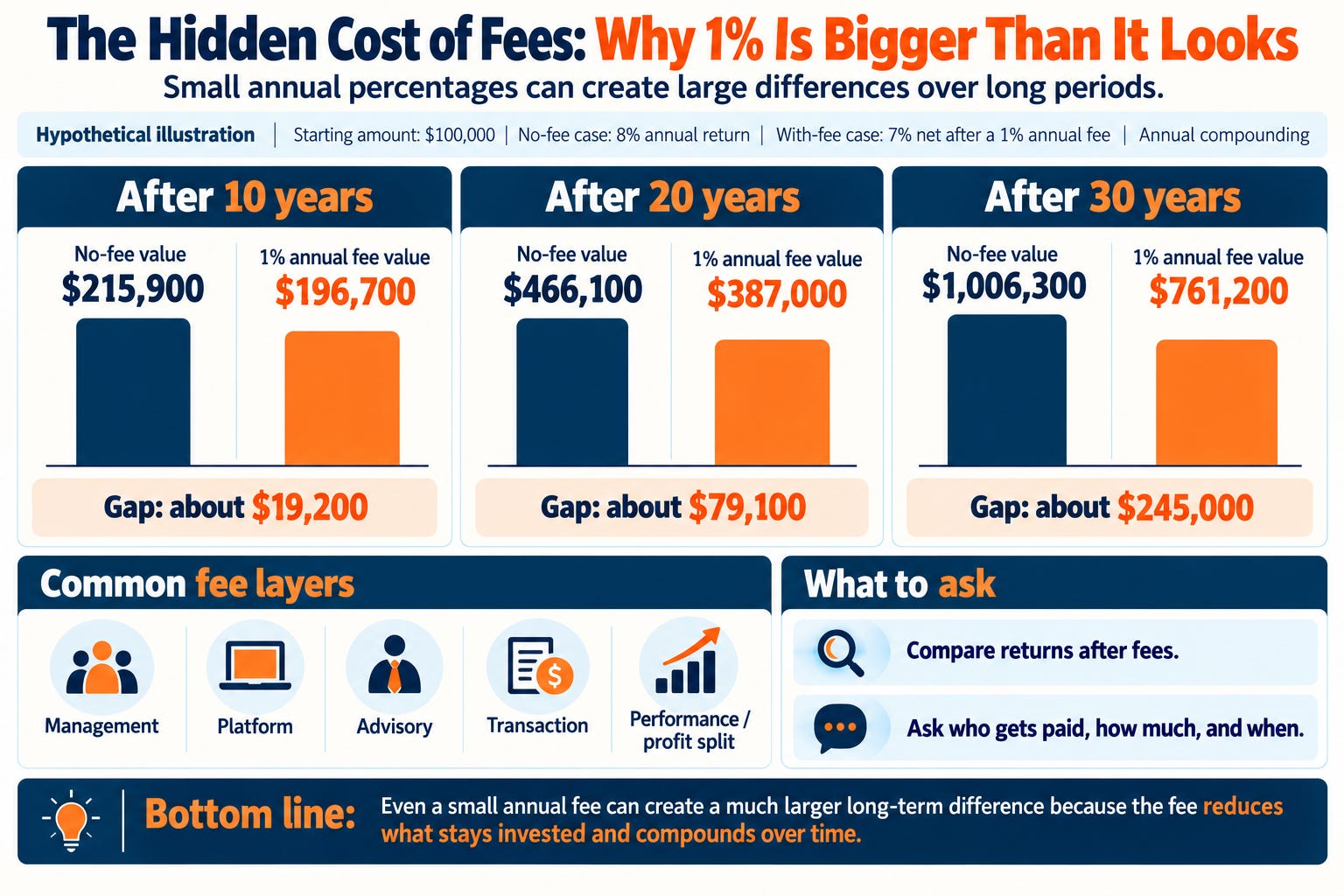
A 1% fee does not sound especially dramatic. On $100, it is one dollar. On $10,000, it is $100. Even on a $100,000 investment, a 1% fee may initially look small compared with the potential return, especially when an investment is targeting income, appreciation, or both.
The problem is that many investment fees are not charged once. They are charged repeatedly, often against an asset base that may be growing. Every dollar that leaves the investment as a fee is also a dollar that is no longer available to earn a future return. Over a long enough period, that difference can become much larger than the percentage printed in the offering documents suggests.
This matters everywhere, from mutual funds and advisory accounts to private credit, real estate syndications, private funds, and investment platforms. Alternative investments can make the issue especially important because fees may appear in several different places and may be calculated differently depending on the structure.
Understanding fees is not about automatically choosing the cheapest investment. It is about knowing what you are actually paying for and comparing the return you may receive after those costs are taken into account.
Why a Small Percentage Can Become a Large Difference
Compounding usually gets discussed as a benefit. An investment earns a return, that return stays invested, and future returns are earned on a larger balance. Given enough time, even modest differences in annual growth rates can produce very different ending values. Fees participate in that same math, only in the opposite direction.
Consider a simplified hypothetical example. Assume an investor starts with $100,000. Investment A earns an 8% gross annual return for 10 years with no annual fee. Investment B earns the same 8% gross annual return, but for illustration we assume a 1% recurring annual fee reduces the net annual return to 7%. Assume annual compounding, no additional contributions or withdrawals, and ignore taxes.
After 10 years, Investment A would grow to approximately $215,892. Investment B would grow to approximately $196,715. The difference is about $19,177. The investor did not simply lose $1,000 per year for 10 years. The difference became larger because money removed by fees was no longer available to compound in later years. This example is deliberately simplified. Real-world fees may be assessed monthly, quarterly, annually, on beginning or ending balances, on committed capital, on invested capital, or using other methods. The point is not that every 1% fee produces this exact result. The point is that recurring costs affect both today’s balance and tomorrow’s compounding. That is why a small annual percentage deserves more attention than its size might suggest.
“The Fee” Is Rarely Just One Fee
One of the easiest mistakes an investor can make is looking for a single line labeled “fee” and assuming that number represents the entire cost of the investment. Sometimes it does. Often it does not.
A traditional public-market fund might charge an expense ratio that bundles many operating costs into one annual percentage. An advisory account may separately charge an advisory fee based on assets under management (AUM). Trading or platform costs may also apply depending on the account.
Alternative investments can involve several layers. A private real estate offering might include an acquisition fee, ongoing asset-management fee, property-management costs, financing expenses, disposition fees, organizational expenses, and a share of profits paid to the sponsor. A private credit investment might include management fees, servicing fees, origination economics, platform fees, or performance-based compensation. A private fund may charge a recurring management fee plus a share of investment profits.
None of these structures is automatically inappropriate. Managing a property, underwriting loans, operating a fund, handling investor reporting, sourcing transactions, and overseeing assets all cost money. The useful question is not simply, “Does this investment have fees?”
The better question is: what are all the fees, who receives them, what are they calculated on, and when are they charged?
Gross Return and Net Return Are Different Numbers
This distinction becomes especially important when comparing opportunities. A gross return describes investment performance before some or all expenses. A net return reflects what remains after applicable fees and costs. Depending on the investment and the presentation, the difference can be substantial.
Suppose two investments both show attractive historical or hypothetical performance. One number is presented before management fees and performance compensation. The other is presented after all investor-level fees. Comparing those figures directly would not tell you which investment actually delivered more to investors.
The same problem appears when one investment advertises a yield while another reports an internal rate of return (IRR). Internal rate of return is a calculation that incorporates the timing of cash flows. It can be useful, especially in private investments where capital moves in and out over time, but an investor still needs to know whether the reported IRR is gross or net of fees.
Fee presentation should be part of return analysis, not a separate administrative detail. When possible, compare net returns to net returns using similar time periods and assumptions. If the numbers are not directly comparable, understanding why they differ may be more useful than the headline percentages themselves.
The Percentage Is Only Half the Question
A fee percentage by itself is incomplete information because the percentage must be applied to something. Consider a private fund charging a management fee. Is the fee calculated on committed capital, invested capital, assets under management, net asset value, or something else? Those bases can produce very different dollar amounts.
Imagine an investor commits $100,000 to a private fund, but only $60,000 has actually been invested. A management fee calculated on the full $100,000 commitment will produce a different cost than the same percentage charged only against the $60,000 currently deployed. Neither structure can be evaluated from the percentage alone.
The fee base can also change over the life of an investment. Some private funds charge management fees on committed capital during the investment period and later switch to invested capital or another measure. Some real estate sponsors charge fees based on equity invested, property revenue, or asset value. An investor who asks only, “What percentage is the management fee?” may still be missing the more important part of the calculation.
Private Real Estate Can Have Fees at Several Levels
Real estate syndications provide a useful example because the underlying business requires actual operating work. A sponsor may need to find the property, negotiate the purchase, arrange financing, complete due diligence, manage renovations, supervise property management, handle accounting, communicate with investors, refinance debt, and eventually sell the asset. Different fees may compensate the sponsor or third-party providers for different parts of that work.
An acquisition fee might be charged when the property is purchased. An asset-management fee may continue while the property is held. Property-management fees may be paid to the company operating the property. Financing or refinancing can generate additional costs. A disposition fee may apply when the property is sold.
Then there may be performance-based economics. Many real estate partnerships divide responsibilities between a general partner (GP), which typically sponsors and manages the investment, and limited partners (LPs), who generally provide investor capital. The GP may receive a greater share of profits after certain return thresholds or distribution structures are met. This is commonly described through terms such as a promote or carried interest. That compensation may align the sponsor with investment performance, but it also affects how much of the property’s economic return ultimately reaches the LP. The correct question is not whether one of these fees exists. It is how the entire structure works together.
Private Credit Has Its Own Fee Layers
Private credit can look simpler because the basic investment is often a loan. A borrower receives capital and agrees to repay principal plus interest. But the rate paid by the borrower is not necessarily the same as the return ultimately earned by the investor.
Suppose a borrower pays interest on a private loan. Part of the economics may compensate the party that originated the loan. Another portion may pay for servicing. A platform may charge a fee for connecting investors with the opportunity or administering the investment. A fund holding the loan may charge management expenses. Depending on the structure, there may also be performance compensation.
This creates an important distinction between the borrower’s cost of capital and the investor’s net return. A loan carrying a high interest rate does not mean every percentage point flows directly to the investor. There may also be credit losses, idle cash, defaults, legal costs, servicing expenses, and other factors that affect the result.
Private lending can still be attractive to investors seeking income-producing alternatives to publicly traded bonds, but the analysis should start with what reaches the investor after the full structure is considered.
Platform Fees Deserve Attention Too
Technology has made alternative investments more accessible. Online platforms can provide investors with access to real estate, private credit, private funds, startups, and other private-market opportunities without requiring the investor to find each deal independently. That convenience has value, but the platform’s economics should still be understood.
Some platforms charge the investor directly. Others are paid by the sponsor, borrower, fund manager, or issuer. Some earn transaction fees. Others charge recurring administrative or servicing fees. There may also be expenses inside the underlying investment itself.
A fee does not become irrelevant merely because someone other than the investor writes the check. If a sponsor pays a platform for access to capital, that expense may still be part of the overall economics of raising or deploying money. The goal is to understand the complete chain. Who owns the asset? Who manages it? Who administers it? Who raises the capital? Who services the investment? And how is each party compensated?
Performance Fees Can Change the Incentives
Recurring management fees are relatively straightforward because they are usually tied to a defined asset or capital base. Performance fees work differently because they depend on investment results. In a private fund, the manager may receive a portion of profits above a particular hurdle or according to a distribution waterfall. Real estate partnerships may use similar structures. This can create alignment because the manager earns more when investors make more. But the details still matter.
Investors should understand how profits are calculated, whether losses must be recovered before new performance compensation is earned, whether prior distributions affect the calculation, and what happens if different assets within a portfolio perform differently. Two funds can both advertise similar performance-fee percentages while producing different investor outcomes because their distribution formulas are different. The headline percentage alone does not explain the economics.
Transaction Fees Affect Shorter Holding Periods More
Not every fee is recurring. Some costs happen only when an investment is bought, financed, refinanced, or sold. These transaction costs can be particularly important when the expected holding period is short.
Suppose an investment incurs meaningful acquisition and disposition costs. If the asset is held for 10 years, those costs are spread economically across a long period of potential income and appreciation. If the investment exits after two years, the same transaction costs consume a much larger portion of the total return. This is why holding period and fee structure should be considered together.
A strategy that depends on frequent buying, selling, refinancing, or redeploying capital may experience more friction than one that holds assets for longer periods. That does not automatically make the strategy worse, but it raises the return the underlying investments must generate before investors receive an attractive net result.
Fees Can Be Worth Paying
It would be easy to conclude that lower fees are always better. That would miss an important part of the picture. Investors are not buying fees. They are buying access, expertise, administration, sourcing, underwriting, management, reporting, and ultimately investment results.
A skilled real estate operator may create value through renovations, leasing, financing, and property management. A private credit manager may have underwriting capabilities and deal access an individual investor does not. A fund manager may build a diversified portfolio that would be difficult for an investor to replicate. A platform may provide administration and access that makes a private investment practical. Paying more for something that produces substantially better net outcomes can be perfectly rational.
The key word is net.
A higher-fee investment that produces stronger returns after fees may be more attractive than a low-fee investment with weaker performance. Likewise, paying a low fee does not make a poor investment good. Fees should be evaluated alongside risk, liquidity, manager quality, asset selection, structure, and expected return.
Public Markets Provide a Useful Comparison
Public-market funds often make fee comparison easier because expense ratios are standardized and widely disclosed. Many index funds operate at very low costs because public securities are liquid, portfolios can be managed at enormous scale, and the investment process can be highly automated. That is a genuine advantage of traditional public markets.
Alternative investments often involve work that cannot be automated as easily. Someone may need to inspect a property, negotiate a loan, underwrite a borrower, supervise a construction project, manage a private company, or resolve a default. Those activities can justify additional expenses.
But complexity should not become an excuse for opacity.
An alternative investment may reasonably cost more to operate than an index fund while still providing valuable diversification, income, access to private assets, or other characteristics. Investors should simply understand what they are paying and what they expect to receive in return.
Watch for Fees on Fees
Layered investment structures can make costs particularly difficult to see. An investor might place money into a private fund that invests in other funds. The top-level fund may charge a management fee, while the underlying funds charge their own fees. A real estate investment might pay an outside property manager while also paying the sponsor an asset-management fee. A retirement account holding alternative assets may have custodial or administrative charges in addition to the investment’s own expenses. Each individual fee may look reasonable. Together, they may materially change the economics.
This does not mean layered structures should be avoided automatically. Sometimes they provide diversification, specialized expertise, or access that would otherwise be unavailable. It does mean that investors should look through the entire structure rather than stopping at the first disclosed percentage. Understanding the investment means understanding where the money goes.
Questions That Make Fees Easier to Understand
A useful fee review starts with plain-English questions. What fees are paid upfront? Which fees recur annually? Are fees based on committed capital, invested capital, assets under management, property value, revenue, or something else? Are there transaction fees when assets are bought, refinanced, or sold? Does the manager participate in profits? Are there third-party expenses in addition to manager compensation?
It is also useful to ask whether historical or projected returns are shown before or after fees. If returns are presented gross, what would investors actually have received after the expenses that apply to them? Are there additional platform, account, custody, tax-preparation, legal, or administrative costs outside the investment itself?
Finally, ask about timing. A fee paid today has a different economic effect from a fee paid years from now. A recurring fee behaves differently from a one-time transaction cost. A performance fee charged only after profits are earned behaves differently from a management fee charged regardless of performance. The goal is not to memorize every possible fee name. It is to understand the flow of money.
What Matters Is What the Investor Keeps
Investment marketing naturally emphasizes what an asset might earn. That is the exciting part. But gross performance is only one side of the equation. Taxes, fees, expenses, losses, and timing all influence what eventually reaches the investor.
This is particularly important in alternative investments because two opportunities that appear similar at first glance may have very different economics underneath. A private real estate deal, private credit fund, or investment platform may each involve multiple parties performing legitimate work and receiving compensation for it. The important task is understanding that compensation before committing capital.
A 1% fee is not automatically high. A 2% fee is not automatically unreasonable. A low-fee investment is not automatically attractive, and a high-fee investment is not automatically poor. The better comparison is what the investor receives after the costs required to produce the result.
Small percentages deserve attention because compounding gives them time to become meaningful. Once investors understand who gets paid, how much they are paid, what the fee is calculated on, and when the payment occurs, the headline return becomes much easier to put into context.
Disclaimer: Beyond Wall Street is published by GoVesty and is provided for educational and informational purposes only. Nothing in this article should be considered investment, financial, legal, tax, or accounting advice, or an offer, solicitation, or recommendation to buy or sell any investment or security. Alternative investments involve risk and may not be suitable for everyone. You should evaluate any opportunity based on your own circumstances and consult with qualified financial, legal, and tax professionals before making an investment decision. GoVesty does not provide investment advice, manage customer funds, or guarantee investment results.