


Key Takeaways
Evaluate the borrower and the collateral separately. A strong property does not automatically make a weak borrower a good credit risk.
The loan structure determines many of the lender’s protections, including the loan amount, LTV, lien position, payment terms, and maturity date.
The exit strategy matters because it explains how the borrower expects to repay the loan and return the investor’s principal.
Over the last several articles, we have looked at private lending one piece at a time. We talked about trust deeds, lien position, loan-to-value, interest rates, and why someone might willingly borrow money at 10% or 12%. Now it is time to put those pieces together and look at what an actual private real estate loan might look like from beginning to end.
At its core, a private real estate loan is pretty straightforward. A borrower needs money, a lender provides it, and a piece of real estate helps secure the debt. But a good loan is not defined by any one of those things. The quality of the investment comes from how the borrower, property, loan amount, lien, terms, documentation, and repayment plan work together.
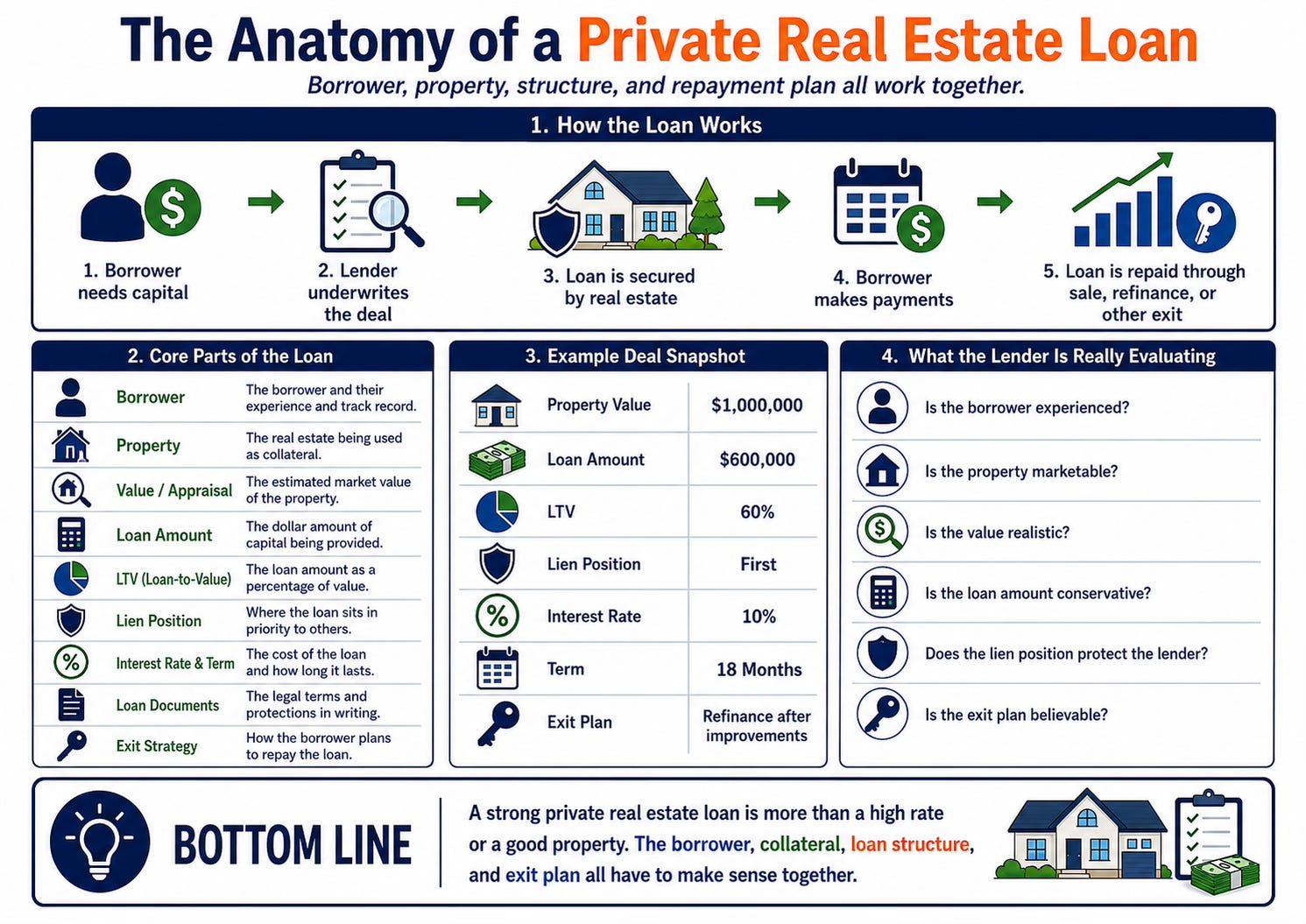
That is what makes understanding the anatomy of the loan so useful. Instead of seeing a private lending opportunity as “10% secured by real estate,” you start seeing the actual transaction underneath it.
Start With the Borrower
Every loan begins with someone who needs money. In private real estate lending, that borrower might be an individual investor, a real estate company, a developer, or a business entity created specifically to own a property.
Suppose an experienced real estate investor finds a small apartment building for $1 million. The property needs some improvements, and the seller wants to close quickly. The investor plans to renovate several units, increase occupancy, improve the property’s income, and eventually refinance with a traditional lender.
The borrower asks a private lender for $600,000 to help complete the purchase.
Before getting excited about the property, the lender should understand the person or company asking for the money. How much experience does the borrower have with similar projects? How much of their own money are they putting into the deal? What is their financial condition? Have they successfully repaid similar loans before?
A lender should not assume the real estate will solve every problem. Ideally, the borrower makes the payments and repays the loan normally. The property is there as protection if that does not happen.
Then Look at the Property
The next piece is the collateral.
In our example, the borrower is buying a $1 million apartment building. That property will secure the $600,000 loan through the appropriate loan documents and lien.
The lender needs to understand what that property actually is. Is it occupied? What condition is it in? Does it generate income today? What repairs are needed? Is it in a market where similar properties sell regularly? If the lender eventually had to take control of the property, would there likely be buyers for it?
This is where private lending starts to look different from simply buying a bond. You are not only evaluating the borrower’s promise to repay. You are also evaluating a specific asset that could become part of the recovery process if the loan goes bad.
That makes the quality and marketability of the collateral important.
How Much Is the Property Really Worth?
The lender also needs a reasonable estimate of the property’s value. Depending on the transaction, that might involve an appraisal, a broker opinion, comparable sales, income analysis, or some combination of those methods.
Let’s assume the apartment building is independently valued at $1 million in its current condition. With a $600,000 loan, the transaction begins at a 60% loan-to-value ratio.
That gives the lender a theoretical $400,000 difference between the property’s estimated value and the loan balance.
As we discussed in the LTV article, that does not mean the lender has a guaranteed $400,000 cushion. The property could fall in value. A foreclosure could involve legal and carrying costs. A forced sale could produce less than the original appraisal.
Still, knowing the loan is $600,000 against a property reasonably valued at $1 million tells you much more than simply knowing the loan pays 10%.
Where Does the Lien Sit?
Now we need to know where the lender stands in line.
Suppose this $600,000 loan is recorded in first position. That generally means the private lender has priority over junior lenders if the property eventually has to be sold to repay the debt, subject to any superior claims that may apply.
That is very different from making the same $600,000 loan in second position behind another $500,000 lender. In that case, the total debt against the $1 million property would be $1.1 million, and another lender would have the stronger claim.
Same borrower. Same property. Same $600,000 loan. Completely different risk.
This is why the pieces of a private loan cannot be evaluated individually. A 60% LTV sounds conservative until you discover there is another large loan sitting ahead of you. LTV and lien position have to be considered together.
Now We Get to the Interest Rate
Once the borrower, property, value, and lien structure make sense, the interest rate starts to have some context.
Suppose the lender agrees to make the $600,000 loan at 10% annual interest. Under a simple interest-only structure, that would equal $60,000 of annual interest if the loan remained outstanding for a full year and the borrower made all payments as agreed.
But the 10% rate is only one part of the economics. The lender should also understand how payments are made. Are they monthly? Is any interest deferred until the loan is repaid? Are there origination fees? Are there servicing or management fees that reduce what the investor actually receives?
This is why a stated interest rate and an investor’s actual return are not always identical. The structure around the rate matters.
The Loan Term Creates a Deadline
Private real estate loans are often shorter than conventional mortgages. Instead of 15 or 30 years, a private loan might run for six months, one year, two years, or another relatively short period.
Let’s make our hypothetical loan 18 months.
That means the borrower has 18 months to execute the plan and repay the $600,000 principal, unless the loan documents provide for an extension.
This maturity date matters because the lender’s money is not supposed to stay in the transaction forever. There needs to be a point where the borrower either repays the loan, refinances it, sells the property, or works out another solution with the lender.
A borrower can make every monthly interest payment on time and still create a problem if the principal cannot be repaid when the loan matures.
That is why lenders pay attention to more than payment history. They also want to know whether the borrower is making progress toward the eventual payoff.
How Is the Borrower Going to Repay the Loan?
This is the exit strategy, and it is one of the most important parts of the transaction.
In our example, the borrower plans to renovate several apartment units, improve occupancy, increase the property’s income, and then refinance the $600,000 private loan with a conventional lender.
That gives us something we can evaluate.
Does the renovation budget make sense? Can the work realistically be completed within the loan term? Are the projected rents reasonable for the market? If the property performs as expected, would a bank likely refinance it?
The lender does not need the future to be perfectly predictable. Real estate rarely works that way. But there should be a believable path to repayment.
An exit strategy that depends on “hopefully someone will buy the property for much more later” deserves more scrutiny than a plan supported by realistic numbers, sufficient time, and multiple ways to repay the debt.
The Loan Documents Turn the Deal Into an Actual Loan
So far, we have mostly talked about the economics. The transaction also needs legal documentation.
A private real estate loan commonly includes a promissory note describing the debt and a mortgage or deed of trust securing the loan against the property, depending on the state and structure. There may also be guarantees, assignments, insurance requirements, escrow instructions, title policies, and other documents specific to the transaction.
The documents spell out things such as the interest rate, payment schedule, maturity date, collateral, borrower obligations, late fees, extension terms, and what may constitute a default.
This part can feel less interesting than discussing returns, but it matters. The lender’s protections are only as useful as the underlying structure and documentation allow them to be.
Saying “the loan is secured by real estate” is one thing. Having a properly documented and perfected security interest is another.
Then the Loan Has to Be Managed
The work does not necessarily stop when the money is funded.
Someone needs to keep track of payments, loan balances, insurance, taxes, maturity dates, and any requirements contained in the loan documents. If the borrower is renovating the property, the lender may also want updates on construction progress or property performance.
This is generally referred to as servicing and monitoring the loan.
If an investor participates through a private lending fund or loan manager, much of this work may be handled by the manager or servicer. If an investor makes loans directly, the investor needs to understand who is responsible for these tasks.
This is another piece that can be easy to overlook when someone focuses only on the interest rate. A loan is not just underwritten once and forgotten. Conditions can change during the life of the investment.
What Does a Successful Loan Look Like?
Now put the whole hypothetical transaction together.
The borrower purchases a $1 million apartment building and contributes a meaningful amount of their own capital. The private lender provides $600,000 in first-position financing at 10% interest for 18 months. The property is independently valued, giving the loan a 60% starting LTV. The borrower renovates the property, improves its income, makes the required interest payments, and ultimately refinances the private loan with a conventional lender before maturity.
The lender receives the agreed interest payments and gets the $600,000 principal back.
That is the outcome everyone wants.
The borrower gets flexible capital that allows the project to move forward. The lender earns income for providing that capital. The property serves as collateral while the loan is outstanding.
Private lending starts to make a lot more sense when you can follow the transaction from beginning to end like this.
A Good Loan Is More Than a Good Property
It can be tempting to reduce private real estate lending to a few headline numbers. Maybe you see 10% interest, 60% LTV, and “first position” and assume you have everything you need.
Those numbers are useful, but they only describe pieces of the loan.
A strong property does not automatically make a weak borrower strong. A low LTV does not fix a bad valuation. First position does not make an oversized loan conservative. A high interest rate does not compensate for an unrealistic repayment plan. And excellent loan documents cannot make a bad underlying transaction suddenly make economic sense.
The real question is how all of the pieces work together.
Who is borrowing the money? What are they buying or refinancing? What is the property really worth? How much is being lent? Where does the lien sit? What is the interest rate? How long is the loan? What protections are built into the documents? And most importantly, how does the borrower expect to give the lender their money back?
Once you can answer those questions, you are no longer looking at a headline return.
You are looking at the anatomy of the actual loan.
Disclaimer: The information provided in this article is for educational and informational purposes only and should not be considered investment, financial, legal, tax, or accounting advice. Nothing in this article is an offer, solicitation, or recommendation to buy or sell any investment or security. Alternative investments involve risk and may not be suitable for everyone. You should evaluate any investment opportunity based on your own circumstances and consult with qualified financial, legal, and tax professionals before making any investment decision. GoVesty does not provide investment advice, manage customer funds, or guarantee investment results.