


Key Takeaways
Know exactly how the investment is supposed to make money before focusing on the projected return.
Understand what could cause you to lose money, how long your capital may be tied up, and what happens if the original plan does not work.
Know who controls your capital, what decisions they can make, and how they are compensated.
Alternative investments can be exciting because they open up opportunities that do not exist inside a typical brokerage account. You may be looking at a private real estate deal, a trust deed, a private credit fund, a business investment, or a fund holding assets you would never find in a standard stock portfolio. That broader opportunity set is part of the appeal. It also means the responsibility for understanding the investment often shifts more heavily onto you.
Public investments usually come with standardized disclosures, market prices, and established reporting systems. Private investments can vary much more from one opportunity to another. Two investments that both advertise an 11% target return might have completely different borrowers, assets, liquidity terms, fees, leverage, and downside risks.
That is why having a repeatable due-diligence framework matters.
You do not need to become an institutional analyst every time you look at an investment. But there are a handful of questions that can quickly tell you whether you understand the opportunity well enough to keep going.
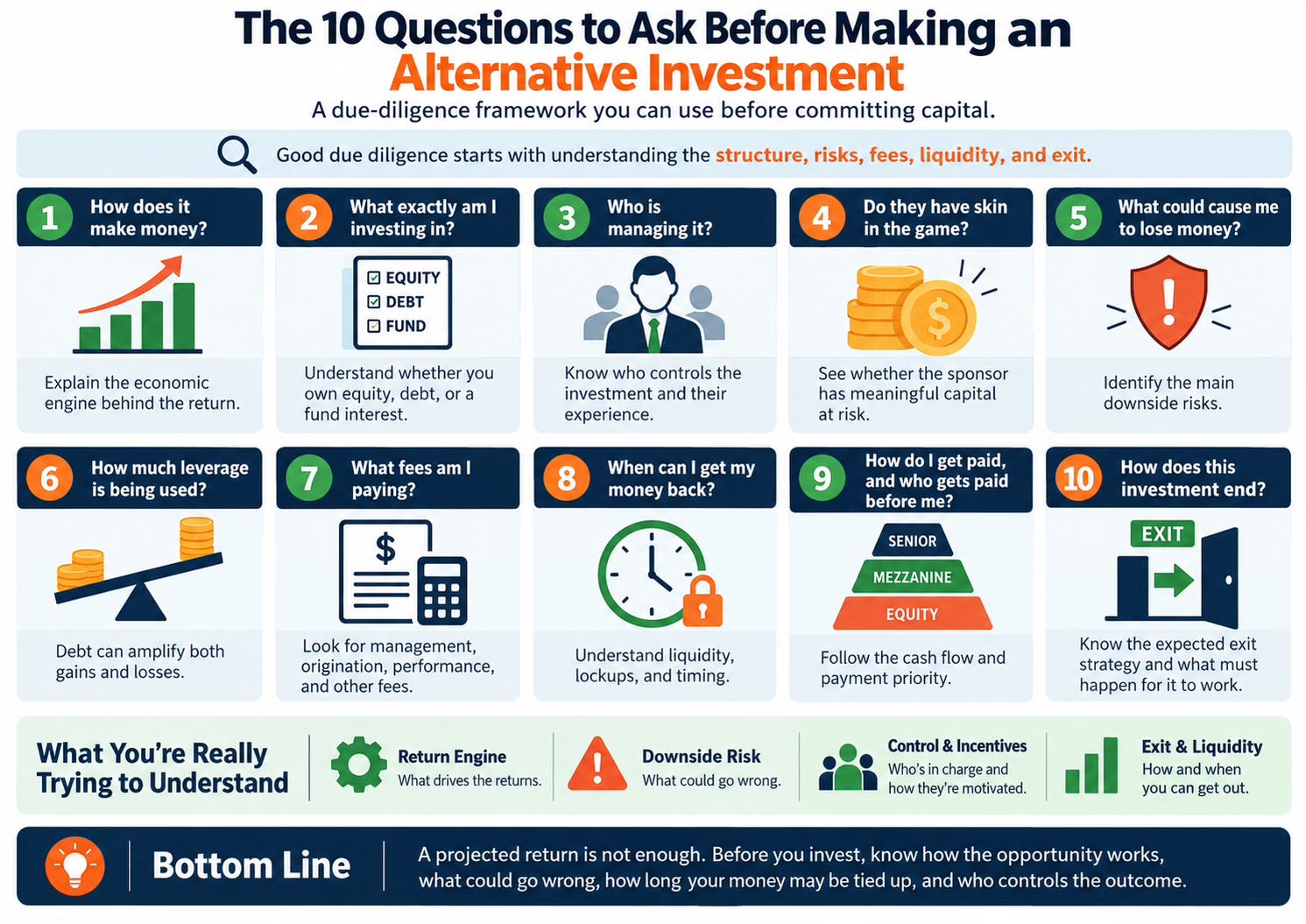
These 10 questions are a good place to start.
1. How Does This Investment Actually Make Money?
Start with the economic engine. Where does your return come from?
If you are investing in private lending, your return may come primarily from interest paid by borrowers. If you are investing in an apartment building, the return might come from rental income, rent growth, debt paydown, and eventually selling the property. A private equity investment may depend on increasing the value of a business over several years and selling it later.
You should be able to explain the source of return in plain English.
If someone tells you the investment is projected to earn 12%, that is not the answer. The question is what has to happen economically for that 12% to exist. Maybe a borrower is paying 12% interest because they need short-term financing. Or a real estate project expects to earn 6% from cash flow and another 6% from appreciation. Maybe a fund is using leverage to increase the potential return.
Those are completely different return engines. The more clearly you understand where the money comes from, the easier it becomes to evaluate whether the projected return makes sense.
2. What Exactly Am I Investing In?
Next, figure out your actual legal and economic position.
Are you lending money directly to a borrower? Are you investing in an LLC that owns a property? Are you buying an interest in a fund that owns dozens of loans? Are you investing in a company that owns operating businesses?
The asset underneath the investment matters, but so does the structure sitting between you and that asset.
Imagine two investors both say they invested in real estate. One owns equity in an apartment building and participates in the property’s income and appreciation. The other made a first-position loan secured by the same property and earns a fixed interest rate.
Both investments are tied to the same building, but they have completely different rights, returns, and risks. This is one of the reasons alternative investments can be confusing. The marketing may focus heavily on the asset, but your actual position may be several layers removed from it.
Before investing, make sure you know what you legally own, what rights come with that ownership, and where you stand if something goes wrong.
3. Who Is Managing the Investment?
The asset matters, but the people running it matter too.
Private investments often rely heavily on a sponsor, fund manager, borrower, or operating team. That group may be responsible for selecting properties, underwriting loans, approving expenses, managing renovations, making distributions, handling defaults, and deciding when to sell.
You want to know who is actually making those decisions.
What experience do they have? Have they managed this type of investment before? How long have they worked together? What happened in their weaker deals, not just their best ones?
Track records deserve some skepticism. A manager may show impressive historical results, but you should understand how comparable those past investments are to the one you are considering now. A sponsor who performed well buying apartments during a strong real estate market may not necessarily have a relevant track record for a ground-up development project. Or a private lender who has made dozens of conservative first-position loans may be entering a different risk category if the new fund starts making junior loans.
Experience matters most when it is relevant.
4. How Much of Their Own Money Is at Risk?
This is sometimes called sponsor alignment or skin in the game.
The idea is simple. If the person managing the investment is asking you to put money at risk, are they taking meaningful financial risk too?
A sponsor who invests alongside investors may have stronger economic alignment because they participate in both the upside and downside. That does not guarantee good decisions, but it gives you useful information about incentives.
The details still matter. If investors contribute $20 million and the sponsor invests $50,000, both parties technically have capital in the deal, but the economic exposure is very different.
You also want to understand whether the sponsor’s compensation comes mostly from the investment performing well or from fees collected regardless of performance. A manager may earn acquisition fees, management fees, loan origination fees, construction fees, asset management fees, or other compensation before investors receive a return.
Again, fees are not automatically bad. You just want to understand whether the manager gets paid primarily for creating investor value, completing transactions, or simply keeping the investment operating.
5. What Could Cause Me to Lose Money?
This may be the most important question on the list.
Do not only ask how the investment works when everything goes according to plan. Ask what happens when it does not.
If you are making a private loan, the borrower could default. The property securing the loan could decline in value. The lender may have to foreclose, and recovery could take longer and cost more than expected.
If you are investing in real estate equity, occupancy could fall, repairs could cost more, rents may not increase, financing costs could rise, or the property might sell for less than projected. Or if you are investing in a private company, revenue may fall, new competitors may appear, financing may become difficult, or the business could simply fail.
You are not trying to imagine every possible disaster. You are trying to understand the investment’s main vulnerabilities. A good investment presentation should make it possible to identify the major ways the thesis could break.
If the entire return depends on one assumption, pay attention to that assumption.
6. How Much Leverage Is Being Used?
Debt can change an investment dramatically.
In a real estate equity deal, leverage allows investors to control a larger property using less equity. That can increase returns when things go well, but it can also increase losses when property values fall.
Suppose investors contribute $4 million toward a $10 million property and borrow the remaining $6 million. If the property rises in value, the equity investors may earn an attractive return on the $4 million they contributed.
But the lender still expects to be repaid regardless of what happens to the equity.
If the property falls from $10 million to $7 million, the lender’s $6 million claim does not disappear. Most of the decline is absorbed by the equity investors.
This is why equity investors should understand the debt sitting ahead of them, including the amount borrowed, interest rate, maturity date, whether the rate is fixed or variable, and what happens if the loan needs to be refinanced. For debt investors, you should understand how much total debt sits against the collateral and whether any other lender has priority over you.
Leverage is not inherently good or bad. It simply changes the amount of room the investment has for things to go wrong.
7. What Fees Am I Paying?
Private investments can have more layers of fees than investors are used to seeing in public-market funds.
You may encounter acquisition fees, origination fees, management fees, servicing fees, disposition fees, performance fees, carried interest, construction management fees, administrative expenses, or other costs.
The first step is identifying every fee.
The second step is understanding when each fee is charged.
Some fees are paid once when the investment begins. Others are charged every year. Some are paid only when the investment generates profits. Others may be earned regardless of whether investors ultimately make money.
You also want to know who receives the fee.
If a sponsor owns the property management company, lending company, or construction company used by the investment, that may create additional compensation streams for related parties. That does not necessarily mean the arrangement is inappropriate. It simply means you need to understand the economics.
Whenever possible, compare investments based on what investors are expected to receive after fees rather than relying only on gross projected returns.
8. When Can I Get My Money Back?
This is the liquidity question, and it is easy to underestimate.
Alternative investments frequently require investors to commit capital for years. A real estate fund may have a five-year term. A private credit fund may limit withdrawals. A direct private loan may keep your principal tied up until the borrower repays it.
The projected term is also not always the actual term. A five-year real estate investment may take six years if the market is weak when the property is supposed to be sold. A borrower may request an extension. A fund may have the right to extend its life under the governing documents. You should understand the lockup period, redemption rules, transfer restrictions, extension provisions, and whether there is any practical secondary market.
Then ask yourself whether the timeframe matches your own needs. An investment may look attractive on paper and still be the wrong fit if you are likely to need the money before the investment ends.
Return and liquidity are both part of the investment.
9. How Do I Get Paid, and Who Gets Paid Before Me?
Understanding the payment order can tell you a lot about risk.
In private lending, lien position determines which lender generally has priority against the collateral. A first-position lender usually gets paid before a second-position lender if the property has to be sold.
In real estate equity, lenders get paid before equity investors. Within the equity structure, there may be preferred returns, return-of-capital provisions, sponsor promote structures, or distribution waterfalls that determine how profits are divided.
You should be able to follow the money.
If the investment generates cash, what happens first? Do lenders get paid? Are management fees deducted? Do investors receive a preferred return? When does the sponsor begin participating in profits?
These structures can look complicated in legal documents, but the underlying question is straightforward.
Where do you stand in line?
An investment may generate plenty of money at the asset level while still producing a disappointing result for a particular investor if too many claims sit ahead of them.
10. How Does This Investment End?
Every investment needs an exit.
For a private loan, the borrower may repay the principal by selling the property, refinancing, using business cash flow, or another source. With real estate equity, the property may eventually be sold or refinanced. As for private equity, the business may be sold to another company, another investor, or potentially taken public. You should understand what the expected exit looks like and what assumptions are required for it to work.
If a real estate investment assumes the property will be sold in five years at a much higher valuation, ask what happens if the market does not support that price. If a borrower expects to refinance a private loan, ask what needs to happen before a bank will approve that refinancing. Or if a fund can extend its term, understand how long your capital could remain committed. The exit is often where projected returns become actual returns.
Until the asset is sold, the borrower repays, or the investment otherwise concludes, much of the projected return may still be theoretical.
Use the Same Questions Every Time
One of the easiest mistakes investors make is changing the standard depending on how attractive an opportunity looks. A projected 15% return appears, and suddenly the due diligence becomes less strict. That is exactly when having a repeatable framework helps.
Ask the same questions whether the investment is projecting 7%, 10%, or 20%. Ask them whether the sponsor is someone you already know or someone you have never heard of. Ask them whether the presentation looks impressive or barely has any design at all.
The point is not to find an investment that has perfect answers. Every investment involves trade-offs. A highly liquid investment may offer a lower return. A higher-return opportunity may require a longer lockup. A conservative first-position loan may pay less than a riskier second-position loan. A real estate equity deal may offer more upside but expose investors to more uncertainty.
What matters is understanding what you are getting in exchange for what you are giving up.
Due Diligence Is Really About Understanding the Story
Most investment opportunities tell a story.
There is an asset, a borrower, a company, or a strategy. Someone believes capital can be put to work in a certain way and eventually produce a return. Your job is to figure out whether that story makes economic sense.
How does the investment make money? What do you actually own? Who controls the decisions? How are they compensated? What could go wrong? How much leverage is involved? What fees come out of the deal? How long is your capital committed? Where do you stand in the payment order? And how does the investment eventually end?
If you can answer those questions clearly, you probably understand the investment far better than someone who only knows the projected return. That is the point of due diligence. Not to eliminate risk, but to understand the risk you are actually taking.
Disclaimer: Beyond Wall Street is published by GoVesty and is provided for educational and informational purposes only. Nothing in this article should be considered investment, financial, legal, tax, or accounting advice, or an offer, solicitation, or recommendation to buy or sell any investment or security. Alternative investments involve risk and may not be suitable for everyone. You should evaluate any opportunity based on your own circumstances and consult with qualified financial, legal, and tax professionals before making an investment decision. GoVesty does not provide investment advice, manage customer funds, or guarantee investment results.