

Private Lending 101: How Investors Become the Bank
A simple look at lending money outside the traditional banking system.
Key Takeaways
Private lending generates returns mainly from interest and, in some cases, loan-related fees.
The quality of the borrower, the loan terms, and the collateral can matter just as much as the interest rate.
A loan being secured by an asset can provide protection, but it does not eliminate the possibility of losing money.
When you put money into a savings account, the bank pays you interest. The bank then uses money from deposits and other sources to make loans to homeowners, businesses, and other borrowers at higher rates.
Private lending takes a similar idea and moves the investor closer to the loan.
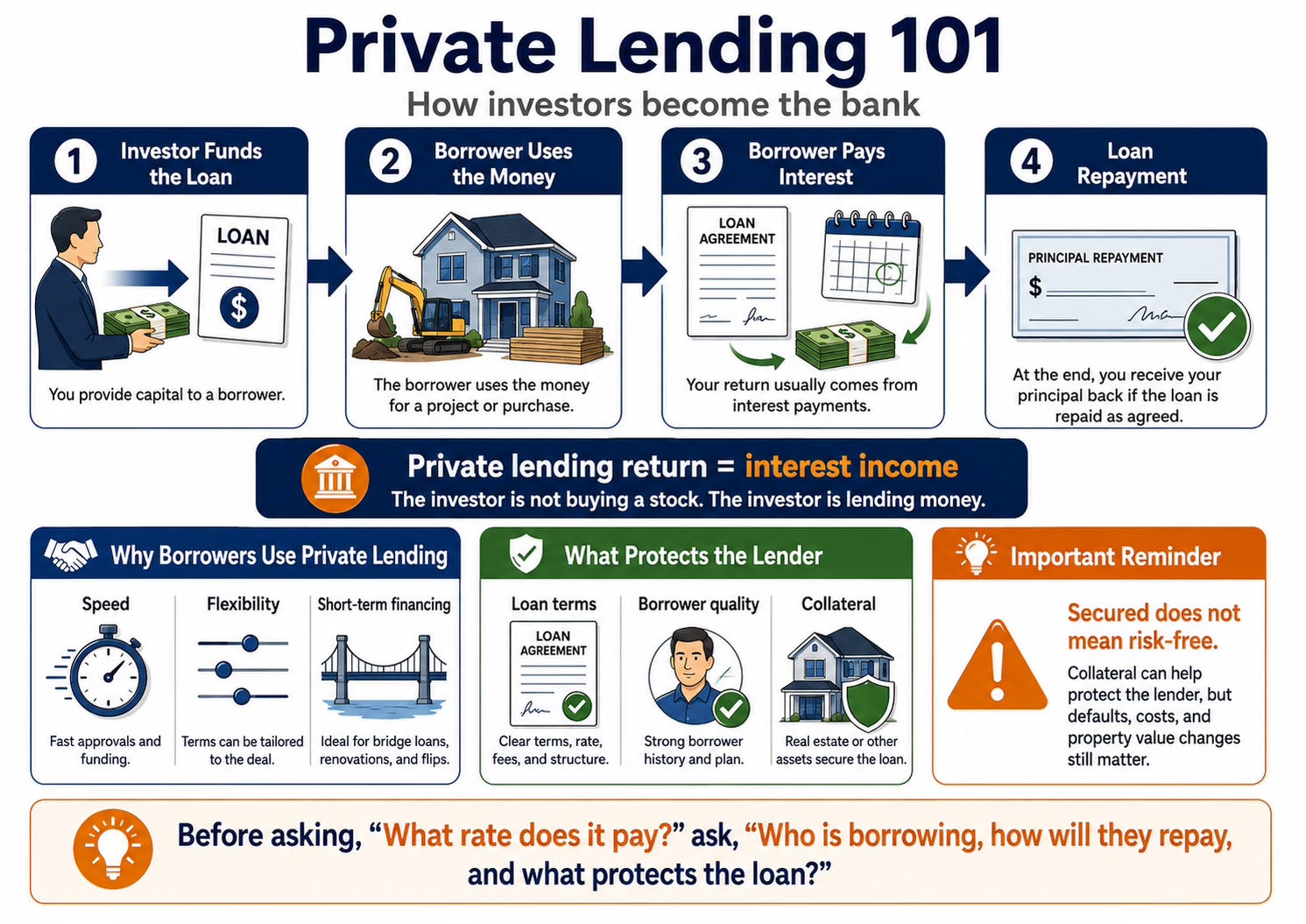
Instead of putting your money in a bank and letting the bank decide where to lend it, private lending allows investors to provide capital outside the traditional banking system. The borrower gets the money they need, and the lender earns interest for providing it.
In simple terms, you are taking on a role that would normally belong to a bank or other lending institution.
That does not mean you are literally becoming a bank. It means your investment return comes from lending money rather than owning a stock, property, or business.
How Private Lending Works
Every private loan starts with two basic parties: a borrower and a lender.
The borrower needs money. Maybe they are buying a property, renovating a building, financing a business, or completing a project. For one reason or another, they decide to borrow from a private lender instead of using a traditional bank loan.
The lender provides the capital. In exchange, the borrower agrees to repay the loan according to a set of terms. Those terms usually include the amount borrowed, the interest rate, the length of the loan, the payment schedule, and what happens if the borrower does not repay the money as agreed.
For example, imagine a real estate investor needs $200,000 to purchase and renovate a property. A private lender agrees to provide the $200,000 at a 10% annual interest rate for 12 months.
If the loan stays outstanding for the full year and the borrower makes all required payments, the lender could earn $20,000 in interest before fees, expenses, taxes, or other costs.
That is the basic economic engine behind private lending. The borrower pays for access to capital, and the lender earns income for providing it.
Why Would Someone Borrow Privately?
A fair question is why a borrower would pay a private lender when banks already exist.
There are a lot of reasons.
Banks tend to have strict lending guidelines. They may require certain credit scores, income documentation, property types, debt ratios, or lengthy approval processes. A loan that makes sense economically may still fall outside a bank’s lending rules.
Speed can also matter. A real estate investor might need to close on a property in two weeks. A traditional bank loan could take much longer. A private lender may be able to review the opportunity and fund the loan faster.
Some borrowers also use private financing for short-term situations. A property investor might borrow money to purchase and renovate a home, then repay the private loan after selling the property or refinancing it with a traditional mortgage.
The borrower may be willing to pay a higher interest rate because the loan solves a specific problem.
This helps explain why private lending can offer investors higher income than some traditional fixed-income investments. The borrower is not necessarily paying more because the loan is automatically riskier. They may also be paying for speed, flexibility, access to capital, or a type of financing a bank does not offer.
Of course, sometimes the higher rate does reflect higher risk. That is why the interest rate by itself does not tell you whether a loan is attractive.
Where the Investor Makes Money
Interest is usually the main source of return in private lending.
A loan might have a fixed annual rate, such as 8%, 10%, or 12%. The borrower may make monthly interest payments, or some of the interest may be paid when the loan is repaid. The exact structure depends on the loan agreement.
Some private loans also include fees. A borrower might pay an origination fee when the loan is created, an extension fee if the loan runs longer than expected, or other charges allowed under the loan documents.
Depending on how an investment is structured, some of those fees may go to the lender, while others may go to the company arranging or managing the loan.
This is why it is worth understanding exactly what a quoted return represents. A 10% interest rate does not necessarily mean an investor will earn exactly 10% after fees and expenses. The timing of payments also matters. If a loan is repaid early, the investor may earn less interest than expected simply because the money was not outstanding as long.
Once again, you want to follow the money rather than just focus on the percentage.
What Protects the Lender?
Private lending becomes especially interesting when the loan is secured by an asset.
Suppose that $200,000 loan is being used to purchase real estate. The lender may require the property to serve as collateral for the loan. Legal documents are recorded that give the lender a claim against the property if the borrower does not repay the debt.
This is where terms such as trust deed, mortgage, lien position, and loan-to-value start becoming important. We will get deeper into those concepts in the next few articles.
For now, the basic idea is that collateral gives the lender something to fall back on if the borrower stops making payments.
That can be very different from making an unsecured loan where there is no specific asset backing the debt.
If a borrower defaults on a properly secured real estate loan, the lender may have the right to take legal action against the collateral and potentially sell the property to recover some or all of the money owed.
That sounds reassuring, but it is important not to confuse collateral with a guarantee.
Secured Does Not Mean Risk-Free
This is one of the easiest mistakes to make with private lending.
Someone hears that a loan is “secured by real estate” and assumes the investment must be safe. Real estate has value, so if something goes wrong, just sell the property and get the money back.
In reality, it may not be that simple.
Property values can decline. The original valuation could have been too aggressive. There may be other loans against the property that get paid first. A foreclosure can take time and cost money. The property may need repairs before it can be sold. Taxes, legal expenses, insurance, and other costs can also reduce what is ultimately available to repay the lender.
This is why the amount of collateral matters, but so do the rest of the loan terms.
Imagine lending $200,000 against a property worth $500,000. That gives the lender a much different cushion than lending $450,000 against the same property.
The property is technically collateral in both situations, but the level of protection is not the same.
We will look at this more closely when we get into lien position and loan-to-value.
The Borrower Still Matters
It is easy to get so focused on the collateral that you forget there is also a borrower on the other side of the loan.
A strong borrower who has experience, sufficient capital, a reasonable plan, and a history of repaying debt may represent a very different risk than someone attempting their first project with very little money of their own invested.
If the loan is for a real estate project, you would want to understand what the borrower plans to do with the property. If they are renovating it, is the budget realistic? If they plan to sell it, is the expected sale price reasonable? If they plan to refinance the private loan, is there a realistic path to getting that new financing?
A lender would rather have the borrower repay the loan normally than rely on the collateral.
Foreclosure is a backup plan, not the business plan.
That is an important way to think about private lending. The property or other collateral can provide protection, but the first source of repayment is usually still the borrower.
Private Lending Can Be Direct or Through a Fund
Not every private lending investment requires you to find a borrower yourself.
Some investors lend directly. They evaluate a specific loan, provide the money, and receive the payments tied to that loan.
Other investors participate through a private credit or lending fund. The fund collects money from multiple investors and uses that capital to make a portfolio of loans. A manager handles the underwriting, loan documentation, servicing, collections, and other parts of the lending process.
The fund approach can spread capital across multiple borrowers instead of having all of your money tied to one loan. The trade-off is that you are also relying on the fund manager to choose and manage those loans well.
Neither structure is automatically better. They simply give investors different ways to participate in private lending.
The Interest Rate Is Only Part of the Story
Private lending can look simple from the outside.
You lend money. The borrower pays interest. You get your principal back at the end.
That is the basic structure, but the quality of the investment depends on everything surrounding those payments.
Who is the borrower? What are they using the money for? How much are they borrowing? What assets secure the loan? How much are those assets actually worth? Are there other lenders ahead of you? How long is the loan? What happens if the borrower needs more time? What happens if they stop paying?
Those questions tell you much more than the interest rate alone.
A 12% loan with weak collateral and an inexperienced borrower may be less attractive than a 9% loan with stronger terms, better collateral, and a borrower with a long track record.
The highest rate is not always the best loan.
Private lending starts to make more sense once you stop looking at it as simply “an investment that pays interest” and start looking at it as an actual loan.
Someone is borrowing your money.
Your job as an investor is to understand why they need it, how they plan to repay it, and what protects you if that plan does not work.
Beyond Wall Street is for educational and informational purposes only. Nothing published here is investment, financial, legal, or tax advice. Private lending and other alternative investments involve risk, including borrower default and possible loss of principal.