

Key Takeaways
Loan-to-value, or LTV, compares the amount of a loan to the value of the property securing it.
A lower LTV usually gives the lender more cushion if the property value falls or the borrower defaults.
LTV is important, but it does not tell you whether the borrower is strong, whether the property value is accurate, or whether the loan is structured well.
If you spend any time looking at trust deed investments or private real estate loans, you are going to hear the term LTV a lot. A loan might be described as 50% LTV, 65% LTV, or 75% LTV. At first, it can sound like just another finance acronym, but the idea behind it is actually pretty simple.
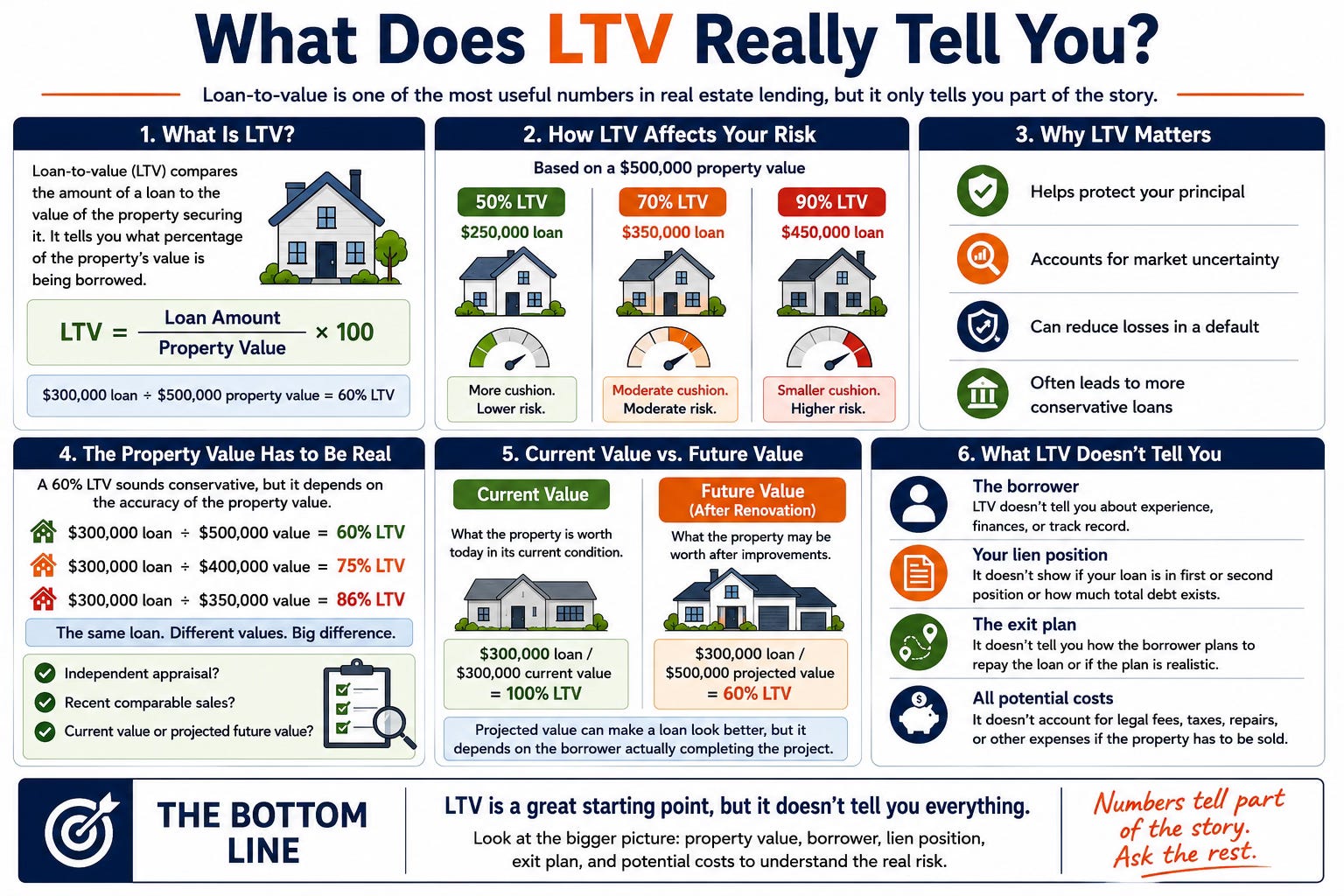
LTV stands for loan-to-value. It compares the amount of money being borrowed with the value of the property securing the loan. That makes it one of the quickest ways to get a sense of how much cushion may exist between the lender’s money and the value of the collateral.
The key word there is may. LTV is useful, but it is not a complete risk score. A low LTV can make a loan look strong even when there are problems somewhere else in the deal. The goal is not just to know how to calculate LTV. You want to understand what the number is actually telling you.
What Is Loan-to-Value?
The calculation is straightforward. You divide the loan amount by the value of the property and turn that number into a percentage.
Imagine a borrower wants a $300,000 loan against a property worth $500,000. The LTV is 60%. That simply means the loan represents 60% of the property’s estimated value. The remaining 40% represents the difference between the property value and the amount being borrowed.
From a lender’s perspective, that difference matters because it can provide some room if the borrower defaults or the property eventually sells for less than expected. The lender does not necessarily need the property to sell for the full $500,000 to recover a $300,000 principal balance. There is a cushion between the amount owed and the estimated value of the collateral.
That cushion is the basic reason lenders pay so much attention to LTV.
Lower LTV Usually Means More Cushion
Consider two properties that are each worth $500,000. The first borrower takes out a $250,000 loan, which gives the loan a 50% LTV. The second borrower takes out a $450,000 loan, which gives that loan a 90% LTV.
Both loans are secured by properties with the same estimated value, but the lenders are not taking the same risk. The lender making the $250,000 loan has much more room for the property value to decline before the principal becomes exposed.
If that $500,000 property eventually sells for $400,000, the $250,000 lender may still have plenty of value available to repay the debt, depending on the costs and other claims involved. A lender who advanced $450,000 against the same property would be in a much different position. A $400,000 sale would not even cover the principal before legal fees, taxes, commissions, property expenses, or other costs are considered.
This is why lower LTV loans are generally viewed as more conservative. There is simply more property value sitting behind the loan.
Think of LTV as a Margin for Error
One of the easiest ways to understand LTV is to think of it as a margin for error.
Real estate values are not fixed numbers. Appraisals can be wrong. Markets can change. Renovations can cost more than expected. Properties can take longer to sell. The eventual buyer may pay less than everyone originally expected.
A lender making a loan at a lower LTV has more room for some of those things to go wrong before the lender starts losing principal. That does not mean a 50% LTV loan cannot lose money. It can. It simply means there is more equity between the loan balance and the property’s estimated value.
That margin can matter quite a bit when a loan goes bad, because recovering money from a property is rarely as simple as selling it at the original appraised value and collecting a check.
The Property Value Has to Be Real
This is where LTV can become misleading. The formula is simple, but the property value being used in the formula has to make sense.
Suppose someone tells you a loan is at 60% LTV. The borrower is taking a $300,000 loan against a property that is supposedly worth $500,000. On paper, that looks pretty conservative.
But what if the property is really worth $400,000? Now the actual LTV is 75%. If the property would realistically sell for only $350,000, the effective LTV is much closer to 86%.
The loan amount never changed. The assumption about the property value did.
That is why one of the first questions you should ask after hearing an LTV is how the property was valued. Was there an independent appraisal? Was the value based on recent comparable sales? Is the number based on today’s condition, or is it based on what the property might be worth after renovations?
Those details can completely change what the LTV means.
Current Value and Future Value Are Not the Same Thing
This issue comes up a lot with real estate projects.
Imagine a borrower buys a run-down property for $300,000 and plans to renovate it. After the work is finished, the borrower believes the property will be worth $500,000. The borrower asks for a $300,000 loan.
If someone calculates the LTV using the projected $500,000 future value, the loan looks like a 60% LTV deal. But based on the property’s current $300,000 purchase price, the loan is much closer to 100% of the current value.
Those are very different situations.
The projected value may turn out to be completely reasonable, but it depends on the borrower finishing the renovation, staying within budget, completing the work on time, and actually achieving that future value. The lender is taking on more than just real estate risk. The lender is also relying on the borrower to execute a business plan.
So when you see an LTV number, make sure you know which value is being used. Current value and projected future value are not interchangeable.
LTV Does Not Tell You Who Is Borrowing
A low LTV can make an investment look attractive very quickly, but it tells you almost nothing about the borrower.
Imagine two borrowers each want a $250,000 loan against a $500,000 property. Both loans are at 50% LTV. The first borrower has completed dozens of similar projects, has strong financial resources, and has a clear plan to repay the loan. The second borrower is doing their first project, has very little cash available, and is depending on nearly everything going right.
The LTV is exactly the same. The loans are not.
This is why collateral is only one piece of private lending. A lender ultimately wants the borrower to repay the loan normally. Taking control of the property is the backup plan, not the goal.
A strong loan ideally has both a reasonable borrower and strong collateral. You do not want the entire investment thesis to depend on one number.
LTV Does Not Tell You Your Lien Position
The previous article covered first position versus second position, and this is another reason you cannot evaluate LTV by itself.
Suppose a property is worth $1 million and already has a $500,000 first-position loan against it. You are considering making a $200,000 second-position loan.
Someone could say your individual loan represents only 20% of the property’s value. Technically, that calculation is true, but it leaves out the $500,000 loan sitting ahead of you.
Once your loan is added, there is $700,000 of total debt against the property. The combined LTV is 70%, and your $200,000 sits behind the first-position lender.
That is much more useful information.
This is especially important for second-position investors. You need to understand how much total debt is against the property, not just the size of your own loan. Your position in the repayment order changes how much of that property value is really available to protect you.
The Cushion Can Shrink Fast
Another common mistake is assuming that if the property value is higher than the loan amount, the lender is fully protected.
Suppose a property is worth $500,000 and the loan balance is $350,000. That is a 70% LTV, which appears to leave a $150,000 cushion.
But if the borrower defaults, that entire $150,000 does not automatically belong to the lender. There could be legal fees, unpaid taxes, insurance costs, maintenance, repairs, commissions, trustee fees, foreclosure expenses, and months of carrying costs. The property may also sell for less than the original valuation.
A cushion can disappear faster than it looks on paper.
That is why experienced lenders often want more room than they think they will actually need. The difference between the loan amount and the property value is not pure profit waiting to protect the investor. It is a buffer that may have to absorb a lot of things before the lender gets repaid.
Is There Such a Thing as a Good LTV?
This is usually the question people want answered. What LTV is considered good?
There is no universal number.
A 60% LTV loan might look conservative in one situation and risky in another. It depends on the property type, the borrower, the market, the condition of the property, the lien position, the purpose of the loan, and how reliable the valuation is.
A stabilized apartment building with steady rental income is different from vacant land. A finished house in a strong neighborhood is different from a half-completed construction project. A first-position loan is different from a second-position loan.
Instead of asking whether a certain LTV is automatically good or bad, it makes more sense to ask whether the LTV fits the risk of that specific loan.
How much could the property realistically fall in value? How easy would it be to sell? How expensive could recovery become? How strong is the borrower? How realistic is the exit plan?
The LTV should make sense when you look at the rest of the deal.
Why Higher LTV Loans May Pay More
Higher LTV loans may come with higher interest rates because the lender is taking on more exposure relative to the value of the property.
If a borrower wants to put less of their own money into a deal and borrow more, that can be attractive from the borrower’s perspective. More leverage means the borrower is using more of the lender’s capital and less of their own.
For the lender, that means the margin for error becomes smaller.
This is another example of why the highest interest rate is not automatically the best investment. A 12% loan may look more attractive than a 9% loan, but if the 12% loan is at 85% LTV while the 9% loan is at 55% LTV, the two returns are compensating investors for very different levels of risk.
The extra return usually comes with something attached to it.
LTV Is a Starting Point
LTV is useful because it gives you a quick way to understand how much debt sits against a piece of real estate. It can help you compare loans, see how much equity cushion may exist, and identify situations where the borrower is using a lot of leverage.
But LTV cannot tell you whether the property value is accurate. It cannot tell you whether the borrower knows what they are doing. It cannot tell you whether you are in first or second position. It cannot tell you how easy the property will be to sell or whether the borrower’s repayment plan makes sense.
Those pieces still have to be evaluated separately.
That is the real lesson behind LTV. The number matters, but what sits underneath the number matters more.
When someone tells you a loan is at 60% LTV, do not stop there. Ask how the property value was determined. Ask whether that is today’s value or a projected future value. Ask how much total debt is against the property. Ask where your lien sits. Ask what could happen to the equity cushion if the borrower defaults and the property has to be sold.
Once you start asking those questions, LTV becomes much more useful. It stops being just another percentage and starts telling you something meaningful about how much room the investment has for things to go wrong.
Beyond Wall Street is for educational and informational purposes only. Nothing published here is investment, financial, legal, or tax advice. Private lending and real estate investments involve risk, including borrower default and possible loss of principal. Property values, appraisals, collateral, lien priority, and loan structures can change and should be evaluated based on the specific transaction.