


Key Takeaways
Income and appreciation are different return engines.
Cash-flow investments can still experience changes in principal value.
Your objective should influence which return profile you prefer.
When people talk about making money on an investment, they often focus on one question: did the value go up? That makes sense when thinking about a stock purchased at $50 and later sold at $75, a piece of land bought for $200,000 and sold for $300,000, or a house that appreciates over time. In each case, much of the return comes from the asset becoming more valuable.
But appreciation is only one way an investment can generate a return. Other investments are designed primarily to produce income while you own them. A rental property may generate rent every month. A private loan may pay interest. A private credit fund may distribute income generated by its loan portfolio. A real estate investment trust (REIT) may distribute a portion of the cash produced by its underlying properties. These investments do not necessarily need their underlying assets to rise substantially in value for investors to make money. Their primary return engine may be the cash they produce along the way.
Understanding the difference clarifies what you are actually expecting an investment to do and explains why two investments that eventually produce the same total return can feel very different to own.
Two Different Return Engines
Income is money produced by an investment while you continue to own it. Depending on the asset, that income might come from rent, interest payments, business cash flow, distributions, royalties, or other recurring sources. Appreciation is the increase in the value of the investment itself. You buy something for one amount and, if things go well, eventually sell it for more.
The distinction sounds simple, but it has important implications. An income-focused investor may receive cash throughout the holding period. An appreciation-focused investor may receive little or nothing until the investment is sold. The first investor begins receiving economic value along the way. The second may have to wait years before knowing whether the expected gain actually materializes.
Neither approach is automatically better. They simply depend on different return engines.
Private credit illustrates the income side clearly. An investor provides capital through a loan or lending vehicle, and the borrower pays interest according to the terms of the loan. Assuming the borrower performs, the investor can receive income without needing the underlying collateral to appreciate. Raw land can sit at the opposite end of the spectrum, producing little or no cash while the investor waits for its value to rise. Both may ultimately produce attractive returns. They get there in very different ways.
Hypothetical Illustration: Same Total, Different Experience
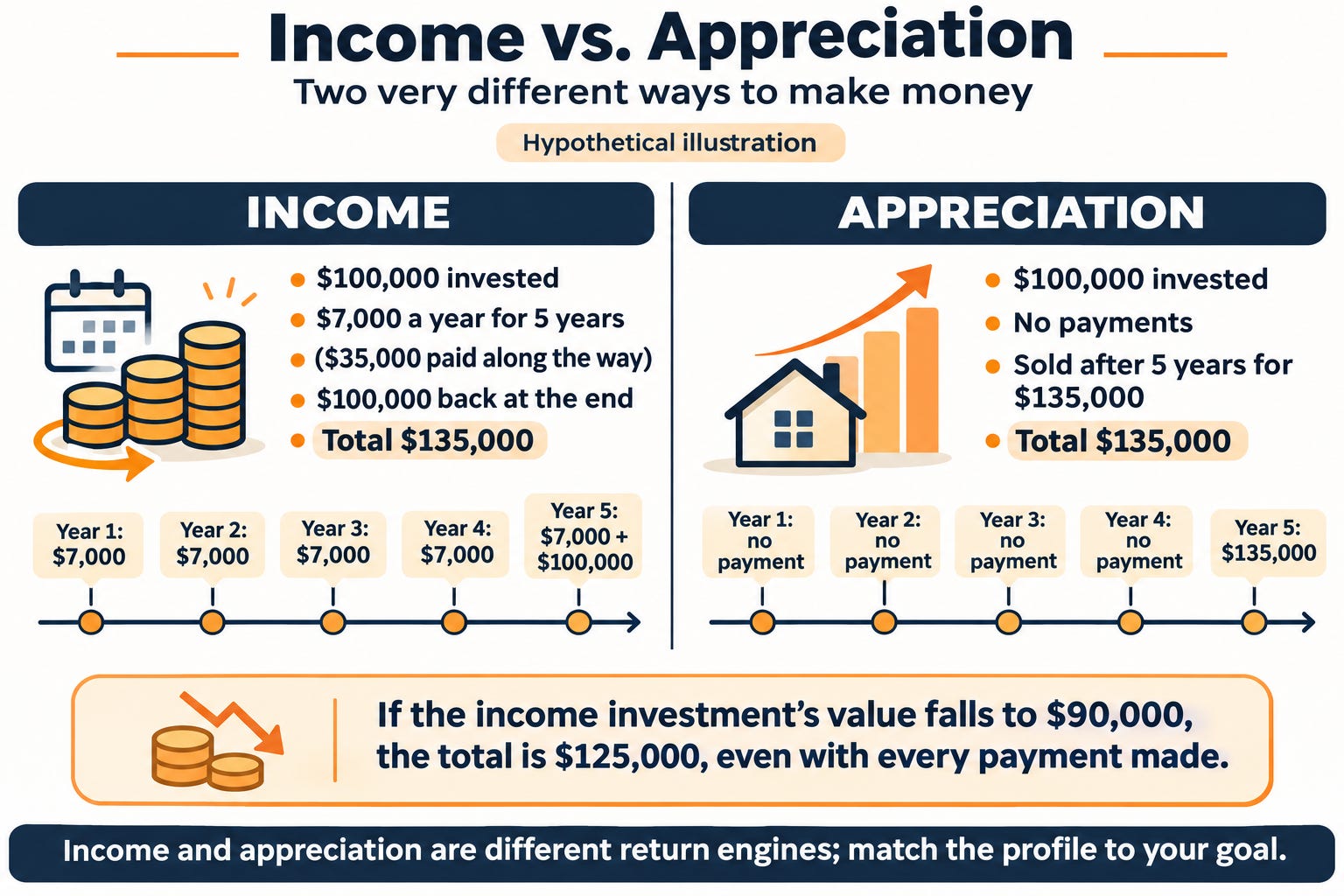
Consider two simplified investments. This example is hypothetical and ignores taxes, fees, inflation, reinvestment, and compounding so we can isolate the difference between income and appreciation. An investor puts $100,000 into an income-focused investment. It distributes $7,000 per year for five years, which produces $35,000 in total distributions. At the end of year five, the original $100,000 is returned. Total value received: $135,000.
Now consider an appreciation-focused investment. The investor again starts with $100,000. This investment produces no distributions during the five-year holding period. At the end of year five, it is sold for $135,000. Total value received: $135,000.
The dollar total is identical, but the experience is not.
The income investor received $7,000 each year. The appreciation investor received nothing during the holding period and depended entirely on the eventual sale price. One investment delivered value gradually; the other concentrated the economic outcome at the end. That difference can affect liquidity, planning, risk tolerance, and how an investor evaluates progress.
Income Does Not Mean Your Principal Is Safe
One of the most important misconceptions about cash-flow investments is that receiving regular distributions means the original investment is stable. It does not. A return on your capital and a return of your capital are separate concepts, and an investment can produce income while the value of the underlying asset falls.
Return to the hypothetical income-focused investment. The investor puts in $100,000 and receives the expected $7,000 annual distribution for five years, totaling $35,000. But imagine that at the end of year five, the underlying investment is worth only $90,000 instead of $100,000. The investor receives $35,000 in distributions plus $90,000 of ending value, for a total of $125,000. Every expected distribution was paid, yet the overall result is $10,000 lower because principal value declined.
The same gap can appear across asset types. A rental property can generate positive cash flow while declining in market value. A private loan can pay interest for several years and still produce a loss if the borrower defaults before repaying principal. A dividend-paying company can continue making distributions while its share price falls.
Cash flow can be valuable, but it should not be confused with preservation of capital.
Rental Real Estate Often Blends Both
Rental real estate is one of the clearest examples of an investment that may combine income and appreciation. A property can generate rental income after operating expenses and debt service. At the same time, the property itself may increase or decrease in value. The investor may receive cash while holding the property, and then potentially realize additional value when the property is refinanced or sold. If rents increase, expenses are controlled, and the property appreciates, both engines can contribute to the overall return.
But they can also move in different directions. A property might generate consistent rental income even during a period when market values decline. Another property might appreciate significantly while producing very little current cash because most available income is being reinvested into renovations, leasing, or debt payments. Calling both “real estate” says little about how each is expected to make money. The business plan matters.
Private Credit Usually Leans Toward Income
Private credit is generally easier to understand through the income lens. An investor provides capital to a borrower, either directly or through a fund or other lending vehicle. The borrower agrees to pay interest and eventually return principal according to the loan terms. The expected return is therefore tied primarily to the borrower’s ability to make payments and repay the loan, not to the loan itself becoming dramatically more valuable. If a $100,000 loan is repaid at $100,000, that does not mean the investment failed to earn anything. The economic return may have come from the interest payments collected throughout the term.
Private credit still has risks. Borrowers can miss payments, collateral values can decline, loans can default, and recoveries can take time, with legal expenses reducing the final result. Interest income does not make those risks disappear. But the primary return engine is usually easier to identify: someone borrowed money and is paying for the use of that capital.
Value-Add Real Estate May Sacrifice Income for Future Value
Some alternative investments deliberately minimize current income because the strategy is focused on creating future appreciation. Consider a value-add apartment investment. A sponsor acquires an existing property and plans to renovate units, improve amenities, increase occupancy, raise rents where supported by the market, and eventually sell or refinance the improved property. During the renovation period, distributions may be limited, because money that could otherwise be distributed may instead be spent improving the property.
The investment thesis is not necessarily “buy this property and collect the existing rent.” It may be “buy this property, improve its operations, increase its income-producing ability, and create a more valuable asset.” That strategy relies more heavily on execution and future value creation. Renovations can cost more than expected, rent increases may not materialize, interest rates may change, and buyers may value the property differently at exit. The potential upside may be greater, but more of the result can depend on what happens later.
Development Deals Push Appreciation Even Further
Ground-up development can move even farther toward the appreciation side. Imagine purchasing land, obtaining approvals, constructing a building, leasing it, and eventually selling the completed project. During much of that process, the investment may produce little or no cash flow. Capital is moving out rather than coming in, funding land, design, permits, construction, and financing costs before the project generates meaningful revenue.
The investment succeeds if the completed asset is ultimately worth more than the total cost and risk required to create it. That can produce strong returns when the plan works, but it also means much of the return is concentrated in future events that have not happened yet.
Land May Depend Almost Entirely on Appreciation
Raw land often produces little or no operating income, and there may be property taxes, maintenance, insurance, or other carrying costs while the investor waits. The thesis may depend on future development, rezoning, population growth, nearby infrastructure, or another buyer eventually valuing the property more highly.
There is nothing inherently wrong with that approach, but investors should recognize what they are buying. If the expected appreciation takes longer than anticipated, there may be no regular cash distributions to compensate the investor during the wait.
Time becomes part of the risk.
Public Markets Use Both Engines Too
This distinction is not unique to alternative investments. Public stocks can produce appreciation when share prices rise, and some companies also pay dividends, creating an income component. Growth stocks may pay no dividends because management reinvests available capital into the business with the goal of increasing the company’s future value. A publicly traded REIT may provide regular distributions generated by property operations while its share price moves up or down in the market. Bonds are typically more income-oriented because investors receive interest and expect repayment of principal, although bond prices can also fluctuate. Alternative assets simply make the difference more visible, because many private investments are explicitly structured around one return engine or the other.
The Timing of Cash Changes the Investment Experience
Receiving $35,000 gradually over five years is different from receiving the entire $35,000 gain in year five, even when we ignore compounding. Cash received earlier provides flexibility: an investor might spend it, save it, or reinvest it.
That can matter when expected timelines change. Suppose a private investment originally expects to sell an asset in five years, but market conditions make year seven more attractive. An income-producing investment may continue generating distributions while investors wait. A pure appreciation strategy may continue producing little or no cash. Neither outcome is necessarily bad, but they create different liquidity experiences. This is why investors should ask not only how much an investment is expected to make, but when they are expected to receive the economic benefit.
Income Has Its Own Risks
Income can feel more predictable because investors see money arriving regularly, and that visibility can create a false sense of safety. Distributions are only sustainable if the underlying economics support them. Rental cash flow depends on occupancy, rent collection, and expenses; private credit income depends on borrowers continuing to pay.
Some investments may even make distributions that are not entirely generated by current operating profits, which means part of what an investor receives could be a return of their own capital. Investors should ask whether distributions are covered by operating income, funded partly from reserves, dependent on borrowed money, or otherwise connected to the capital structure.
A regular payment schedule tells you when money is being distributed. It does not automatically tell you why the money is available.
Appreciation Has Its Own Risks
Appreciation strategies depend heavily on future value. That value may come from genuine improvement, such as renovating a building or increasing operating income, and partly from broader market conditions. Interest rates, investor demand, economic conditions, and construction costs can all shift, and buyers may be unwilling to pay the price originally expected.
When an investment produces little current cash flow, more of the eventual outcome may depend on a successful exit. That makes valuation assumptions particularly important. If a deal’s projected return depends on selling an asset for significantly more than its purchase price, investors should understand why that higher future value is expected.
Appreciation is not something an investment simply receives because time passes.
Many Investments Use Both
Real investments rarely fit perfectly into one box. A private credit fund may collect interest while also buying loans at discounts that create additional upside. A value-add real estate investment may initially focus on appreciation but later generate significant cash flow once renovations are completed.
The question is not whether an investment contains only one return engine. The more useful question is which engine is expected to do most of the work. If most of the projected return depends on distributions, investors should understand how sustainable those distributions are. If most of the return depends on appreciation, investors should understand what is expected to create that additional value. If both matter, each deserves separate analysis.
Taxes Can Treat the Two Differently
Taxes can also make the distinction relevant, although treatment depends heavily on the investment, account type, investor, holding period, legal structure, and applicable tax law. Income from interest, rents, dividends, partnership distributions, and other sources may receive different tax treatment depending on the circumstances, and gains realized when an asset is sold can be taxed differently from recurring income. Private real estate can introduce depreciation, depreciation recapture, and partnership reporting, and tax-advantaged accounts can change the analysis again.
The important point is not that income or appreciation receives universally better tax treatment. There is no single answer that applies to every investor or every investment. Because taxes affect what investors actually keep, it helps to understand the expected return engine first and then evaluate the potential after-tax result with qualified professionals.
Your Objective Changes What Matters
Two investors can look at the same opportunity and reasonably reach different conclusions because they need different things from their capital. Someone seeking current cash flow may value predictable distributions from assets like rental real estate or private credit. Another investor may have little need for current income and prefer long-term growth, where development, value-add real estate, private equity, or land may fit more naturally. A third investor may want both.
The important step is identifying the objective before comparing investments. Otherwise, it is easy to choose an attractive projected return without noticing that its timing or source does not match what the investor actually wants.
Questions to Ask Before Choosing a Return Profile
Start by asking where the projected return comes from. How much is expected from recurring income? How much depends on the asset increasing in value? Are distributions expected immediately, or only after an operating period? Can distributions change? What happens if revenue falls?
For appreciation-focused investments, ask what is supposed to make the asset worth more. Is it physical improvements, higher income, development approvals, market appreciation, or some combination? Then look at the exit. Does the projected return depend on selling the asset? What assumptions are being made about the future sale price? What happens if the investment must be held longer?
Principal risk deserves its own question. Even when an investment pays income, what could cause the underlying investment to lose value? If the asset declines, how much of the income received would offset that loss? Finally, consider timing. When is cash expected to reach the investor, and does that timing match the reason the money is being invested in the first place?
How You Make the Return Matters
Investors naturally focus on how much an investment might earn, but the source and timing of that return can be just as important. An income-focused investment may provide regular cash while its principal value holds steady, rises, or falls. An appreciation-focused investment may provide little current income but create significant value at a future sale. Some investments combine both approaches.
The hypothetical illustration shows why. Receiving $35,000 over five years and then getting $100,000 back is not the same experience as waiting five years to sell for $135,000, even though both total $135,000 before taxes, fees, and inflation. And five years of $7,000 distributions do not guarantee that the original $100,000 remains intact.
Understanding the return engine clarifies what needs to go right, what could go wrong, when cash may arrive, and what risks the investor is actually taking. Not every investment needs to rise in value to make money, but every investment needs a clear explanation of where its return is expected to come from.
Disclaimer: Beyond Wall Street is published by GoVesty and is provided for educational and informational purposes only. Nothing in this article should be considered investment, financial, legal, tax, or accounting advice, or an offer, solicitation, or recommendation to buy or sell any investment or security. Alternative investments involve risk and may not be suitable for everyone. You should evaluate any opportunity based on your own circumstances and consult with qualified financial, legal, and tax professionals before making an investment decision. GoVesty does not provide investment advice, manage customer funds, or guarantee investment results.