


Key Takeaways
Understand exactly what you are buying, owning, or lending against before you spend much time looking at the projected return.
Identify every fee you can find, when it is charged, and who receives it. The headline return and the investor’s actual return may be very different.
Read the risk factors, assumptions, and repayment plan closely. A projection only makes sense if you understand what has to happen for it to become reality.
Alternative investment offerings can look impressive. There may be professional photography, charts showing projected returns, biographies of experienced managers, market research, and pages explaining why a particular opportunity looks attractive.
None of that is necessarily a problem. Investors need information, and a well-organized presentation can make a complicated investment easier to understand. The mistake is assuming the presentation itself tells you whether the investment is good.
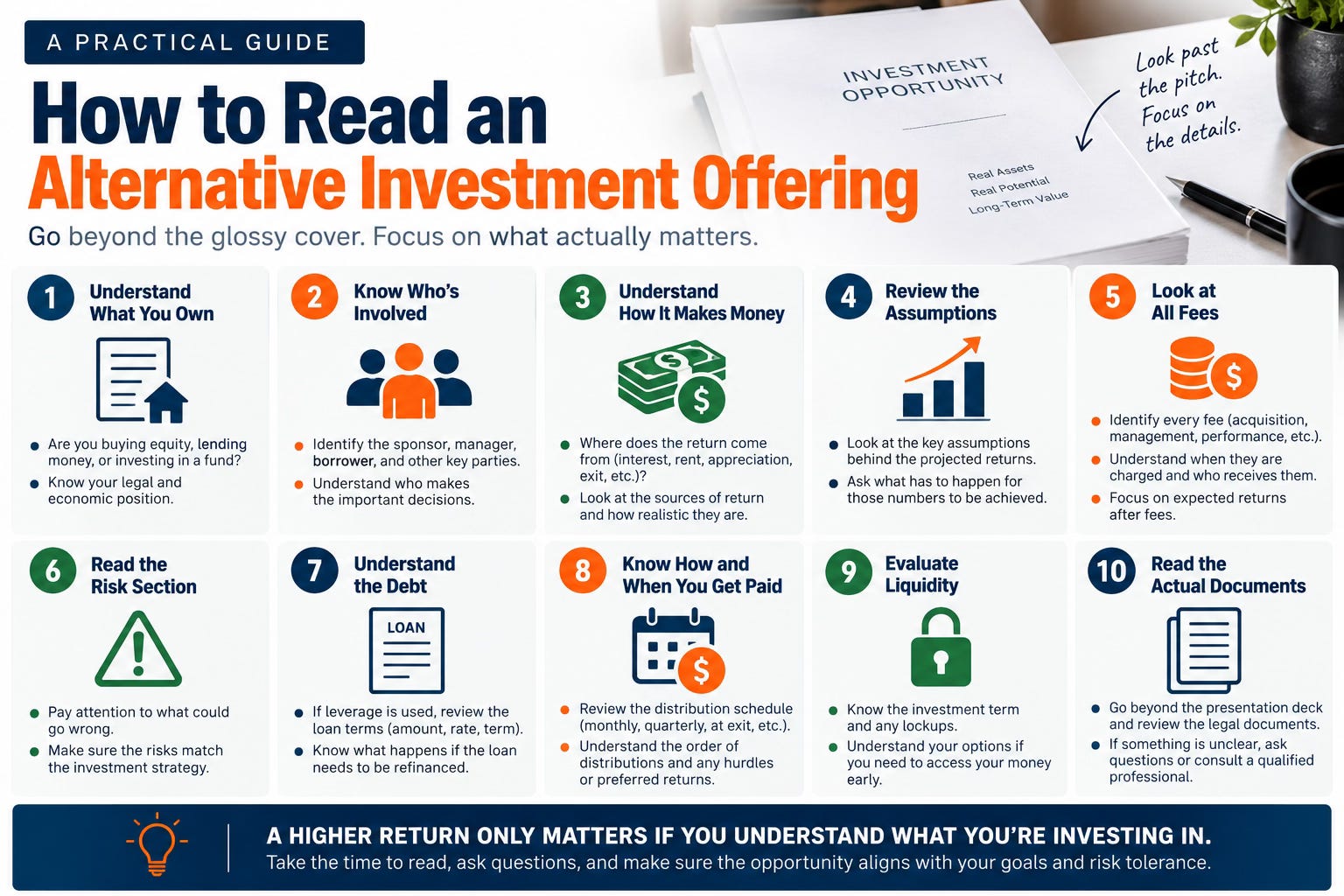
When you review a private real estate deal, private credit fund, trust deed investment, private equity opportunity, or another alternative investment, your job is to look past the presentation and understand what is actually being offered. What are you buying? Who controls the money? How is the investment supposed to make money? What could cause that plan to fail? What fees come out before you get paid? And how do you eventually get your capital back?
Those questions are much more useful than starting with the projected return.
Start With What You Actually Own
One of the first things to figure out is what your investment actually represents. This sounds obvious, but private investment structures can make it surprisingly easy to lose sight of.
Suppose you are looking at a real estate opportunity involving a $10 million apartment building. You might be investing equity into an LLC that owns the property. You might be lending money directly to the property owner. You might be investing in a fund that owns loans made to several different properties. You could even be investing in a company that owns another company that ultimately owns the real estate.
All of those investments can have real estate somewhere underneath them, but your legal and economic position can be completely different.
If you are an equity investor, you may participate in rental income and appreciation, but you also typically stand behind lenders if the property runs into trouble. If you are a lender, you may have a contractual interest rate and potentially a lien against property, but you generally do not participate in the upside the same way an owner does.
Before evaluating anything else, try to answer a very simple question: What exactly am I putting money into?
If you cannot explain that in plain English, you probably need to keep reading.
Figure Out Who Is Involved
The next thing to understand is who is actually running the investment.
Private offerings often involve several different parties. There may be a sponsor, fund manager, borrower, property manager, lender, servicer, custodian, broker, or administrator. Sometimes one company performs several of those roles. Other times the responsibilities are spread across multiple companies.
You want to know who makes the important decisions.
Who decides which properties to buy? Who approves loans? Who controls the bank account? Who decides when an asset gets sold? Who handles a borrower default? Who calculates distributions? Who can extend the investment term?
This matters because you are not just evaluating an asset. You are also evaluating the people responsible for managing it.
A great property can still become a bad investment if it is poorly managed. A lending fund can have attractive underwriting guidelines on paper but still perform poorly if the manager ignores them. The quality of the structure only matters if the people operating it actually follow the structure.
This is also where track record becomes useful, but you have to read it carefully. A sponsor may show impressive historical results, but you want to know whether those results came from the same type of investment, during a similar market environment, and under the same team that will manage your money.
Understand How the Investment Makes Money
Once you understand what you own and who controls it, move on to the return engine.
Where is the money supposed to come from?
If it is a private loan, the answer may be relatively simple. The borrower pays interest, and those payments fund the investor’s return.
If it is an apartment investment, returns may come from rental income, rent increases, expense reductions, debt paydown, and eventually selling the property for more than the purchase price.
If it is private equity, the return might depend on increasing the value of a business and eventually selling it.
The more sources of return an investment depends on, the more assumptions you may need to evaluate.
This is where I would slow down before getting excited about a projected 12%, 15%, or 20% return. Instead of asking whether the number looks attractive, ask what has to happen to produce it.
Does occupancy need to rise from 70% to 95%? Do rents need to increase 20%? Does the property need to sell at a higher valuation five years from now? Does a borrower simply need to make contractual interest payments? Does a company need to double its earnings?
A projected return becomes much more useful when you can see the economic activity underneath it.
Look at the Assumptions Behind the Projection
Alternative investment presentations often contain detailed financial projections. These can be useful, but projections are built from assumptions.
That means you should look at the assumptions before looking at the final return.
Imagine a real estate offering projects a 16% annualized return. That number may depend on the property being purchased for $10 million, renovations being completed for $1 million, rents increasing 15%, occupancy staying above 95%, interest rates remaining manageable, and the property eventually selling for $15 million.
If one or two of those assumptions change, the result may change too.
That does not mean the projection is dishonest. Every financial model has assumptions. The important question is whether those assumptions seem reasonable.
Look at what the investment needs to accomplish rather than simply what management says it expects to accomplish.
If an offering assumes rents will grow much faster than the surrounding market, ask why. If the exit value depends on selling the property at a very aggressive valuation, understand what would happen if that valuation is lower. If the investment uses debt, look at what happens if interest rates are higher when the loan needs to be refinanced.
A good model should help you understand the investment. It should not replace your judgment.
Fees Deserve Their Own Review
Fees are one of the easiest things to overlook because they are rarely as exciting as the projected return.
Private investments can have acquisition fees, origination fees, management fees, servicing fees, asset management fees, disposition fees, construction management fees, performance fees, carried interest, administrative fees, or other expenses depending on the structure.
Not every fee is unreasonable. Managing investments costs money, and people performing real work should expect to be compensated. The issue is understanding how much is being charged and whether the incentives make sense.
Start by asking who receives each fee and when they receive it.
A sponsor paid heavily when a property is purchased may have a different incentive from one that earns most of its compensation only after investors receive a certain return. A lending manager paid an origination fee when a loan is made may have an incentive to make more loans. That does not automatically mean they will make bad loans, but the compensation structure is worth understanding.
Also determine whether projected returns are shown before or after fees.
A deal projecting 12% before fees may deliver something very different to the investor if several layers of expenses come out along the way. Whenever possible, focus on what investors are expected to receive after the investment-level fees have been considered.
Read the Risk Section Even Though It Is Boring
Risk disclosures are rarely the most exciting part of an investment offering.
They may be long. They may sound repetitive. Some of the risks may seem obvious. It is tempting to skim them and move on to the charts showing potential returns.
That is often the wrong instinct.
The risk section can tell you what the people offering the investment believe could realistically go wrong. It may discuss property value declines, borrower defaults, leverage, interest rates, construction problems, lack of liquidity, conflicts of interest, regulatory risks, concentration, limited operating history, or the possibility of losing your entire investment.
Some risk disclosures are broad legal language. Others point directly at issues that are central to the deal.
Pay special attention when a risk connects directly to the investment’s main source of return.
If a deal depends on refinancing in three years, refinancing risk matters. If the plan depends on selling a property, market value and liquidity matter. If a private lender depends heavily on one borrower, borrower concentration matters. If investors cannot redeem their money for five years, liquidity risk matters.
The risks should make sense when compared with the investment strategy.
Understand the Debt
If an investment uses leverage, you should understand the debt even if you are investing in the equity.
How much is being borrowed? What is the interest rate? When does the loan mature? Is the rate fixed or variable? Are there extension options? What happens if the property cannot refinance when the loan comes due?
Debt can improve equity returns when things go well because investors are controlling a larger asset with less equity. It can also increase losses when things go badly.
Suppose investors put $4 million into a property and borrow another $6 million. If the property’s value rises, the equity investors may benefit significantly because they only contributed part of the purchase price.
But if the property declines in value, the lender still expects to be paid. The equity investors absorb the decline first.
This is why you should not read an equity offering without understanding the debt sitting ahead of the equity.
Know How and When You Get Paid
A projected return is not the same thing as cash in your account.
Look at how distributions actually work.
Does the investment expect to pay monthly, quarterly, annually, or only when an asset is sold? Are distributions required or made at the manager’s discretion? Can income be retained inside the investment instead of distributed?
You should also understand the order in which money gets distributed.
Some deals use a distribution waterfall. Investors may receive a preferred return first, followed by a return of capital, with additional profits then split between investors and the sponsor according to a formula.
Those structures can be perfectly reasonable, but they can also become complicated quickly.
The key is being able to follow the money. If the investment generates $1 million, who gets paid first? Who gets paid second? When does the sponsor start participating in profits? What expenses come out before distributions?
If you cannot follow the cash through the structure, keep digging.
Pay Attention to Liquidity
Private investments often require you to commit money for a long time.
A five-year projected investment term does not necessarily mean you can request your money back in exactly five years. The property may take longer to sell. A fund may extend its term. A borrower may need an extension. Market conditions may make an exit unattractive.
Look for language describing lockups, redemption rights, transfer restrictions, extension provisions, and secondary-market limitations.
Ask yourself a practical question: What happens if I need this money sooner than expected?
If the answer is that there is no practical way to access it, that does not automatically make the investment bad. It means you should only invest capital you can realistically leave committed for that period.
Liquidity is part of the investment return whether it appears in the projected percentage or not.
Understand Conflicts of Interest
Private investment structures often create situations where the manager has responsibilities to multiple parties.
A sponsor might own the property management company. A lending fund might make loans to companies affiliated with the manager. A sponsor may earn fees when buying, managing, financing, and eventually selling an asset.
These relationships are not automatically inappropriate. In some cases, having services handled internally can make an investment more efficient.
But you should know they exist.
Look for disclosures explaining related-party transactions and conflicts of interest. Ask how fees are set, whether transactions are conducted at market rates, and who has the authority to approve them.
The goal is not to assume everyone has bad intentions. The goal is to understand where incentives may not perfectly align with yours.
Read the Actual Documents
A presentation deck is useful, but it may not be the document that legally controls the investment.
Depending on the opportunity, you may also receive an offering memorandum or private placement memorandum, operating agreement, subscription agreement, promissory note, deed of trust, fund documents, or other legal materials.
These documents can be dense, but they often contain details that do not fit neatly into the marketing presentation.
You may discover that the manager can extend the investment term. You may find restrictions on transferring your ownership interest. You may learn how voting rights work, what happens if additional capital is needed, or how the manager can be removed.
You do not necessarily need to become a securities attorney to read an investment offering, but you should understand which documents actually govern your investment.
If something important is unclear, that is a good time to involve a qualified professional.
Work Backward From the Downside
One useful way to review an offering is to stop asking what happens if everything goes right and ask what happens if something goes wrong.
Suppose the property does not appreciate. Does the investment still generate income?
What if rents do not increase?
What if the borrower needs another year to repay?
What if refinancing rates are much higher?
What if the property sells for the same price it was purchased for?
What if you need your money back early?
You are not trying to predict every possible problem. You are trying to understand how much of the projected return depends on things going exactly according to plan.
The more assumptions an investment needs to hit perfectly, the more fragile the projection may be.
Build Your Own Simple Version of the Deal
After reading the materials, you should be able to explain the investment without using the sponsor’s presentation.
For example:
“I am investing equity into an LLC that will own a $20 million apartment building. Investors are providing $8 million, and the property will have $12 million of debt. The plan is to renovate the property, increase rents, distribute available cash flow, and sell it in about five years. Investors receive a preferred return before the sponsor participates in additional profits. My money is not liquid during the investment period.”
That simple explanation tells you far more than saying, “It is a real estate investment targeting 15%.”
If you cannot explain the investment simply after reading the materials, you may not understand it well enough yet.
Start With the Deal, Not the Return
Alternative investment offerings can be complicated because there are more moving parts than many investors are used to seeing in a brokerage account.
That is not necessarily a bad thing. One of the advantages of private markets is that investments can be structured around specific assets, borrowers, businesses, and opportunities. But that flexibility also means investors need to pay closer attention to the details.
Start with what you own. Understand who controls the investment and how that person gets paid. Follow the money to see where your return is supposed to come from. Examine the assumptions behind the projections, the debt, the fees, the liquidity restrictions, and the major risks. Then look at how your capital eventually gets returned.
Once you understand those pieces, the projected return becomes much easier to evaluate because you know what has to happen to produce it.
The glossy cover can tell you what the opportunity is supposed to look like.
The structure tells you what you are actually investing in.