

Key Takeaways
Both bonds and private credit are forms of debt investing. In each case, you are providing capital with the expectation of receiving interest and getting your principal back.
Private credit is usually less liquid and more individually structured than publicly traded bonds. The loan terms, collateral, borrower, and repayment plan can vary significantly from one deal to another.
Comparing the interest rate alone misses the point. You also need to understand liquidity, collateral, repayment priority, underwriting, fees, and what happens if the borrower cannot repay.
At first glance, private credit and bonds can look pretty similar. In both cases, you are lending money rather than buying ownership in a company or property. The borrower gets capital, agrees to pay interest, and is expected to return your principal at some point in the future.
That basic structure is the same. What changes is everything around it.
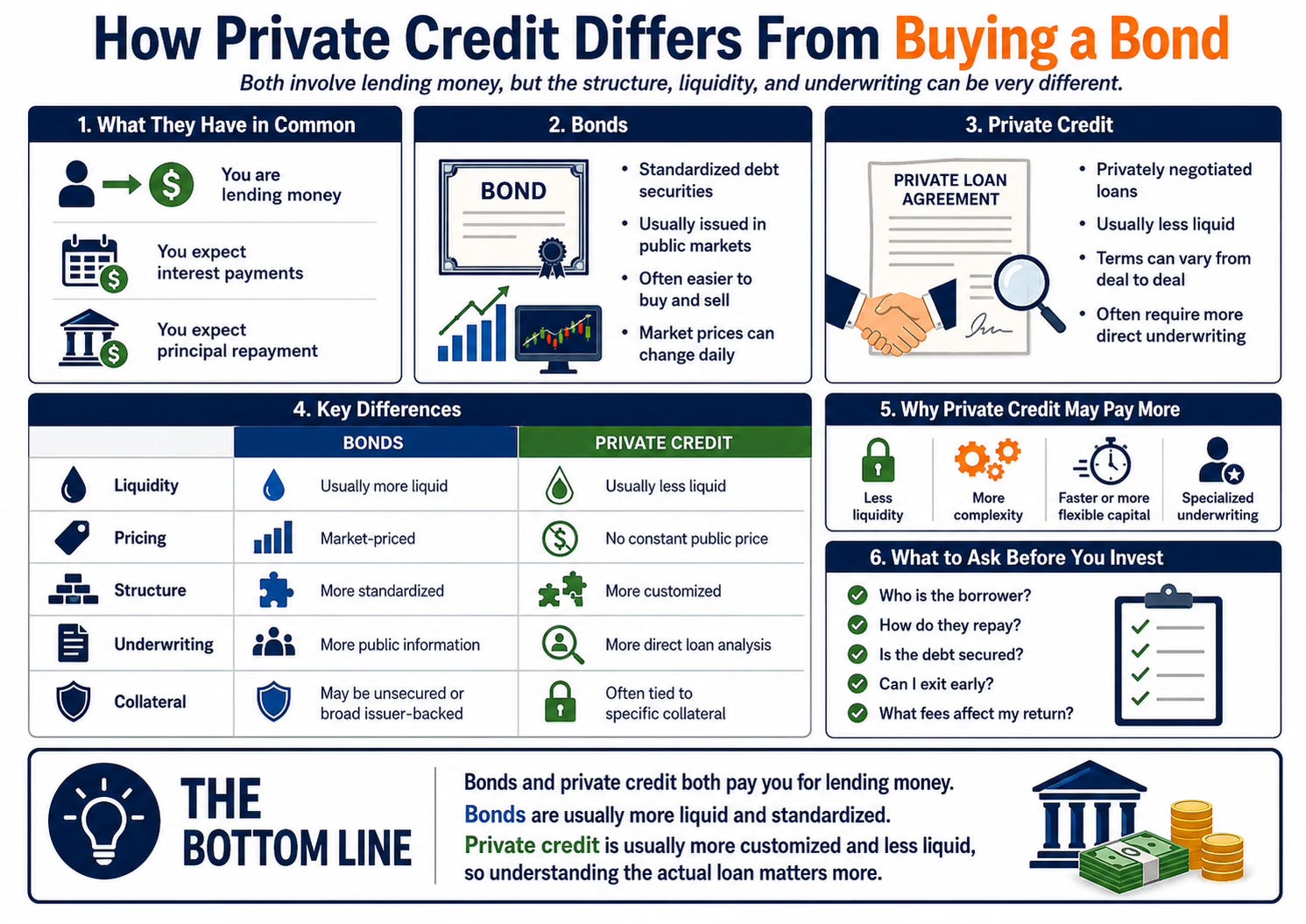
A bond is usually a standardized debt instrument issued by a corporation, government, municipality, or other organization. Private credit is generally a loan or debt investment negotiated outside the public markets. That difference affects how the investment is priced, how easily you can sell it, how much information you receive, what protections may be included, and how much work goes into evaluating the borrower.
So while both investments fall on the debt side of the investing world, owning a bond and participating in a private loan can be very different experiences.
Start With What They Have in Common
Whether you buy a bond or invest in private credit, you are primarily acting as a lender.
You are not buying a piece of the borrower’s business in the same way a stockholder does. You are providing capital under an agreement that says the borrower owes you money. In return, you generally expect interest payments and repayment of principal.
Suppose a company needs $10 million. It might raise that money by issuing bonds to investors. Those investors buy the bonds, collect interest according to the terms, and expect to receive their principal when the bonds mature.
A private company or real estate investor might also need $10 million, but instead of issuing bonds into the public market, it may borrow from a private credit fund or group of private lenders. Those lenders also expect interest and repayment of principal.
The economic idea is similar. The borrower needs capital, and the investor gets paid for providing it.
Where things start to separate is in how those loans are created and traded.
Bonds Are Usually More Standardized
Public bond markets are built around securities that can be bought and sold among investors. A corporate bond may have a stated face value, maturity date, interest rate, credit rating, and other terms that investors can review before buying it.
Because many bonds are issued into established markets, investors can often compare one bond with another fairly quickly. They may look at the issuer, maturity, yield, credit rating, and current market price and decide whether the bond fits their portfolio.
Private credit tends to be much more deal-specific.
One private loan might be secured by an apartment building. Another might finance equipment for a business. Another might provide working capital to a company that does not qualify for traditional bank financing. The interest rate, repayment schedule, collateral, covenants, fees, and maturity can all be negotiated around the particular transaction.
That flexibility is part of what makes private credit interesting. It also means you usually need to understand more than a ticker symbol, credit rating, or quoted yield.
You need to understand the actual loan.
Private Credit Is Usually Less Liquid
Liquidity is one of the biggest differences between the two.
Many publicly traded bonds have a secondary market. That does not mean every bond can be sold instantly at the price you want, but there is generally a market where investors can attempt to buy and sell them before maturity.
Private credit often does not have that kind of market.
If you invest in a 24-month private loan, you may need to wait until the borrower repays the loan before you receive your principal back. If you invest through a private credit fund, there may be lockup periods, redemption restrictions, or limits on when you can withdraw your money.
In some cases, you might be able to sell your interest to another investor, but that does not mean there will be a buyer waiting for you or that you will receive the price you want.
This lack of liquidity is not automatically bad. An investor who does not need the money for several years may be comfortable giving up liquidity in exchange for other characteristics of the investment.
But it is a real trade-off.
A 10% private credit investment that locks your money up for three years is not the same as a bond yielding 7% that you may be able to sell next month. The higher rate does not exist in a vacuum. Part of the difference may be compensation for giving up access to your capital.
Pricing Works Differently
Public bonds have market prices that can change as interest rates, credit conditions, and investor demand change.
Suppose you buy a bond paying 5% interest. Later, newly issued bonds with similar risk begin paying 7%. Your 5% bond becomes less attractive, so its market price may fall if you try to sell it before maturity.
The borrower may still be making every payment exactly as promised, yet the value of your bond can move because the market around it has changed.
Private credit does not usually have a constantly quoted market price.
If you make a private real estate loan at 10%, you may simply receive the agreed interest payments while the loan remains outstanding. You probably will not open an app every morning and see that your loan is suddenly worth 97 cents on the dollar or 103 cents on the dollar.
That can make private credit feel less volatile because there is no public price flashing on a screen every day. But the absence of a constantly changing market price does not mean the risk disappeared.
The borrower’s financial condition can still change. The collateral can decline in value. The borrower can miss payments. The loan can become more or less risky even if there is no public market showing you a new price every afternoon.
No daily price does not mean no risk.
Underwriting Matters More in Private Credit
Public bond investors often have access to standardized financial information, credit ratings, regulatory filings, analyst research, and market pricing. None of those things guarantee that a bond is safe, but they give investors a fairly established set of information to work with.
Private credit requires a different type of evaluation.
If you are considering a loan secured by real estate, you may want to understand the borrower, the property value, the loan-to-value ratio, the lien position, the borrower’s experience, the use of the money, and the plan for repaying the loan.
If you are lending to a business, you may want to look at revenue, cash flow, existing debt, assets, operating history, and whether the company can realistically make the required payments.
This process is called underwriting.
In private credit, the quality of the underwriting can be a major part of the investment. There may not be a public credit rating you can lean on. Someone has to decide whether the borrower deserves the loan and what terms make sense for the risk being taken.
That makes the experience and discipline of whoever is making those decisions especially important.
Collateral Can Play a Bigger Role
Some bonds are secured by assets, but many investors are familiar with corporate bonds that depend largely on the financial strength of the company issuing them.
Private credit frequently puts more emphasis on specific collateral.
A private real estate loan might be secured by a deed of trust against a particular property. An equipment loan might be secured by the machinery being financed. Other loans may have claims against business assets, receivables, or other forms of collateral.
This can give the lender another potential source of recovery if the borrower cannot repay normally.
As we have already seen with trust deeds, lien position, and LTV, the word “secured” only gets the conversation started. You still need to know what the collateral is worth, how much debt sits ahead of you, how easily the asset could be sold, and how much recovery might cost.
Still, private credit can allow investors to see much more clearly what stands behind a specific loan.
Instead of simply knowing that a company owes you money, you may be able to identify the exact property or assets securing that debt.
Private Loans Can Be Built Around the Deal
One of the biggest differences between private credit and public bonds is flexibility.
Public bonds are usually issued with terms designed for a broad group of investors. Once issued, an individual investor generally does not get to negotiate a different maturity date, additional collateral, or a special repayment requirement.
Private loans can be much more customized.
A lender might require a certain amount of borrower equity. The loan could include limits on additional borrowing. The borrower might have to maintain insurance, meet financial targets, provide regular reporting, or get approval before making certain changes.
These requirements are often called covenants.
The lender may also negotiate what happens if the borrower needs an extension, misses a payment, sells the collateral, or violates part of the agreement.
That ability to structure the deal can be valuable. Rather than simply deciding whether to buy an existing security, a private lender may have more influence over the protections built into the investment from the beginning.
Of course, those protections are only useful if they are properly documented and enforced.
Why Might Private Credit Pay More?
Private credit often gets attention because the potential income can be higher than what investors see from many traditional bonds.
There are several reasons for that.
The investor may be giving up liquidity. The borrower may need money quickly. The loan may require specialized underwriting. The borrower may not fit a bank’s lending criteria. The transaction may be too small or unusual for the public bond market. The lender may also be taking on more credit, collateral, or execution risk.
In other words, the borrower may be willing to pay more because private capital is solving a problem that cheaper financing cannot solve as easily.
This does not mean every private credit investment should pay more than every bond. It means there are economic reasons why certain private loans can carry higher interest rates.
The important question is whether the additional return adequately compensates you for the additional risk, complexity, and lack of liquidity.
That is a much better question than simply asking which investment has the higher yield.
Transparency Is Different Too
Public bond issuers often operate within established disclosure and reporting systems. Depending on the type of bond, investors may have access to financial statements, offering documents, ratings, market data, and ongoing information about the issuer.
Private credit information is usually distributed differently.
You may receive financial information directly from the borrower or investment manager. A private fund may provide quarterly updates. A real estate lender may receive property reports, payment histories, appraisals, or borrower financial statements.
The information can actually be very detailed, but it is not necessarily available to the general public.
That means investors have to pay attention to what information they will receive after investing, not just what they receive before the loan closes.
If the investment lasts three years, how will you know how the borrower is doing during those three years? Who monitors the loan? How often are property values or financial conditions reviewed? What happens when a payment is late?
Private investing requires you to think about ongoing monitoring, not just the original investment decision.
One Is Not Automatically Better Than the Other
It would be easy to turn this into an argument that private credit is better than bonds, or that bonds are safer and therefore better.
That misses the point.
They solve different problems.
Public bonds can provide income, diversification, transparent pricing, and more liquidity. Private credit can provide access to loans and structures that do not exist in public markets, potentially higher income, more customized protections, and exposure to different borrowers and assets.
Each comes with trade-offs.
An investor who needs daily liquidity may prefer public bonds. Someone willing to commit capital for several years may be comfortable considering private credit. An investor who wants a highly diversified bond fund may not want to analyze individual loans. Another investor may specifically want to understand the collateral and structure behind each investment.
The right comparison is not simply private versus public.
It is what you are getting in exchange for what you are giving up.
Look Beyond the Interest Rate
Suppose you are comparing a bond yielding 6% with a private credit investment paying 10%.
The easy conclusion is that the private loan pays four percentage points more.
But that does not tell you whether it is the better investment.
How long is your money committed? What is the borrower’s financial condition? Is the debt secured? Where does the loan sit in the capital structure? What fees reduce your actual return? Can you sell the investment if you need cash? How is the loan monitored? What happens if the borrower defaults?
Once you ask those questions, you are no longer comparing two percentages.
You are comparing two different lending structures.
That is really the lesson here.
A bond and a private credit investment can both pay you for lending money, but the path between your investment and your eventual return can look very different.
Public bonds tend to give investors more standardization, market pricing, and liquidity. Private credit tends to offer more customized structures and direct underwriting, often in exchange for less liquidity and more responsibility for understanding the underlying loan.
Neither label tells you whether the investment is good.
You still have to understand who owes you money, why they borrowed it, what they have promised to pay, what protects you if they cannot, and how easily you can get your capital back.
Once you understand those pieces, the difference between private credit and buying a bond becomes much clearer.