

3 Takeaways
A first-position lender generally has the first claim on a property if the borrower defaults and the property has to be sold.
A second-position lender gets paid only after the first-position lender has been satisfied, which can create more risk if there is not enough property value to cover both loans.
Simply knowing that a loan is “secured by real estate” is not enough. You also need to know where that loan sits in the repayment order.
In the last article, we talked about trust deed investments and how real estate can be used as collateral for a private loan. That seems pretty straightforward when there is only one loan against the property. Things get more interesting when the same property has two or more loans attached to it, because those lenders do not all have the same claim.
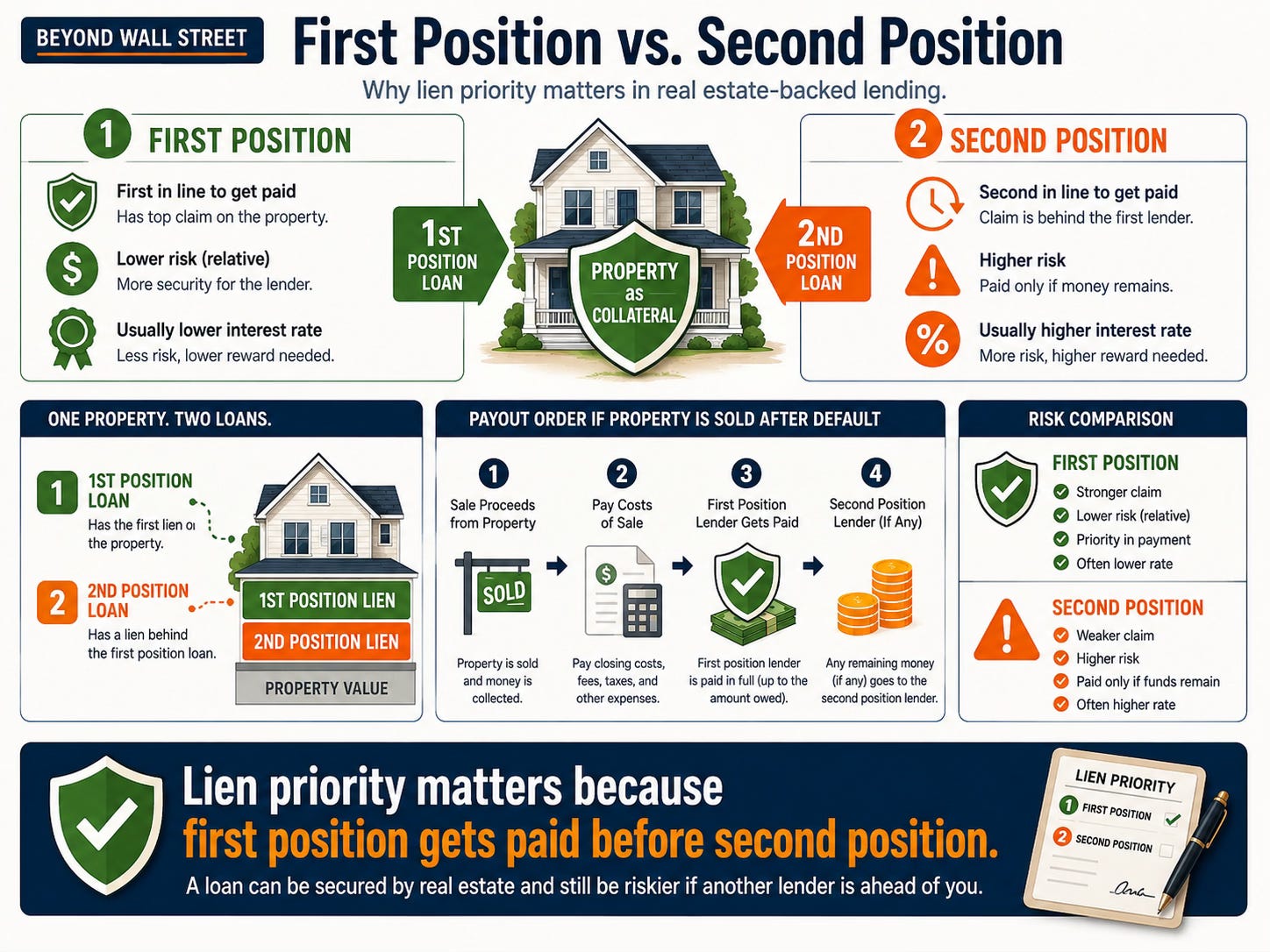
This is where lien position comes in. A lender can be in first position, second position, or sometimes even further down the line. That position determines who generally gets paid first if the borrower defaults and the property eventually has to be sold. It may sound like a small legal detail, but it can have a major impact on how much risk a lender is actually taking.
What Does “Position” Actually Mean?
When a loan is secured by real estate, a lien is generally recorded against the property. That lien gives the lender certain legal rights connected to the property if the borrower does not repay the debt as agreed. If there is only one loan, there may not be much confusion about who has the strongest claim. When multiple loans exist, the order of those liens becomes much more important.
Imagine a property already has a $300,000 loan against it. The owner later needs another $100,000 and borrows from a second lender. The original lender may hold the first-position lien, while the new lender holds the second-position lien. Both loans are secured by the same property, but they are not equally protected because the first lender generally has priority over the second.
That priority becomes most important when something goes wrong. If the borrower keeps making payments and eventually repays both loans, lien position may never become an issue. But if the borrower defaults and there is not enough money to repay everyone, the order suddenly matters a lot.
Why First Position Is Usually Stronger
First position generally gives the lender the strongest claim against the property. If the property has to be sold after a default, the first-position lender usually gets paid before the second-position lender, subject to applicable taxes, costs, other claims, and local law. That does not guarantee the first lender will recover every dollar, but it puts that lender ahead of anyone sitting behind them.
Suppose a property sells for $400,000 after a default. The first-position lender is owed $250,000 and the second-position lender is owed $75,000. If there is enough money left after foreclosure expenses, taxes, selling costs, and other obligations, both lenders may be paid in full. If those expenses are higher than expected or the property sells for less, the first lender still gets paid first and the second lender becomes more exposed to a loss.
That is the basic reason first-position loans are generally considered less risky than second-position loans secured by the same property. The lender is closer to the front of the repayment line. There is simply less debt standing between that lender and the value of the collateral.
Second Position Is Not Automatically a Bad Investment
It would be easy to look at this and assume first position is always good and second position is always bad. That is too simple. A second-position loan can still have a meaningful amount of protection if there is enough equity in the property.
Imagine a property worth $1 million with a $300,000 first-position loan. A second lender provides another $100,000. The total debt is now $400,000 against a property believed to be worth $1 million. Even though the second lender sits behind the first, there is still a significant amount of property value supporting both loans.
Now change the numbers. The property is still worth $1 million, but the first-position loan is $750,000 and the second-position lender adds another $200,000. The second lender is still technically secured by the property, but there is far less room for anything to go wrong. A decline in property value, foreclosure costs, unpaid taxes, or selling expenses could quickly reduce or eliminate the amount available to repay that second loan.
This is why lien position should never be evaluated by itself. You also need to understand how much total debt is against the property and how much value is believed to remain after the loans ahead of you are considered.
Follow the Money After a Default
One of the easiest ways to understand lien priority is to walk through what could happen if a property has to be sold. Suppose a property sells for $500,000 after the borrower defaults. The first-position lender is owed $350,000 and the second-position lender is owed $125,000, so the combined loan balance is $475,000.
At first glance, it looks like there should be enough money to repay both lenders. But distressed properties can come with expenses. There may be foreclosure costs, legal fees, unpaid property taxes, repairs, commissions, insurance costs, or other claims. If those expenses total $50,000, only $450,000 remains to repay the lenders.
The first-position lender receives its $350,000. That leaves $100,000 for the second-position lender, even though that lender is owed $125,000. The second lender would be short $25,000.
This example is important because the property technically sold for more than the combined loan balance before expenses were considered. Yet the second-position lender still lost money. That is why hearing that a loan is “secured by real estate” should lead to another question: secured in what position?
Why Would Someone Make a Second-Position Loan?
If second position carries more risk, there needs to be a reason an investor would consider it. In many cases, that reason is a higher potential return. A borrower may already have a traditional mortgage or private loan on a property but still need additional capital for renovations, business expenses, another acquisition, or a short-term opportunity.
Because the second-position lender is accepting a weaker claim against the collateral, the interest rate may be higher than what a first-position lender would require. The borrower is paying more because the second lender is taking on additional risk. This is another good example of why a higher return should always make you ask where that return is coming from.
The higher rate does not automatically make a second-position loan attractive. The investor still needs to look at the property value, the balance of the first loan, the amount of the second loan, the borrower’s experience, and the plan for repaying both debts. A high interest rate does not help much if there is not enough collateral to protect the principal.
Property Value Alone Can Be Misleading
Suppose someone tells you that your loan will be secured by a property worth $800,000. That sounds good, but you still do not know enough to judge the loan. If you are making a $200,000 first-position loan against that property, the situation looks very different from making a $200,000 second-position loan behind an existing $550,000 mortgage.
The property value is the same in both examples, and your loan amount is the same. What changes is how much debt stands ahead of you. In the first example, your $200,000 loan has the first claim against an $800,000 property. In the second, there is already $550,000 ahead of you before your $200,000 loan is even considered.
This is why real estate-backed lending requires you to look at the entire capital structure around the property. The value of the collateral matters, but so does the amount of debt already attached to it. Without knowing both, the property value alone can give you a misleading sense of security.
First Position Can Still Lose Money
Being first in line does not make a loan risk-free. Imagine a lender makes a $450,000 first-position loan against a property believed to be worth $500,000. If the market declines and the property eventually sells for $400,000 after foreclosure costs and other expenses, the first lender can still lose money even though no other lender is ahead of them.
The problem in that situation is not lien priority. The problem is that there was not enough property value relative to the size of the loan. This is why lien position and loan-to-value need to be looked at together.
Lien position tells you where you stand in line. Loan-to-value helps tell you how much cushion exists between the loan balance and the estimated value of the property. One without the other gives you an incomplete picture, which is why loan-to-value will be the focus of the next article.
Think About Where You Stand in Line
The easiest way to remember lien priority is to picture several lenders waiting to get paid from the same property. The first-position lender is at the front of the line. The second-position lender stands behind them. If there is plenty of money to repay everyone, the order does not make much difference. If there is not enough money, the order becomes one of the most important parts of the investment.
That is why two loans secured by the exact same property can carry very different levels of risk. The collateral matters, the loan amount matters, and the borrower matters, but where you stand in the repayment line matters too.
Before investing in any real estate-backed loan, one of the simplest questions you can ask is also one of the most useful: What position am I in?
“Secured by real estate” only tells you part of the story. Lien priority tells you who gets paid first.
Beyond Wall Street is for educational and informational purposes only. Nothing published here is investment, financial, legal, or tax advice. Private lending and trust deed investments involve risk, including borrower default and possible loss of principal. Lien priority and creditor rights can vary based on applicable law, taxes, other claims, loan documents, and the specific circumstances of a transaction.