

We’ve spent the last few articles talking about private lending, trust deeds, lien position, and loan-to-value. Most of those conversations have focused on the debt side of real estate. But there’s another side: equity.
Understanding the difference between debt and equity is one of those concepts that makes a lot of other things in investing start to make more sense.
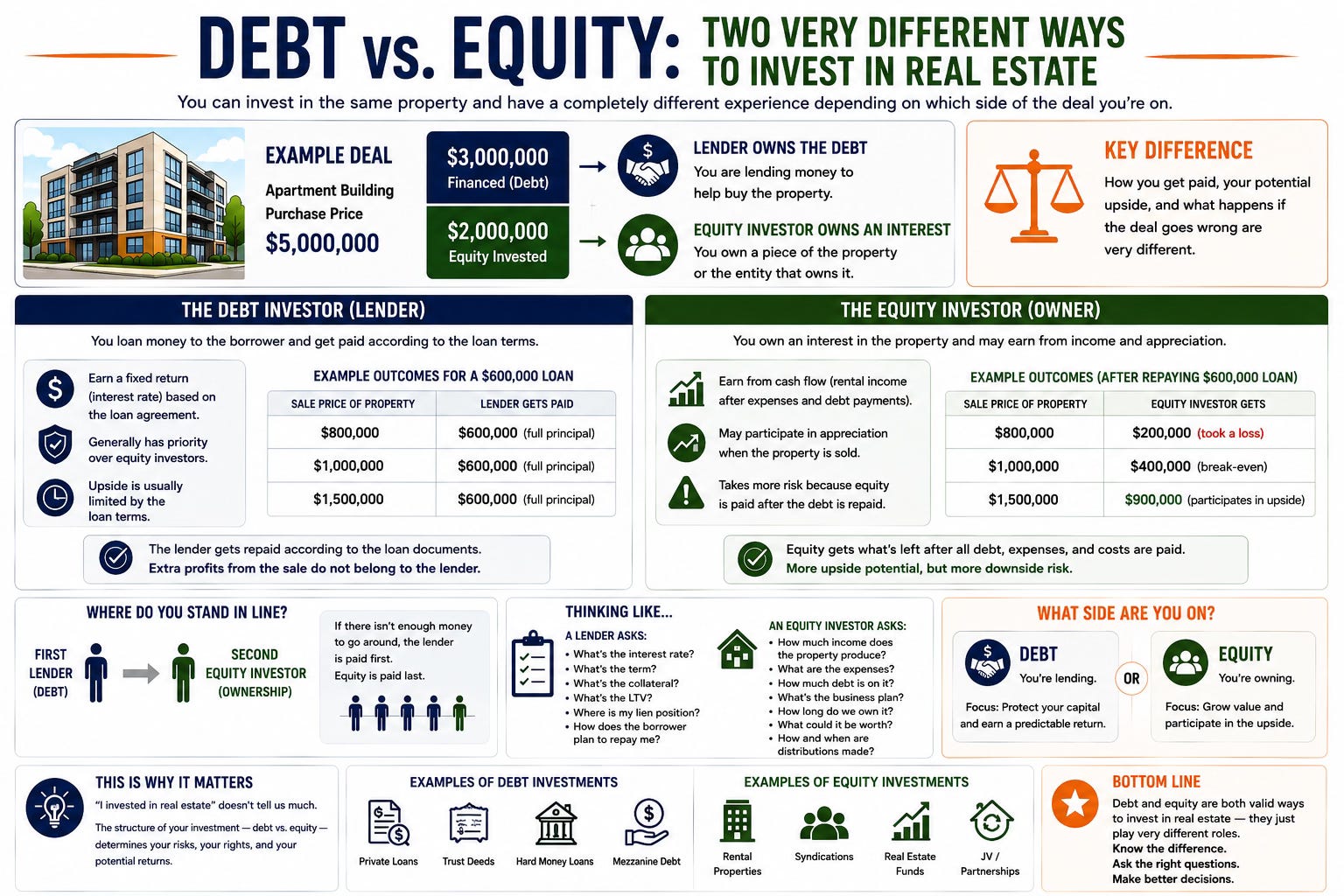
Let’s say someone is buying an apartment building for $5 million. They borrow $3 million and put $2 million of equity into the deal. Both groups have money invested in the same building, but they’re not making the same investment. The lender owns the debt. The equity investors own an interest in the property or the entity that owns it.
That difference changes how they get paid, how much upside they may have, and what happens if the deal doesn’t go according to plan.
Think about the lender first. If you lend $3 million to help buy the building, your return is generally based on the terms of your loan. Maybe the loan pays 9% interest. If the building becomes wildly successful and doubles in value, that’s great for the owner, but your interest rate doesn’t suddenly double. You’re still owed whatever the loan agreement says you’re owed.
That’s one of the tradeoffs of being on the debt side. Your upside is usually limited by the terms of the loan, but you may have priority over the equity investors when it comes to getting paid.
The equity investor has a different deal. Let’s say you put $500,000 into the ownership group that buys the apartment building. You aren’t lending the property owner money. You’re one of the owners.
Now your return may come from the income the property produces and from what happens to the value of the property over time. If the building collects rent, pays its operating expenses, makes its debt payments, and still has money left over, some of that cash may be distributed to the equity investors. Then maybe five years later the building is sold for $7 million instead of the original $5 million purchase price. After paying off the remaining debt and other expenses, the equity investors may participate in that gain.
That’s the upside of equity. But there’s another side to it. Equity is also usually behind the debt.
Remember when we talked about standing in line? The same basic concept applies here. The lender generally has a contractual claim for repayment according to the loan documents. The equity investors get what’s left after the property’s obligations are paid. If the property performs really well, being the owner can be a great place to be. If it performs poorly, the equity investors may feel the pain first.
Let’s make the example really simple.
Imagine a property is purchased for $1 million. A lender provides $600,000, and the owner puts in $400,000 of equity. Now imagine the property eventually has to be sold for $800,000.
Ignoring transaction costs and other complications for a moment, there’s still enough value to repay the $600,000 loan. That leaves $200,000 for the equity side. The lender may recover the full principal, while the equity investor put in $400,000 and now has only $200,000 remaining.
Same property. Very different outcome.
Now imagine the property sells for $1.5 million instead. The lender doesn’t automatically get a piece of that extra $500,000 just because the property increased in value. The lender gets what the loan documents say they’re entitled to. The equity investors may participate in the remaining upside after the debt and other obligations are paid.
This is one of the easiest ways to understand debt versus equity. Debt generally gives up some of the upside in exchange for being higher in the capital structure. Equity generally takes more of the downside risk in exchange for having more potential upside.
Of course, real deals can get much more complicated than that. There can be preferred equity, mezzanine debt, multiple classes of investors, profit-sharing arrangements, preferred returns, waterfalls, and all kinds of other structures. We’ll get to some of that later.
For now, you don’t need to make it complicated. Ask one basic question: Am I lending money, or am I buying ownership?
That question tells you a lot.
If you’re lending money, you should be thinking like a lender. What’s the interest rate? What’s the term? What’s the collateral? What’s the LTV? Where is my lien position? How does the borrower plan to repay me?
If you’re buying equity, your questions change. How much income does the property produce? What are the expenses? How much debt does the property have? What’s the business plan? How long do we expect to own it? What could the property eventually be worth? How and when are distributions made?
You’re looking at the same real estate through two completely different lenses.
There’s also a difference in how you tend to think about the investment. Equity naturally gets you thinking about how much you could make. If we buy this property for $5 million, improve it, increase the rents, and sell it for $8 million, what could my investment become?
Debt tends to make you think more about getting your money back. If I lend $3 million against this property, how am I getting repaid? What happens if the business plan fails? Is there enough collateral value? Where do I stand if something goes wrong?
Neither way of thinking is wrong. They’re just different.
And depending on what you’re trying to accomplish, you might prefer one over the other. Maybe you like the idea of earning interest and don’t care as much about participating in appreciation. Debt might be interesting. Maybe you’re willing to take more risk because you want to participate in the potential growth of the property. Equity might be more interesting.
Or maybe you own both.
That’s another thing I think gets lost when people talk about investing. It doesn’t always have to be stocks versus real estate or debt versus equity. Different investments can serve different purposes.
The important part is knowing what you actually own.
Because saying, “I invested $100,000 in real estate” doesn’t tell me very much. Did you buy a rental property? Did you invest in an apartment syndication? Did you make a private loan? Did you buy a trust deed? Did you invest in a real estate fund?
Those can all involve real estate, but the economics can be completely different.
That’s why I like starting with debt versus equity. It’s a simple distinction that helps you figure out which side of the deal you’re actually on.
If you’re debt, you’re lending.
If you’re equity, you’re owning.
And once you know that, you can start asking the right questions.
Key Takeaways
Debt investors lend money and generally earn returns based on the terms of the loan, while equity investors own an interest and may participate in both property income and appreciation.
Debt generally sits ahead of equity in the capital structure, which can give lenders greater repayment priority if a deal runs into trouble.
Before investing in any real estate opportunity, ask one simple question: Am I lending money, or am I buying ownership?
Beyond Wall Street is for educational and informational purposes only. Nothing published here is investment, financial, legal, or tax advice. Private lending, real estate debt, and real estate equity investments involve risk, including possible loss of principal. Investment structures, payment priorities, collateral rights, and returns vary by transaction.