


Key Takeaways
Retirement accounts can offer broader investment choices than many people realize.
Custodial and tax rules still apply.
Investment selection and account structure are separate decisions.
For a lot of people, retirement investing and stock-market investing feel like the same
thing. You open an IRA or contribute to a 401(k), and the choices in front of you are usually mutual funds, ETFs, stocks, bonds, target-date funds, or cash. After seeing
that menu for years, it is easy to assume those are simply the investments retirement
accounts are allowed to own. That is not always the case. Some retirement accounts can potentially hold assets outside the public markets, including real estate, private loans, promissory notes, private-company interests, private funds, and certain precious metals. The important distinction
is that the retirement account and the investment inside it are two different things. An IRA is an account structure. Real estate is an asset. A private loan is an asset. A private-equity interest is an asset. The fact that an investment is not publicly traded does not automatically prevent retirement money from reaching it. The bigger question is whether the particular account, custodian, plan document, transaction, and investment all fit within the applicable rules.
The Investment Menu May Be Broader Than the Brokerage Menu
Traditional brokerage firms have made retirement investing remarkably convenient, but convenience can also shape our perception of what is possible. A brokerage IRA may present hundreds or thousands of publicly traded investments while offering no direct way to buy a rental property or participate in a private loan. That does not necessarily mean federal retirement-account rules prohibit those assets. It may simply mean the brokerage does not administer them.
This is where self-directed retirement accounts enter the picture. A self-directed IRA is still an IRA, but it is held with a custodian that is willing to administer a wider range of assets. Some participant-directed retirement plans can also provide broader investment flexibility, depending on how the plan is written and administered. The IRS recognizes that participant-directed defined-contribution plans may allow participants to choose how their individual account balances are invested.
The word “self-directed,” however, should not be confused with “anything goes.” The account still operates under retirement-plan rules. The custodian or plan administrator may impose its own restrictions. And an asset that sounds alternative or interesting is not automatically permissible. Think of the account as a container with rules around what can enter, how it can be managed, and how the owner can interact with it.
Real Estate Is One of the Most Familiar Examples
Direct real estate is often the first alternative asset people associate with self-directed retirement money. Instead of owning shares of a publicly traded REIT, a retirement account may potentially own real property directly or hold an interest in a private real estate entity, assuming the account structure and transaction are permitted.
That could mean residential property, commercial real estate, land, or an interest in a private real estate partnership or fund. The important point is that the retirement account owns the investment. The account owner cannot treat IRA-owned property like personally owned property simply because they selected it.
This distinction changes how the transaction must be handled. Income associated with the retirement investment generally belongs to the retirement account. Expenses associated with an IRA-owned asset generally need to be handled through the retirement account rather than casually paid from the owner’s personal checking account. Personal use, self-dealing, and transactions involving certain related parties can create prohibited-transaction issues. The investment thesis might be about property values, rent, development, or income. The retirement-account analysis is separate.
Private Loans and Promissory Notes Can Also Fit the Picture
Retirement money may also potentially be used for certain private lending arrangements. Instead of purchasing a publicly traded bond, a retirement account might hold a promissory note or participate in a properly structured private loan.
For example, a retirement account could potentially lend money in a transaction secured by real estate. The account would hold the lending investment, and interest and principal payments would flow back to the retirement account rather than to the owner personally. This is one of the clearest examples of why account structure and investment analysis should not be blended together. The retirement account may be allowed to hold the note, but that tells you almost nothing about whether the loan itself is attractive. The borrower still matters. The collateral still matters. Lien position still matters. Loan-to-value still matters. Documentation, maturity, repayment ability, and exit strategy still matter.
Being able to hold an investment inside a retirement account is an administrative and tax question. Whether the investment is worth owning is an underwriting question, and those are not the same decision.
Private Placements and Private Funds May Be Accessible Too
Some self-directed retirement accounts can also hold interests in privately offered securities, private companies, private real estate funds, private credit funds, or other private-market vehicles. This can open a much broader universe than the typical public-market retirement menu, but it can also introduce different types of complexity. Private offerings may have long holding periods, limited transferability, less frequent valuation information, and no readily available public market where an investor can sell the position.
The retirement account does not make those characteristics disappear.
If a private fund expects to hold assets for seven years, the fact that the investment sits inside an IRA does not suddenly make it liquid. If a private-company interest is difficult to value, placing it inside a retirement account does not create a daily market price. If a private placement has substantial fees, complex distribution waterfalls, or business risk, the retirement wrapper does not remove those factors. Alternative assets can expand what retirement money can access. They can also expand the amount of due diligence required.
Certain Precious Metals May Qualify, but the Rules Are Specific
Precious metals are another category that often comes up in conversations about alternative retirement assets. This area is a good reminder that “alternative” does not mean “permitted without restrictions.”
The IRS generally treats collectibles as prohibited IRA investments, including many metals and coins. There are, however, specific exceptions for certain qualifying coins and bullion that meet applicable requirements. That means someone cannot simply buy any collectible coin or piece of gold they like and assume it belongs inside an IRA. The exact asset and structure matter. Similar limitations apply elsewhere. IRAs cannot invest in life insurance, and transactions involving collectibles can be treated as distributions under the tax rules. The broader lesson is more useful than memorizing individual exceptions: alternative-investment flexibility still operates inside a rulebook.
The Account Type Matters
A self-directed IRA is probably the best-known structure for holding alternative retirement assets, but it is not the only retirement arrangement that may offer participant-directed investment flexibility.
A one-participant 401(k), often called a solo 401(k), can be available to an eligible business owner with no employees other than a spouse. Depending on the plan document and provider, some of these plans may allow broader investment choices than a conventional brokerage plan. Other qualified retirement plans can also permit participant-directed investments under their governing documents. The key phrase is “depending on the plan.” Federal tax rules do not mean every provider must support every permissible investment.
This makes the provider and plan structure important. One custodian may specialize in real estate and private notes. Another may support private funds but not direct property. A solo 401(k) provider may allow a broad range of participant-directed assets, while another may limit the plan to conventional brokerage investments. So before evaluating an alternative investment, it helps to ask a separate question: what retirement-account structure would actually be used to hold it? That answer can affect administration, tax treatment, reporting, distribution requirements, and how transactions are carried out.
Prohibited Transactions Still Matter
Broader investment choice does not loosen the rules around self-dealing. Retirement accounts and plans are subject to restrictions involving transactions with certain disqualified persons. Prohibited transactions can include improper transfers of plan assets, using retirement assets for the benefit of a disqualified person, or transactions where a fiduciary uses retirement assets for personal interests. Similar restrictions apply to IRAs and their owners or beneficiaries.
In practical terms, that means the account owner has to pay attention not only to what the retirement account is buying, but also to who is on the other side of the transaction and who receives the benefit. An IRA purchasing an unrelated investment is one thing. Using retirement assets in a transaction involving the owner, certain family members, or other disqualified persons can be another matter entirely. This is one reason alternative assets can require more planning than clicking “buy” on an ETF. The transaction structure itself may need review before money moves.
Taxes Can Still Appear Inside a Tax-Advantaged Account
A retirement account can be tax-advantaged without every possible investment activity being completely insulated from current taxation. An IRA that conducts certain unrelated business activities can potentially generate unrelated business taxable income, often shortened to UBTI. Debt-financed investments can also create additional tax considerations. Under the unrelated debt-financed income rules, income from certain investment property acquired with borrowing can become taxable in proportion to the debt, subject to the applicable rules and exceptions.
This is particularly relevant when alternative-investment strategies use leverage. For example, retirement money may participate in real estate through an entity or investment structure that uses debt. The investment may still be permissible, but the presence of leverage can change the tax analysis. This is why “It’s inside my retirement account” should not be used as a substitute for understanding how the investment produces income and how it is structured.
Valuation Becomes More Important When There Is No Ticker Symbol
Public markets make valuation easy to observe. A stock or ETF may have a market price every second of the trading day. Alternative assets often do not. A piece of real estate needs to be valued. A private-company interest may require an appraisal or other valuation methodology. A private loan may need to be valued even though it does not trade on an exchange. A private fund may report values periodically rather than continuously.
That matters because retirement accounts have reporting obligations and, depending on the account and owner’s circumstances, may eventually be subject to distribution requirements. If the underlying asset is difficult to value or difficult to sell, those retirement-account obligations do not disappear.
Required minimum distributions are a good example. Traditional IRAs and many retirement-plan accounts generally become subject to required minimum distribution (RMD) rules beginning at the applicable age, while Roth IRAs do not require distributions during the original owner’s lifetime.
If most of a retirement account is invested in illiquid property or private investments, generating the cash necessary for distributions may require more planning than it would in a portfolio of publicly traded securities. Liquidity is not just an investment characteristic; it can become an account-management issue.
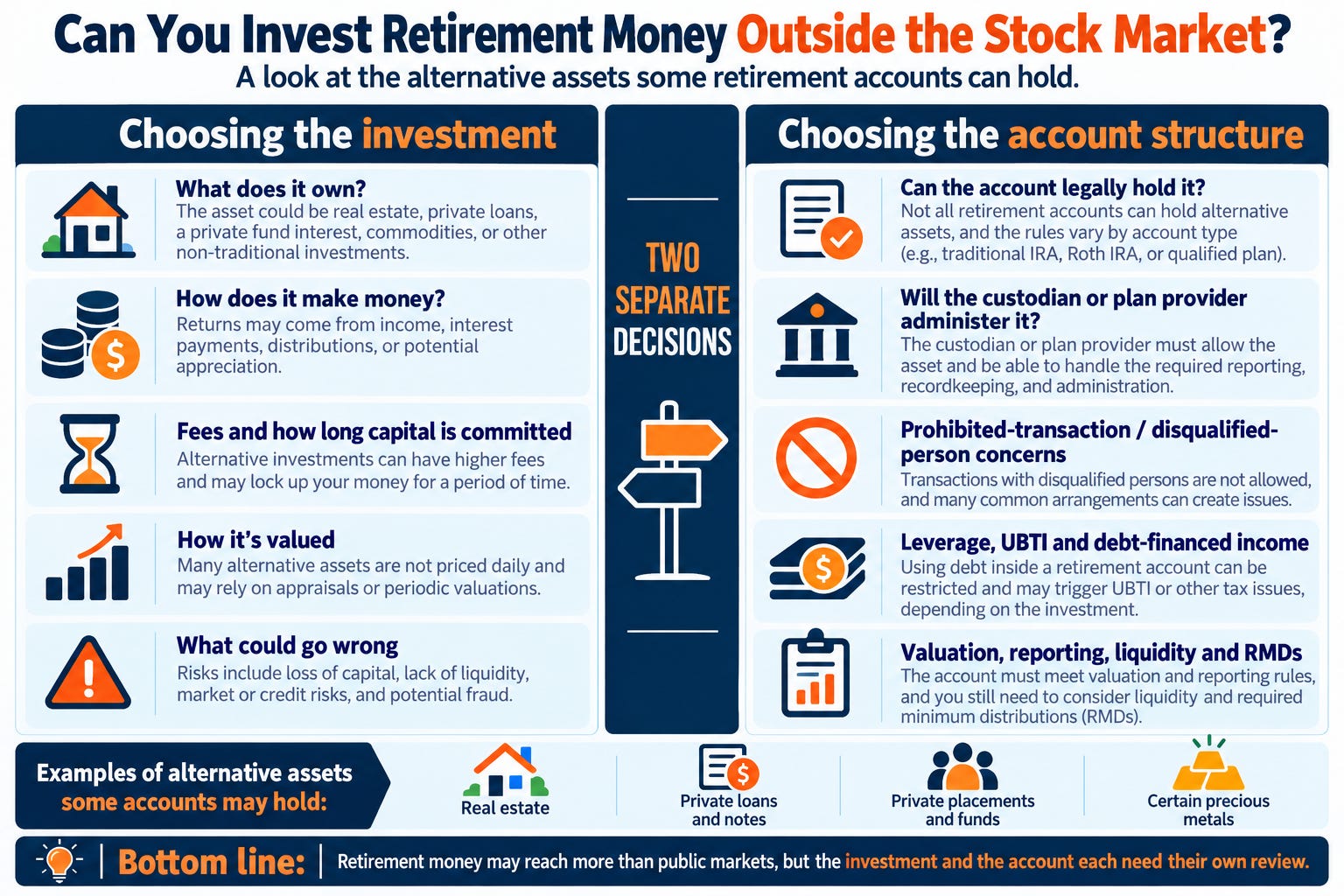
Choosing the Investment and Choosing the Account Are Two Decisions
This may be the most useful way to think about alternative assets inside retirement accounts. First, evaluate the investment. What does it own? How does it make money? What could go wrong? What are the fees? How long might the capital be committed? How is the asset valued? Who controls the investment? What happens if the borrower defaults, a property underperforms, or an exit takes longer than expected?
Then evaluate the retirement-account structure. Can the account legally hold the asset? Will the custodian or plan provider administer it? Are there prohibited-transaction concerns? Does the investment use leverage? Could UBTI or debt-financed income become relevant? How will the investment be valued and reported? Is the liquidity profile compatible with future distribution requirements?
A strong answer to one set of questions does not answer the other.
An excellent retirement-account structure cannot rescue a weak investment. A compelling investment does not automatically fit every retirement account.
Retirement Investing Does Not Have to Mean Public Markets Only
The familiar retirement portfolio of stocks, bonds, ETFs, and mutual funds remains popular partly because it is simple to access, easy to value, and highly integrated into mainstream brokerage platforms. But that should not be confused with a rule that retirement money must remain entirely inside public markets.
Depending on the account and provider, retirement capital may potentially reach real estate, private lending, promissory notes, private placements, private funds, certain precious metals, and other permitted investments. That can give investors a broader opportunity set and exposure to assets that behave differently from publicly traded securities.
The flexibility comes with additional responsibility. Alternative investments may involve less liquidity, more complicated valuations, additional administrative work, transaction restrictions, specialized tax considerations, and greater responsibility for due diligence.
The real question is not simply, “Can retirement money invest outside the stock market?” In many cases, the better questions are: What exactly is the investment, what account would own it, and what rules come with putting the two together?
Disclaimer: Beyond Wall Street is published by GoVesty and is provided for educational and informational purposes only. Nothing in this article should be considered investment, financial, legal, tax, or accounting advice, or an offer, solicitation, or recommendation to buy or sell any investment or security. Alternative investments involve risk and may not be suitable for everyone. You should evaluate any opportunity based on your own circumstances and consult with qualified financial, legal, and tax professionals before making an investment decision. GoVesty does not provide investment advice, manage customer funds, or guarantee investment results.