

Key Takeaways
Alternative investments are investments that exist outside the traditional world of publicly traded stocks and bonds.
Alternatives can include real estate, private lending, private companies, commodities, and infrastructure, and each can generate returns in different ways.
Alternative does not automatically mean better or safer. You still need to understand how the investment works, where the return comes from, and what risks you are taking.
When most people think about investing, they usually think about the stock market. Stocks, bonds, mutual funds, ETFs, and retirement accounts are what most of us are introduced to first. They are easy to access, easy to follow, and they make up a huge part of the way investing is talked about in the media.
But that is only one part of the investment world.
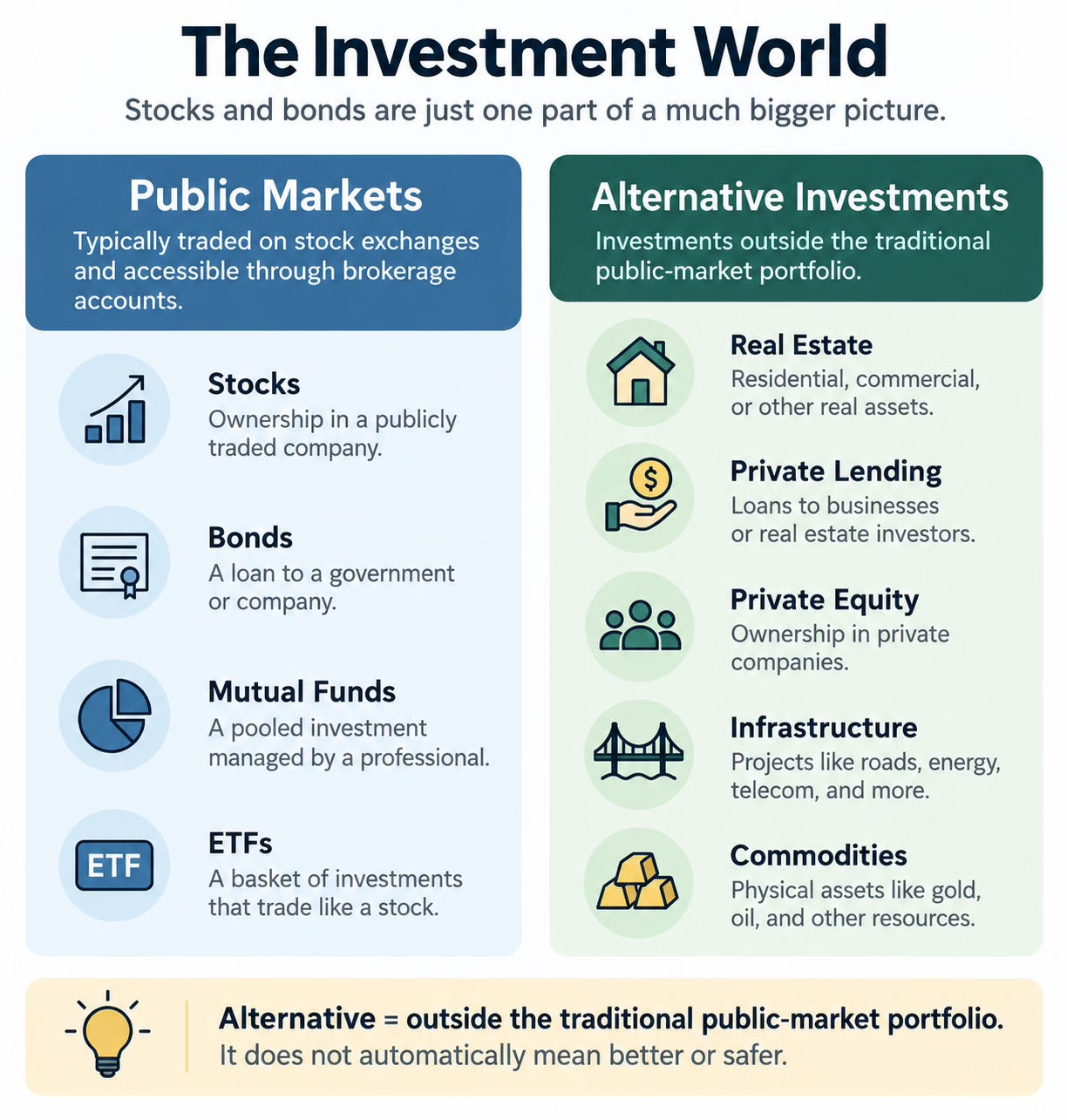
There is another side made up of real estate, private lending, private companies, infrastructure, commodities, and other investments that do not trade every day on a public exchange. These are generally called alternative investments.
The word “alternative” can make them sound unusual or complicated, but many of them are pretty easy to understand. A rental property is an alternative investment. So is lending money to a real estate investor and earning interest. Investing directly into a private business would also fall into this category.
The basic idea is simple. Traditional investments usually refer to publicly traded stocks and bonds. Alternative investments are investments that sit outside that traditional public-market portfolio.
What Makes an Investment Alternative?
One of the easiest ways to understand the difference is to look at where the investment exists.
If you buy shares of Apple through a brokerage account, you are buying part of a company that trades on a public stock exchange. The price changes throughout the trading day, financial information is widely available, and you can usually sell your shares whenever the market is open.
Now compare that with investing in an apartment building alongside a group of private investors. There is no ticker symbol to watch. You probably cannot sell your ownership with the click of a button. Your return might come from rental income, the eventual sale of the property, or a combination of both.
The same basic difference shows up in private lending. Instead of buying a publicly traded bond, you might lend money directly to a borrower or invest through a private lending fund. The borrower pays interest, and that interest becomes part of your potential return.
These investments operate outside the normal public-market system, which is why they are considered alternatives.
There Is a Much Bigger Investment World
Real estate is probably the alternative investment most people already understand. You can buy a rental property yourself, invest with other investors in a larger property, or invest through a private real estate fund.
Private lending is another large category. In this case, the investor is not trying to own the property or business. The investor is providing capital and earning interest in return. Some private loans are backed by real estate or other assets, which can provide another layer of protection if the borrower cannot repay the loan.
Private equity involves investing in companies that are not publicly traded. Venture capital falls into a similar area but usually focuses on younger companies that are still growing. Infrastructure investments can include things like energy projects, utilities, transportation systems, and data centers. Commodities can include assets such as gold, silver, oil, and agricultural products.
There are many more categories, but you do not need to memorize them. The important thing to understand is that there are a lot more places to invest money than a brokerage account.
Why Investors Look Outside the Stock Market
Diversification is one reason investors start looking at alternatives.
Someone can own hundreds of stocks through an index fund and still have most of their investment portfolio tied to the public stock market. If the market drops, a large portion of that portfolio may move with it.
Alternative investments can create exposure to different types of assets and different ways of making money. A rental property can produce income from tenants. A private loan can generate interest payments. A private company might increase in value as the business grows.
That does not mean alternative investments automatically perform well when stocks fall. It also does not mean adding a private investment instantly makes a portfolio diversified. The point is that the source of the return may be different.
This is one of the biggest ideas to understand about alternatives. You are not just buying a different investment. You may be investing in a completely different economic activity.
The Trade-Off Is Usually Convenience
Public markets are incredibly convenient. You can pull out your phone, check the price of a stock, read financial information about the company, buy shares, and sell those shares later with very little effort.
Private investments usually do not work that way.
Your money might be committed for several years. There may not be a public market where you can sell your investment. Updates may come directly from a sponsor, borrower, company, or fund manager instead of through the same reporting systems used by public companies.
That means you have to understand the investment before putting money into it. You need to know what you are actually investing in, where the return is supposed to come from, how long your money will be tied up, what fees are involved, and what could happen if the investment does not go according to plan.
Those questions matter because two investments can both be called “alternative investments” and still be completely different from each other.
A private real estate loan backed by property has very little in common with investing in a startup. Both may be alternatives, but the risks, potential returns, time horizons, and reasons for owning them are completely different.
Alternative Does Not Mean Better
This is probably the most important thing to understand before going any further.
An investment is not better just because it is private. It is not safer just because it is backed by real estate. And a projected return of 12 percent does not automatically make an investment more attractive than one projecting 7 percent.
Every investment has trade-offs.
A private loan may offer more income than a traditional bond, but the borrower can still default. A real estate investment may produce steady cash flow, but property values can fall and unexpected expenses can show up. A private company may have a lot of growth potential, but it can also fail.
There is no shortcut around understanding what you own.
The term “alternative investment” only tells you that the investment exists outside the traditional stock-and-bond portfolio. It does not tell you whether the investment is good.
Beyond the Ticker Symbol
For decades, most everyday investors have been taught to think about investing through stocks, bonds, mutual funds, and eventually ETFs. Those are useful investments, and they play an important role in the financial system.
But there is a lot happening outside of them.
Businesses borrow money privately. Real estate developers raise capital. Private companies bring in investors. Properties generate rent. Borrowers pay interest. Infrastructure projects need financing.
All of those activities create investment opportunities.
That is the world Beyond Wall Street is going to explore. The goal is not to convince you to abandon stocks and bonds. It is to help you understand what else exists, how these investments work, how they make money, and what risks come with them.
Once you realize the stock market is only one part of investing, the financial world starts to look a lot bigger.
Beyond Wall Street is published by GoVesty and is for educational and informational purposes only. Nothing published here is investment, financial, legal, or tax advice. Alternative investments involve risk and may not be appropriate for everyone.